

Claude Now Fingerprints Its Output. Here's What That Means If You Build With It.
Anthropic started watermarking everything Claude generates, including the code it helps you write. As a builder, here is the part that actually affects you.
Most of the coverage this week framed it as a content-moderation story: Claude now watermarks AI text and images. True, but that framing misses us. If you use Claude Code, the API, or Cowork to ship software, this is a supply-chain and provenance story, and it has some genuinely weird properties. I read Anthropic's docs so we can talk about the builder-specific parts.
What shipped, in one paragraph
As of August 11, 2026, Anthropic marks Claude output automatically. Generated text gets an invisible statistical watermark. Generated images and files (.svg, .png, .jpg) get signed C2PA provenance metadata instead. It is on by default for models launched on or after August 2, 2026, it covers the API, Claude.ai, Claude Code, Cowork, and the Slack app, plus the big cloud partners, and it applies worldwide. There is no opt-out, and there is no public detector yet. It is a compliance move for the EU AI Act's transparency rules, applied globally.
That is the summary. Now the parts that matter if you build.
The irony: the watermark is weakest exactly where we use it
Here is the technical detail that should interest any engineer. Statistical text watermarking needs length and entropy to encode a reliable signal. It works by nudging token selection toward a keyed subset over many tokens. The more predictable and constrained the output, the less room there is to hide that signal.
Code is low-entropy and often short. Syntax is rigid, identifiers repeat, boilerplate is boilerplate. So the exact kind of output most of us generate with Claude, functions, configs, snippets, is the output where an in-text watermark is weakest and least reliable. Anthropic's own docs flag short and low-entropy passages as a degradation case.
The watermark is most robust on long, free-form prose, and least robust on short code. We mostly generate short code.
I am not saying your generated code is definitely unmarked. I am saying the signal there is, by the design of the technique, the shakiest, and there is no public tool to check it either way. Treat any strong claim about "detecting AI-written code" with the skepticism it deserves.
"Our data, their mark"
The part that gives builders pause is not the mark itself, it is the ownership question underneath it. When Claude's output carries a provider fingerprint, an artifact in your repo, your pipeline, or your product now encodes "a Claude model was here."
For a lot of teams, that fact is itself sensitive. "We used an AI to help build this" can be information you did not intend to ship inside the file. And the open questions are real:
What happens with self-hosted or fine-tuned deployments? Undocumented.
What about output that flows through third-party tools built on the API that reformat or strip it? Unclear.
Does provenance metadata survive your build and bundling steps, or get stripped like any other metadata? Almost certainly stripped, which cuts both ways.
None of this is nefarious. It is just under-specified, and under-specified provenance in your supply chain is worth tracking.
Processed, not authored: the epistemics we should care about
The single most important line in Anthropic's docs is that a mark means content "may have been processed by Claude." Not authored. Processed.
For builders that distinction is everything, because our workflow is almost never "AI wrote this from scratch." It is you writing a function, Claude refactoring it, you reviewing the diff, Claude renaming a variable, you shipping. The mark cannot distinguish your hand-written, AI-refactored code from fully-generated code. It flattens the entire collaboration into one bit: model touched this.
And it fails symmetrically. No mark does not mean no AI. So as a signal for "was this human-authored," it is both over- and under-inclusive by construction. Useful as a transparency hint. Useless as a verdict. Do not let anyone use it as a verdict on you.
What survives, what does not
The practical robustness picture, from Anthropic's caveats plus the watermarking literature:
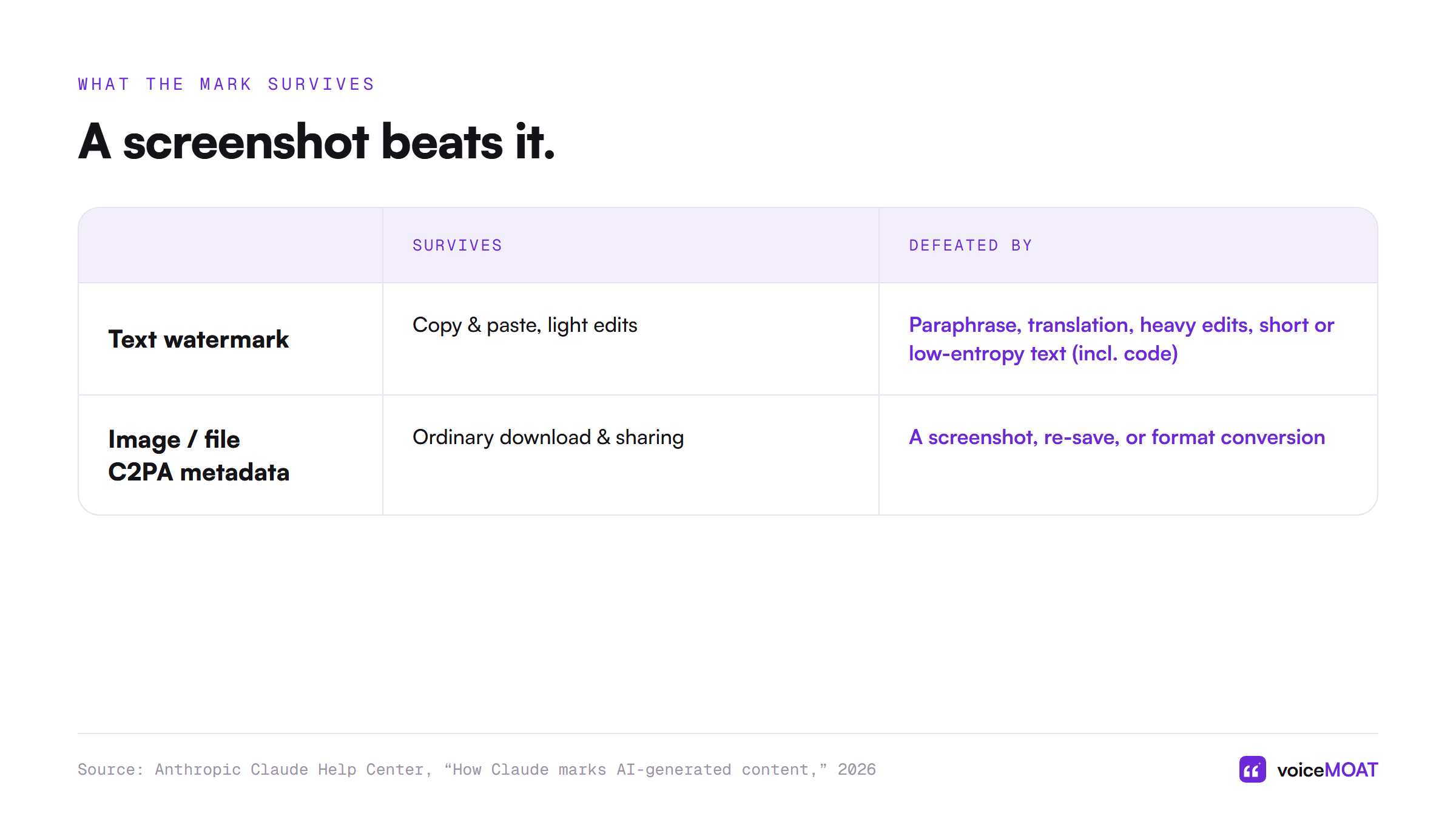
Academic paraphrase attacks remove this class of text watermark at rates near 100%. An Anthropic engineer reportedly called it a "first step," which is honest. It is a speed bump, not a lock. Worth remembering the next time someone sells you an "AI code detector."
How I think about disclosure as a builder
I am not precious about using AI to build. I am precious about being straight about it. My rule is boring:
Disclose where it is load-bearing, not where it is spellcheck. Claude renaming a variable is not a disclosure event. Claude architecting a module is closer to one.
Put it where builders look. A line in the README or the PR description ("AI-assisted, reviewed by me") beats a silent fingerprint that surfaces later and looks like something you hid.
Own the review, not just the generation. The defensible claim is not "I wrote every token." It is "I understand and stand behind every line." That is a claim no watermark can make for you, and no detector can take from you.
Full disclosure on my own bias: I build VoiceMoat, so I think a lot about provenance and voice. Weigh that. But the builder takeaway holds without my product: output is cheap now, judgment and ownership are the scarce parts.
The open question
Here is what I am genuinely unsure about, and I would like the room's read.
If provenance marks become standard across model providers, do we end up wanting the opposite of what Anthropic shipped? Not "this was touched by a model," but a positive, verifiable signal of human review: a way to sign "a named engineer read and stands behind this," attached to a commit or an artifact. Provenance of accountability, not provenance of tooling.
Would you adopt something like that in your workflow, or is it just more metadata theater? Curious where builders land.
Prateek Singh builds VoiceMoat, an AI social media tool for Twitter and LinkedIn. This is based on Anthropic's official documentation and August 2026 reporting; where a mechanism is not publicly disclosed, it is labeled as inference. Current as of August 12, 2026.
Sources: Anthropic Claude Help Center (support.claude.com). · TechCrunch, Aug 11 2026. · EU AI Act Article 50 (artificialintelligenceact.eu). · C2PA (c2pa.org). · Google DeepMind SynthID (deepmind.google), for the token-biasing mechanism, presented as inference. · Academic paraphrase-attack literature on token-level text watermarks.

Join Prateek on Peerlist!
Join amazing folks like Prateek and thousands of other builders on Peerlist.
0
0
0