

We Built Our Writing Tool the Slow Way on Purpose. Then LinkedIn Killed Its Own AI Writer and the Slow Way Became the Whole Category.
A build log about one product decision I second-guessed for a year: corpus-trained voice matching instead of one-click generation. It cost us signups. Then LinkedIn shipped an AI writer, watched its f
Most of my hardest product decisions never get validated. They just quietly turn out fine or quietly turn out wrong, and I never really know which. This is the story of one that got validated in the loudest way possible, by the biggest professional network on earth shipping the opposite decision and then reversing it in public.
I build VoiceMoat, an AI writing tool for people who post on Twitter and LinkedIn. Early on we made a call that, on paper, looked like bad product sense. We decided our tool would learn from your real writing before it wrote a word for you. No writing from a blank profile. No "type a topic, get a post" on day one. You bring a body of your actual writing, the tool studies it, and only then does it try to sound like you.
Every growth instinct I have screamed against this. And then this summer LinkedIn built the exact thing we refused to build, watched what it did to the feed, and killed it. So I want to write the honest build log: the decision, what it cost us, why I almost caved, and why I now think it was not a preference at all. It was the shape of the whole category, arriving a year early.
The setup: everyone shipped the one-click writer, including LinkedIn
If you were building anything in the AI writing space over the last two years, the default product was obvious. You ship a box. The user types a rough thought or just a topic. Your model returns a clean, confident, finished post. One click, zero friction, instant value. The entire genre optimized around removing effort between "I have a vague idea" and "I have something to publish."
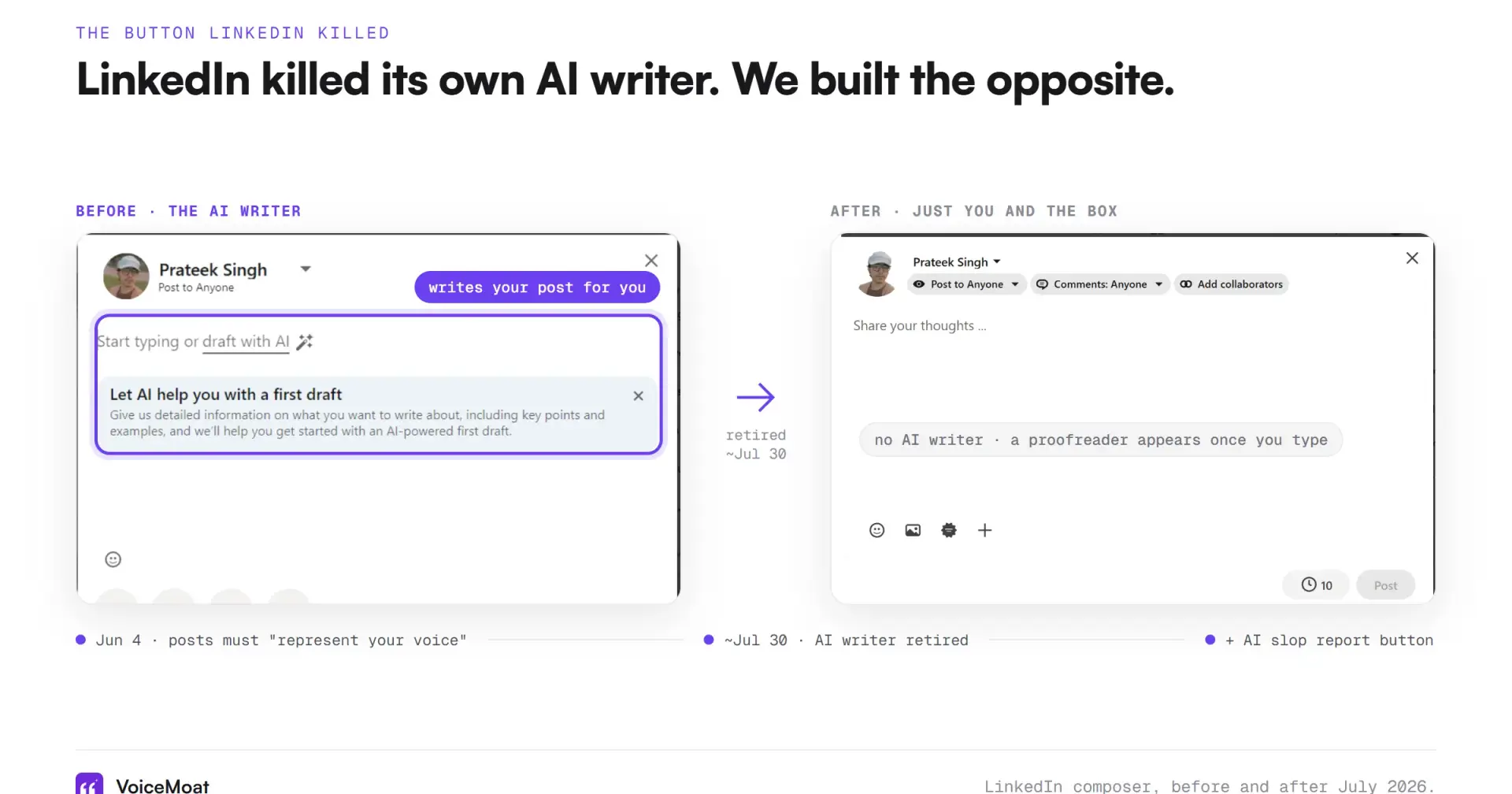
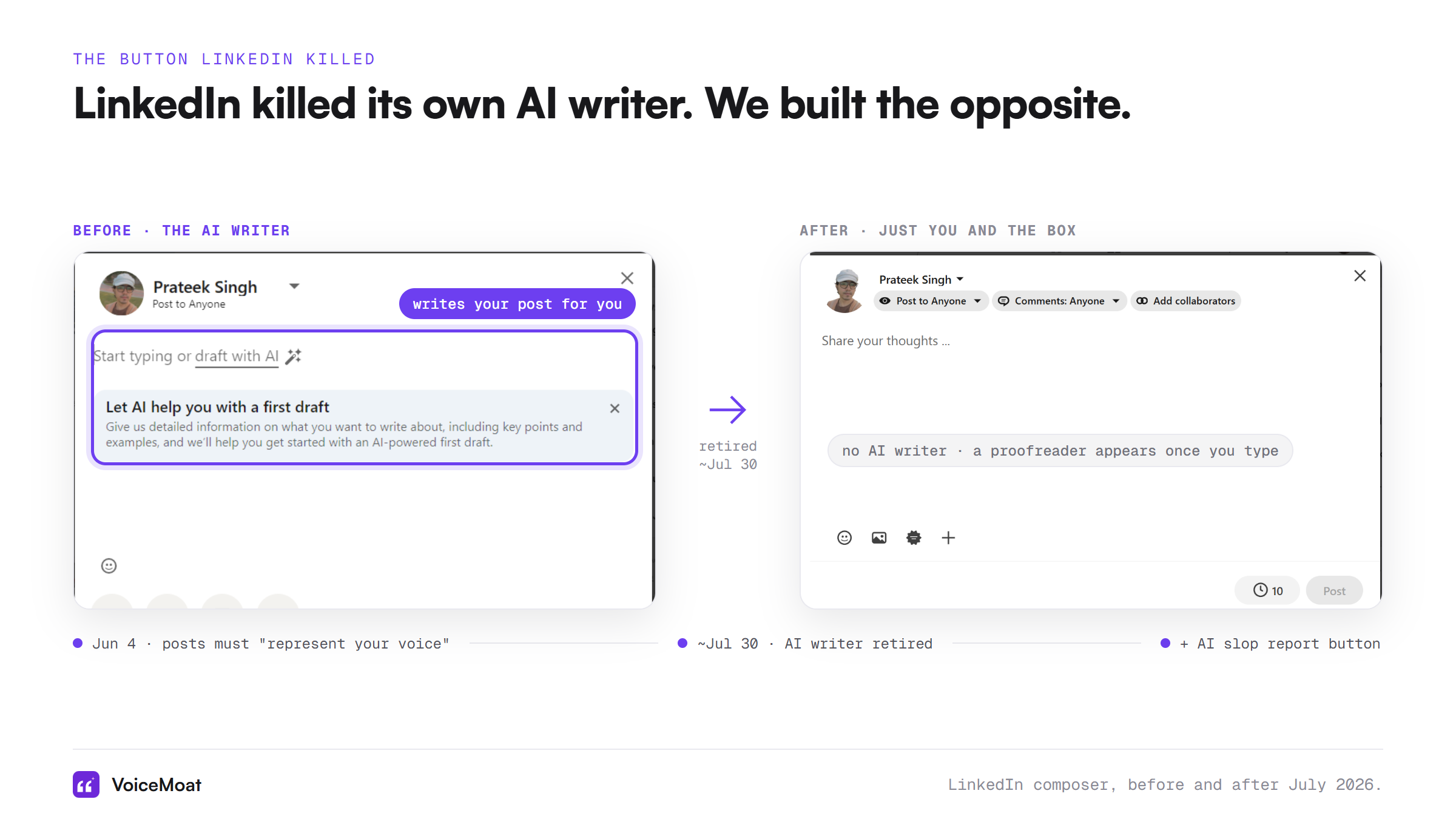
LinkedIn built it too. They put an AI writer directly in the composer, called "Enhance your post." You typed a few rough sentences, tapped it, and got back a smoother, longer, more polished version. It was a good build. It did exactly what that category of feature is supposed to do. And the pitch was the same one every tool in the space runs on, including the ones we compete with: writing in public is hard, so let the machine do the hard part. Type less, sound more professional, post more often.
I understand the appeal completely, because I feel it as a builder. Friction kills activation. Every onboarding step you add, you lose people. A tool that turns three nervous sentences into a finished post is a beautiful activation story. You can watch the "aha" happen in the first thirty seconds. So when we chose to put a corpus step in front of that moment, we were knowingly walking away from the cleanest activation funnel in the category. More on what that cost us in a minute.
For a single post, the one-click writer works. The output is competent. It is clean. The problem is not any one post. The problem only shows up at the scale of a whole platform, and that is exactly the scale LinkedIn operates at.
The turn: the whole feed converged on one voice
Here is the failure mode of one-click generation, and it is not a bug in any single tool. It is what happens when millions of people all reach for the same handful of models to write for them.
The models are trained to produce the most likely, most agreeable, most average version of any thought. That is literally the objective. So a feed full of one-click output slowly converges on a single voice: confident, frictionless, faintly corporate, the sound of the average of the internet. You have felt it. The identical openers, the tidy three-bullet body, the little inspirational bow at the end, post after post from different people all somehow sounding like the same eager stranger.
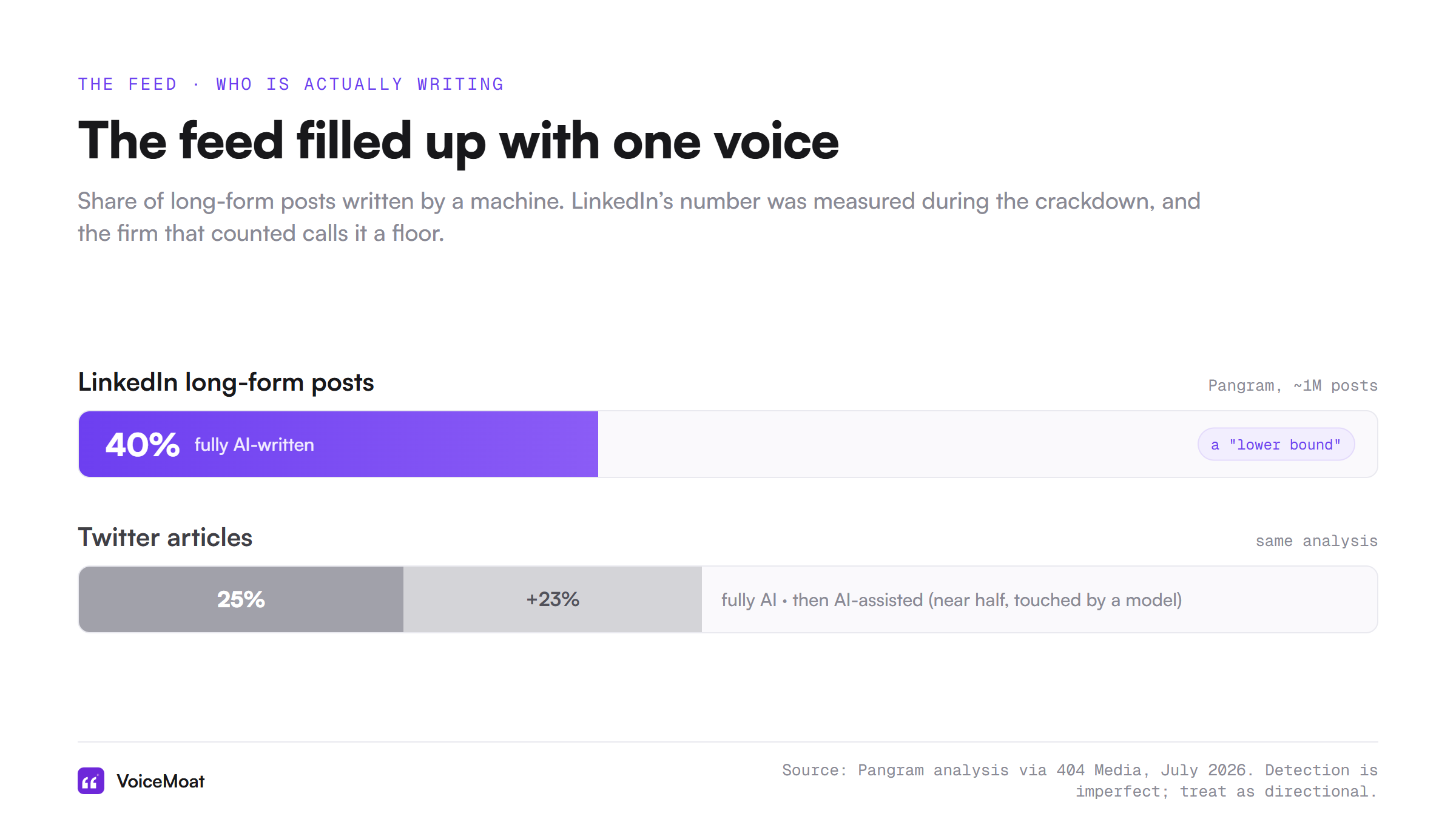
The scale is not small, and this is the number that reframes it from vibe to market signal. An analysis by the detection firm Pangram, reported by 404 Media in July 2026, scrolled roughly a million posts over two months and found that about 40% of long-form LinkedIn posts are now fully AI-written. Not assisted. Generated. Pangram's CEO called that a lower bound, meaning the true share is probably higher. Their detector is not perfect either, with roughly a one-in-ten-thousand false-positive rate on their own numbers and the honest caveat that no detector is foolproof. On Twitter the same report found about 25% of long articles fully AI plus another 23% AI-assisted. Different platform, same direction.
There is research under the feeling too, and one study landed personally for me. A controlled experiment presented at CHI 2025, the top human-computer interaction conference, had 118 people from India and the United States write with and without AI suggestions. The finding: the AI suggestions pushed the Indian writers toward Western writing styles, altering not just what they wrote but how they wrote it, sanding off cultural nuance toward an averaged default. To be precise about scope, it tested India versus the US and did not catalog every feature that shifted. But as an Indian founder the direction was unmistakable. Generic generation does not just help you write. It pulls your writing toward the center of gravity of its training data.
So the category's default product, the one-click writer, had a structural side effect at platform scale: it homogenized the feed. And LinkedIn's own button was one of the machines doing it.
The consequence: LinkedIn killed the writer it built
This is the part that turned my private product hunch into something I would now stake the company on. Faced with a feed drowning in its own averaged voice, LinkedIn did the thing you almost never see a company do. It turned on its own feature.
Four moves, all on the record.
It killed the AI writer. "Enhance your post" is retired. In its place LinkedIn shipped a plain proofreading tool, and it was specific about the difference: the new tool corrects your writing without altering your voice. That is a company drawing a hard line between fixing your commas and writing your post.
It shipped a slop report button. Around July 30, 2026, LinkedIn rolled out a "seems like AI slop" option, reported by TechCrunch. Flag a post and two things happen: your report feeds LinkedIn's detection models, and the post's reach outside your network drops.
It started demoting generic AI content. On its own newsroom, not a leak, LinkedIn wrote that low-effort AI content "is less likely to be widely distributed beyond a person's immediate network." They claimed their detector was "correctly identifying generic content 94% of the time" in initial testing. Treat that 94% as LinkedIn's own unaudited number, but the intent is clear.
It started flagging privately. LinkedIn began quietly marking potentially inauthentic content inside some users' dashboards, and says it blocks hundreds of thousands of automated comment attempts daily.
The clearest statement of the new rule is older and quieter. From a June 4, 2026 newsroom post: "It's ok to use AI to help you write, but your posts and comments need to represent your voice and your perspectives. The ultimate value comes from the human behind the tool." LinkedIn's chief product officer, Hari Srinivasan, put it plainly to Fortune: "AI slop is a top priority for all of us. We really care about this. People come to LinkedIn to connect with real people and share their real perspectives, ideas, and expertise."
Read that as a builder and it is a market signal you cannot ignore. The platform that owns the distribution just defined the category boundary in product and in policy. AI that helps you write, fine, distributed normally. AI that replaces your voice, demoted, reported, flagged. That is the exact line we had bet the product on, drawn for us by the largest player in the space.
For about a day, I let myself feel validated. Then the data ruined it, in the most useful way.
The twist: enforcement did not stop the slop, which is the actual point
Here is where a lazier version of this post would end, with "and so the platform fixed it, and our bet paid off." It did not, and the reason it did not is the real argument for how we built.
That 40% figure? Pangram measured it in July, in the middle of the crackdown, and still called it a lower bound. The enforcement was live and the slop was at its high-water mark at the same time. Detection is a blunt instrument in both directions: it misses plenty of generated posts, and it will occasionally flag a real human who wrote cleanly. A report button only works when people bother to report. And none of it touches the incentive underneath, which is the strongest force in the system. The pressure to post more, faster, with less effort has not weakened. There are ten new one-click tools this month promising a week of posts in a Sunday afternoon.
So the honest read is this. LinkedIn can throttle the average voice. It cannot manufacture yours. The platform proved, at its own scale, that policing generation is a losing game against the incentive to generate. You can demote the average all day and the average keeps regenerating, because the tools that produce it are free, instant, and multiplying.
And that is the whole case for the product decision. If enforcement could solve homogenization, the durable move would be a better generator that dodges the filters, and the whole thing would be an arms race. But enforcement cannot solve it, which means the durable move is not on the generation side at all. It is on the input side. The only thing that does not regenerate into the average is a voice that started from a specific human in the first place. The problem was never that the output was AI. The problem was that the input was thin. You cannot get a specific voice out of a generic prompt no matter how good the model is, and no crackdown changes that math.
Which is exactly why we built the slow way. Not because generation is evil. Because generation from thin input is structurally incapable of producing the one thing that survives.
The payoff: why we chose corpus-trained matching over one-click generation
So let me be straight about the actual decision, including the part that hurt.
The distinction we bet on is voice cloning versus voice matching, and most of the category is quietly doing the first while advertising the second. Cloning generates a plausible post from thin input, a bio or a topic or a vibe, and produces the polished, generic voice that reads like "a person like you." Matching learns from your real body of writing and produces output where your actual patterns, your rhythm, the words you reach for, the way you open and close, all line up into something a reader recognizes as you.
You can see the gap in competitors' own descriptions. One popular LinkedIn tool builds a "Content DNA" profile it says captures your identity and promises every generated post matches your professional identity, while publishing no measurement of how close that match actually is. A popular Twitter tool is more revealing: its AI ghostwriter will write "in your voice" from your bio, or a short description of yourself, with past posts optional. You cannot rebuild a human voice from a one-line bio. A bio is a job title and two adjectives. That is not matching a voice. It is inventing a plausible person and stapling your name on top, which is precisely the thing LinkedIn just started burying. Worth noting: at least one popular scheduler in this space, Taplio, has been reported to be treated by LinkedIn as an automation tool that goes against its terms, with enforcement that restricted the tool's own page in 2025. I flag that as reported risk, not as my claim, but it is the kind of risk the generation-first path runs into.
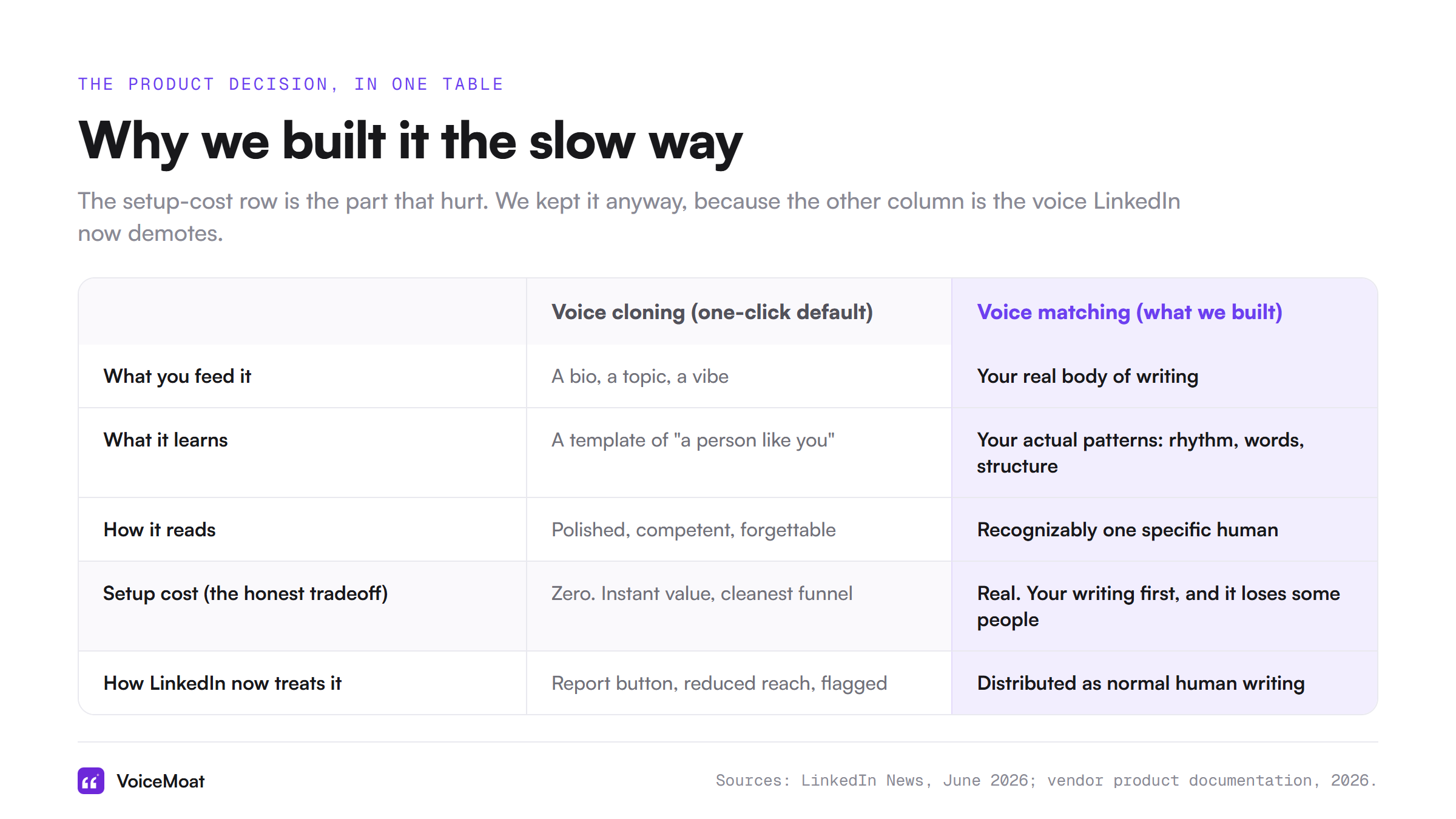
Now the honest part, the part I would want if I were reading someone else's build log. Look at that "setup cost" row. It is not a footnote. It was the whole risk of the decision. Voice matching is slower and needs the user's real writing as input before it can do anything useful. One-click generation is instant and needs nothing. In activation terms that is not close. Every step between signup and first "aha" leaks users, and we deliberately put the heaviest possible step, "go get your actual writing," right at the front. It cost us signups. I can see it in the funnel. People land, hit the corpus step, and some of them bounce to a competitor where they can type a topic and get a post in ten seconds. That is a real number and it is not small, and for a long stretch I was not sure the bet was worth it.
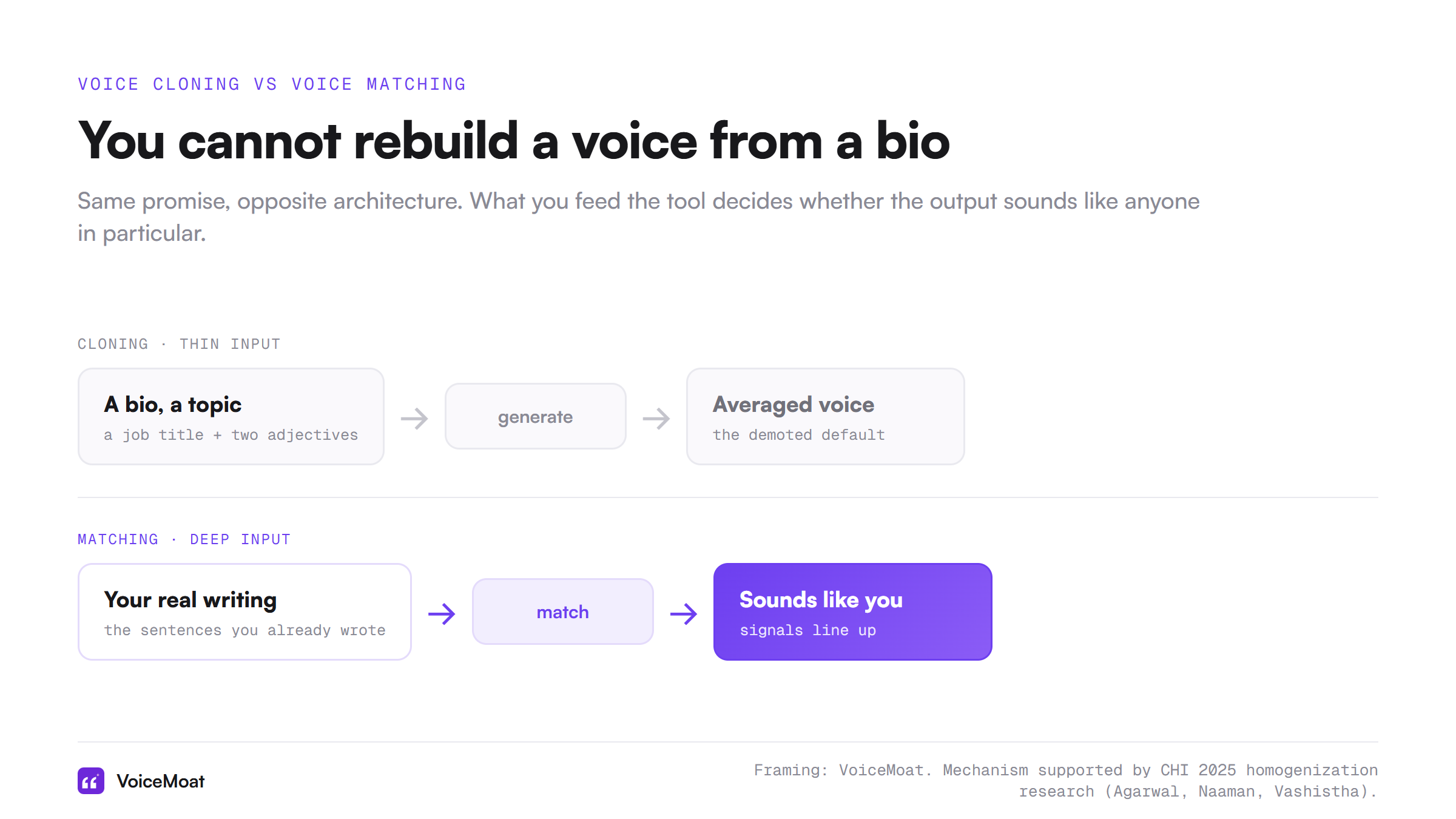
What I could not price, until this summer, was the other side of that tradeoff. The instant funnel produces the averaged voice, and the averaged voice is now a demoted asset on the platform where our users actually want to be seen. The setup cost buys the one thing that survives distribution. We were paying an activation tax to avoid a distribution tax, and until LinkedIn moved I genuinely did not know which tax was bigger. Now I think the distribution tax is the one that compounds, and the activation tax is the one you can slowly engineer down. So we are keeping the corpus step and getting relentless about making it faster, not deleting it.
I use AI every day, including on the first draft of this post, so this is not a purist stance. It maps exactly onto the line LinkedIn drew: AI to help you write, yes. AI to replace your voice, no. My bias is obvious and I will name it once. I build VoiceMoat, so of course I read this news as vindication. Weigh that accordingly, and the logic still holds without my product. If you want a fast, honest gut check on how AI-average your own writing currently reads, the free Viral Tweet Analyzer is a thirty-second mirror, no signup, no pitch.
The open question I actually want other builders to argue with
Here is where I am genuinely unsure, and where I would rather have the argument than pretend I have the answer.
If the durable thing is a voice that provably started from a specific human, then the input becomes the trust boundary for the whole category. And that raises a question I do not think any of us have answered yet: does every writing tool now have to prove it learned from your real corpus, the way we ended up proving it? Does "this was trained on your actual writing" become a claim you have to substantiate rather than assert, maybe even something a platform or a reader could verify? Put more sharply: is "sounds like a specific, identifiable human" about to become a signal worth verifying, the way we verify identity or authorship, and if so, who gets to be the one who verifies it?
I do not know. I built my product as if the answer is yes, and this summer made me more confident, not less. But I have been wrong about which taxes compound before. So I will put it to the other builders reading this: if enforcement cannot stop generation, and the only durable input is a real human corpus, what does that make the moat, and who is going to own proving it? Tell me where this reasoning breaks. I would rather find the crack now than a year from now.
Prateek Singh is the founder of VoiceMoat, an AI social media tool for Twitter and LinkedIn that helps you create, schedule, engage, and grow with content that still sounds like you wrote it. This is a build log, not neutral analysis, and my bias is disclosed above. It is based on LinkedIn's official newsroom posts and reporting from mid-2026. Facts are current as of August 13, 2026, and this space moves fast, so verify before you quote.
Sources: LinkedIn News, "Keeping conversations real on LinkedIn," June 4 2026 (news.linkedin.com). · TechCrunch, "LinkedIn adds a button to report AI-generated slop," July 30 2026. · Fortune, Hari Srinivasan interview, July 31 2026. · 404 Media, "LinkedIn and X are flooded with AI spam, browsing data suggests," July 9 2026 (Pangram analysis). · Agarwal, Naaman, Vashistha, "AI Suggestions Homogenize Writing Toward Western Styles and Diminish Cultural Nuances," CHI 2025 (118 India and US participants). · Supergrow and Postwise product documentation, 2026 (vendor claims). · Kondo blog on Taplio and LinkedIn automation terms, 2025 to 2026 (reported risk).

Join Prateek on Peerlist!
Join amazing folks like Prateek and thousands of other builders on Peerlist.
0
0
0