

Managing DI(Dependency Injection) in FastAPI
A Practical Approach to Better Backend Architecture
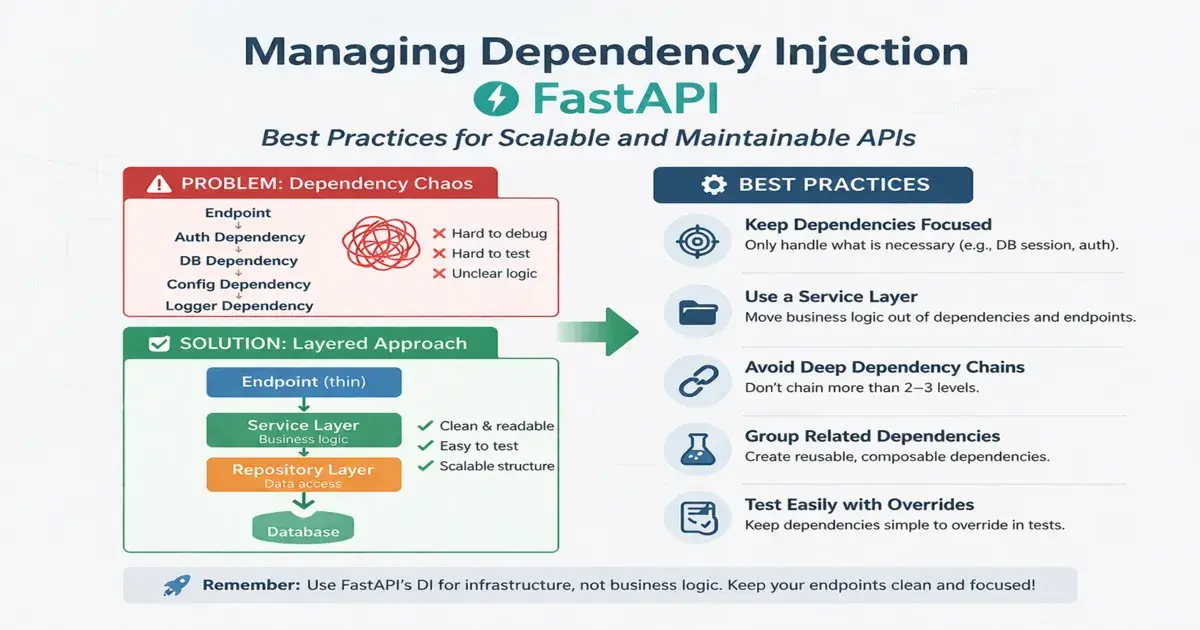
FastAPI’s dependency injection system is one of its most powerful features—but as your application grows, it can quickly become a source of confusion and complexity. What starts as clean and elegant can turn into deeply nested, hard-to-debug chains that slow down development.
The Problem: When Dependencies Spiral Out of Control
In small projects, dependencies are straightforward. But in real-world applications, they often stack on top of each other:
Endpoint → Auth Dependency → Database Dependency → Config Dependency → Logger Dependency
This chaining creates hidden complexity. Debugging becomes difficult, testing becomes painful, and onboarding new developers takes longer. The logic is no longer obvious—it’s scattered across multiple layers.
Why This Happens?
FastAPI encourages reusable components through Depends(). While this is great in theory, overusing it leads to tightly coupled and deeply nested dependency graphs. Developers often try to inject everything—database sessions, authentication logic, configurations—directly into endpoints, making them harder to read and maintain.
Real Impact on Development
First, debugging becomes a challenge because errors can originate from any layer in the dependency chain. Second, testing becomes complicated since each dependency must be mocked or overridden. Third, code readability suffers, making it harder to understand the actual business logic of an endpoint.
The Solution: Shift to Layered Architecture
Instead of stacking dependencies endlessly, introduce a clear separation of concerns:
Endpoint → Service Layer → Repository Layer → Database
In this approach, FastAPI dependencies are used only where necessary—primarily for request-level concerns like authentication or database session creation. The actual business logic moves into a service layer, which is easier to manage, test, and scale.
Best Practices to Reduce Complexity
Keep dependencies small and focused. Avoid chaining more than two or three layers of dependencies. Move business logic out of dependencies and into dedicated service classes or functions. Use dependency injection mainly for infrastructure concerns like database sessions or security. Group related dependencies together instead of scattering them across the codebase.
Testing Becomes Easier
With a cleaner structure, testing improves significantly. Instead of overriding multiple dependencies, you can directly test the service layer in isolation. FastAPI’s dependency overrides can still be used, but now they are minimal and predictable.
"Dependency injection in FastAPI is a powerful tool—but like any powerful tool, it must be used carefully. Overusing it leads to complexity, while structuring it properly leads to clarity and scalability. The goal is not to eliminate dependencies, but to control them. Keep your endpoints thin, your logic organized, and your dependencies intentional—and your FastAPI applications will remain clean and maintainable as they grow."

Join Pravin on Peerlist!
Join amazing folks like Pravin and thousands of other builders on Peerlist.
0
14
0