

How Markey learns, posts, and finds conversations for you
A look under the hood at the three systems that make Markey tick
When i started building Markey, one of the things i kept running into was this: most AI writing tools generate content once and then completely forget it ever happened. You hit "generate", get something decent, and the next time you come back it has no idea what worked or what flopped. No memory, no improvement, nothing.
Markey is built differently. The whole idea is that it should get better the more you use it. It watches what resonates with your audience, adjusts when it posts, and actively goes looking for conversations you should be part of. Three systems make that happen: learning, posting, and discovery. They're not three separate products bolted together, theyre more like three layers of the same loop.
This is a writeup of how each one actually works.
The feedback loop everything runs on
Before getting into each system separately, it helps to understand what ties them together: engagement polling.
Every time Markey publishes a post with a real external post ID, it starts checking back on that post at regular intervals over the next few days. It's looking at likes, comments, shares, upvotes depending on the platform, and normalizing everything into a score between 0 and 1. Those scores are what the learning system reads. They're also what the scheduling system uses to figure out when to post next
If youre brand new and have zero published posts, the system runs on reasonable defaults and industry priors. Nothing breaks, it just doesnt have your data yet. Once posts start accumulating, all three systems start adapting to your specific audience and voice.
Learning: how Markey gets better over time
The learning system is built for a reality most founders are in: you've got a few dozen posts published, maybe a couple hundred if you've been at it for a while. Not enough to train a model, but enough to notice patterns.
There are four things it learns from your posts.
First, it looks at how your posts open. Every post has an opening hook and Markey classifies each one into a type: a question, a stat, a bold take, a personal story, an announcement, and so on. Over time it builds a picture of which hook styles tend to land for your audience versus which ones get ignored. This is more of an analytics layer right now but the plan is to feed it directly into generation so future posts naturally lean toward what's worked.
Second, it keeps track of your best performing posts by platform and content type. Before generating new content, it looks back at what you've already published and pulls in a few strong examples as context. The idea is simple: if a certain style or angle got traction, the next generation pass should be aware of that. It's not copying, it's learning.
Third, when Markey generates multiple content variants (like different angles on the same campaign), it tracks which variants performed better and uses that as a signal for future variant runs. So the system gets progressively better at knowing which direction to explore.
Fourth, the scheduling system learns your best posting times. More on that in the next section.
Posting: when and how content actually ships
Posting in Markey means more than just clicking publish. It covers which account gets the post, when it goes out, what approval state its in, and whether the platform lets Markey post automatically or requires you to do it manually.
When you generate a campaign, Markey automatically maps content to your connected accounts and proposes posting times. Each post starts as a draft. You review, approve it to "queued", and from there it ships automatically at the scheduled time (on platforms that support it) or sends you a notification to post it manually on platforms like X and Threads that dont allow third-party autopublishing.
The scheduling part is where it gets interesting. Markey uses a simple but effective approach: it tracks which day/time combinations have historically performed well for each platform, blends that with known general priors (like "Tuesday morning tends to work well on LinkedIn"), and uses that blended score to pick slots. Early on, it's mostly priors. As you post more, your observed data starts outweighing the defaults.
There's also a small exploration factor built in. Most of the time it picks from your top performing slots, but occasionally it will try something new to gather data on untested times. And slots are jittered so your posts dont all go out at exactly the same time every week, which looks robotic and can actually hurt reach on some platforms.
One thing worth noting: Markey can only "autopublish" on platforms that have proper API support for it. X and Threads explicitly block third-party posting, so for those, Markey drafts the content and notifies you when it's time to post. You still get the content ready to copy-paste, just not the one-click publish.
Discovery: finding conversations worth joining
This is the part of Markey that surprised people the most when i started demoing it. Discovery is split into tw modes: Signal Radar and Reply Radar.
Signal Radar goes outbound. It scans Reddit and X for conversations that are relevant to your product and audience. To do this, it first generates a set of search queries based on your brand profile: which subreddits to watch, what phrases to look for, what kinds of posts signal buying intent. Then it runs those searches, collects results, and scores each one.
The scoring considers things like whether the post text shows genuine purchase intent, how closely the person's situation overlaps with your ICP, how recent the post is, and how much engagement it's getting. Each signal ends up with a score, and the highest-scoring ones surface in your Markey inbox with a draft reply already attached. The reply is written in your brand voice and tries to be genuinely helpful rather than promotional. You can tweak it and post it yourself.
Reply Radar goes inbound. It monitors the replies and quote-posts on your own published content and surfaces the ones worth engaging with. Same scoring idea: are these people showing interest, do they fit your audience, are they worth a response? Drafts are generated lazily when you open the thread.
Neither of these systems uses your post engagement scores. They're entirely signal-based, reading conversation text and audience signals rather than what performed well in your feed.
How it all connects
The three systems are separate in what they do but they all feed into each other through the campaign.
Your brand profile and campaign brief feed into both generation and discovery. The content Markey generates becomes posts. Those posts get published and start accumulating engagement. That engagement feeds back into the next generation cycle, adjusting what examples get shown, what angles get prioritized, and what times get picked. Discovery runs in parallel, independently, finding external conversations that complement what you're publishing.
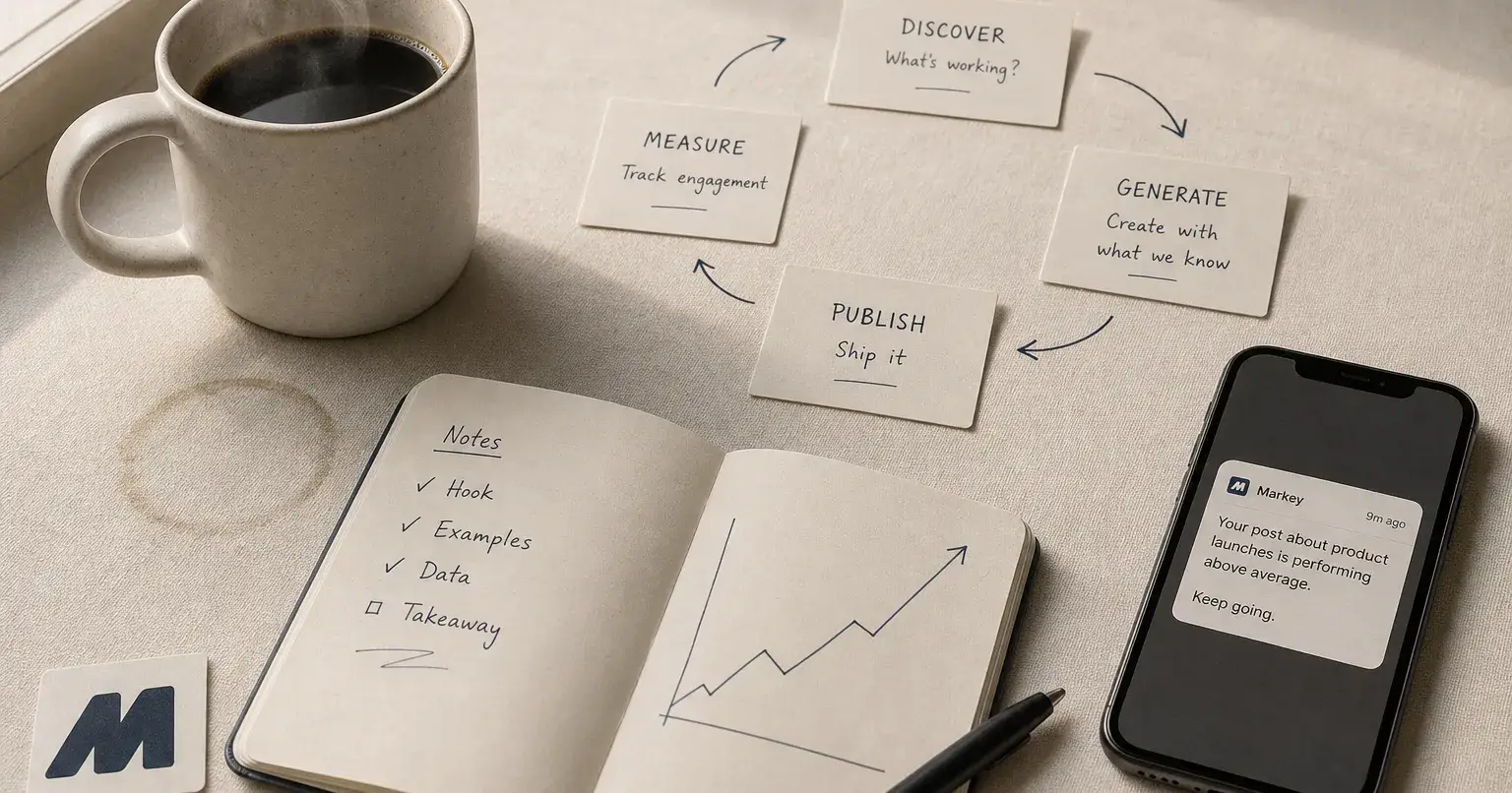
The loop loos like: discover opportunities, generate content informed by what's worked, schedule it intelligently, publish it, measure it, improve the next cycle. No data science team required. No model training. Just a system that keeps your data and uses it sensibly.
That's the version of Markey i wanted to build from the start. It's still early, there's a lot more to do, but the bones are there and they work. If you want to try it, you can paste your build URL at markey.app and see what comes out.

Join rick on Peerlist!
Join amazing folks like rick and thousands of other builders on Peerlist.
1
0
0