

What Does a Product Designer Actually Do in the Age of Agentic AI?
Agents are operating several steps ahead of users now. They’re inferring intent, taking actions, making micro-decisions that users never explicitly approved.
Let me say something that might sting a little.
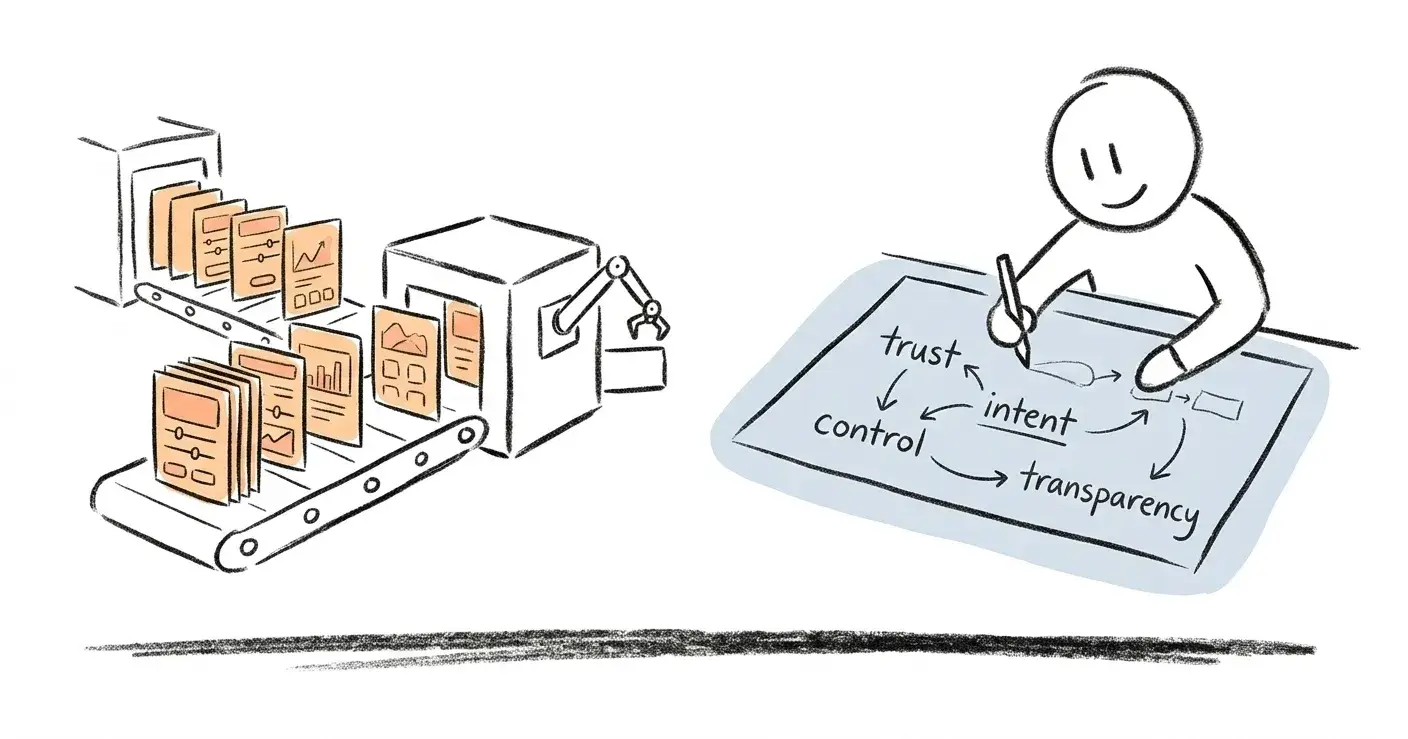
A big part of what we call “UI design” — the craft of assembling screens, laying out components, choosing spacing systems, deciding where the button goes — is being commoditized faster than most of us are ready to admit.
AI agents are already generating functional interfaces. Design tokens are being consumed by systems that never opened Figma. Screens are being composed in real time, based on user intent and context, not a designer’s decision months earlier in a sprint.
So if your entire value as a designer lives in how a screen looks, you should be thinking hard right now.
But here’s what I actually believe: this is the best moment in history to be a product designer. Just not the kind we’ve trained ourselves to be.
Nobody is talking about this shift clearly enough
We’re entering what’s being called the agentic era. Unlike generative AI — which mostly creates content — agentic AI acts. It plans, makes decisions, executes tasks, and works toward goals with minimal human input. It doesn’t wait for a click. It moves.
The market for agentic AI is projected to hit $5.1 billion in 2025 alone. Salesforce predicts one billion AI agents in operation by end of fiscal year 2026. These aren’t hypotheticals. Adobe, Intercom, Dovetail — the tools we use every day are already embedding agent behaviors into their products.
And when an agent can browse, decide, and act on behalf of your user — the question changes entirely.
It’s no longer “how should this screen be designed?”
It’s “how should this system behave?”
UI Execution Is Being Commoditized. UX Judgment Cannot Be.
Here’s the distinction I keep coming back to:
UI is the surface. UX is the contract.
When a user opens a product for the first time and something just feels right — that’s not the color palette talking. That’s the product honoring an emotional contract: “I understand what you need, I won’t waste your time, I won’t make you feel stupid, and I’ll be honest with you when I get it wrong.”
AI can generate a screen. It cannot yet understand the weight of that contract.
Agents are operating several steps ahead of users now. They’re inferring intent, taking actions, making micro-decisions that users never explicitly approved. The design question becomes: how do you keep a person trusting a system that’s moving faster than they can verify?
That’s a UX problem. A deeply human one. And it has no shortcut.
Designers Need to Move Earlier, Not Later
Here’s a question I’ve been asking a lot lately: are you pulling designers earlier into the product process now, or later?
Because if AI agents are generating screens — and they are — but those agents don’t yet understand the emotional contract between a product and its user, then the designer’s most critical contribution isn’t screen execution. It’s defining the intent architecture before the agent ever touches a pixel.
What is this system allowed to do without asking? What does trust look like at each step of this flow? When the agent is wrong — and it will be — how does the product recover without breaking the user?
These are design questions. They need to be answered before the sprint starts, not after the agent has already built five screens.
The designers who will lead this era aren’t the ones polishing components. They’re the ones who can diagram a system’s decision logic, define its personality, and write the emotional guardrails that make autonomy feel safe instead of scary.
What the New Design Work Actually Looks Like
The work is shifting from pixels to principles. From flows to behaviors. From persona archetypes to individual, adaptive experiences.
A few things I think become essential:
Designing for transparency, not just clarity. When an agent takes an action, users need to understand why — not buried in a log, but surfaced naturally in the interface. The best agentic experiences don’t hide their reasoning; they make it readable.
Designing control surfaces with the same care as primary flows. Stop. Pause. Override. Undo. These used to be edge cases. Now they’re trust architecture. If a user can’t easily redirect an agent, they won’t trust it enough to delegate in the first place.
Designing the waiting state as seriously as the result. Agentic tasks take time. The experience between “I gave it a goal” and “here’s what it did” is where anxiety lives. Most products design this as an afterthought — a spinner, a loading bar. It deserves far more thought than that.
Designing for failure with honesty. When an agent gets it wrong — and it will — users won’t blame the AI model. They’ll blame the product. The failure experience is a design surface. Treat it like one.
The Emotional Contract Is Still Ours to Design
I want to end where I started, because I think it’s the thing that matters most.
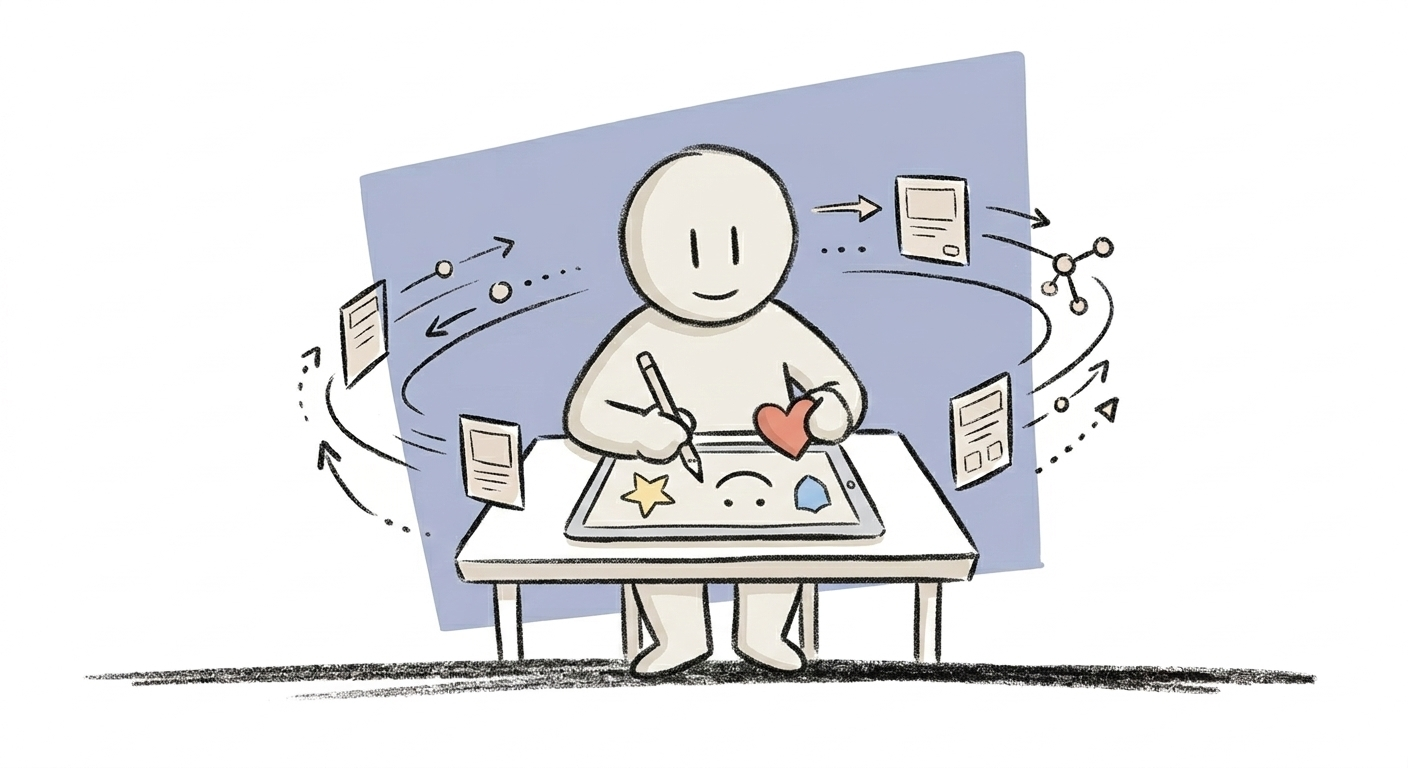
Products that succeed aren’t just efficient. They make people feel something — capable, understood, in control, even delighted. That feeling is designed. It’s intentional. It comes from someone who understood the human on the other side of the screen deeply enough to make a thousand invisible decisions on their behalf.
AI agents are extraordinarily good at pattern recognition, task execution, and processing information at scale. What they don’t have — what they won’t have for a long time — is the ability to feel the weight of a frustrated user at 11pm trying to fix something before a deadline. Or understand why a button that’s technically correct still feels wrong in context.
That intuition is human. That judgment is designed.
So no — UI execution isn’t where our value lives anymore.
But UX? The thinking behind why a product feels right?
That’s never been more important.
❤️ Thanks a ton for giving this a read! ❤️
I’m Rakibul, co-founder and CAO at Panze Studio — a UX/UI product design firm based in ABQ, New Mexico.
I write about the intersection of agentic AI and product design, and what it means for how we build software in 2026 and beyond the upcoming future.

Join Rakibul on Peerlist!
Join amazing folks like Rakibul and thousands of other builders on Peerlist.
0
10
1