

Gestalt Principles: The Psychology Behind Seeing Wholes in UX
How Grouping and Visual Organisation Shape User Experience
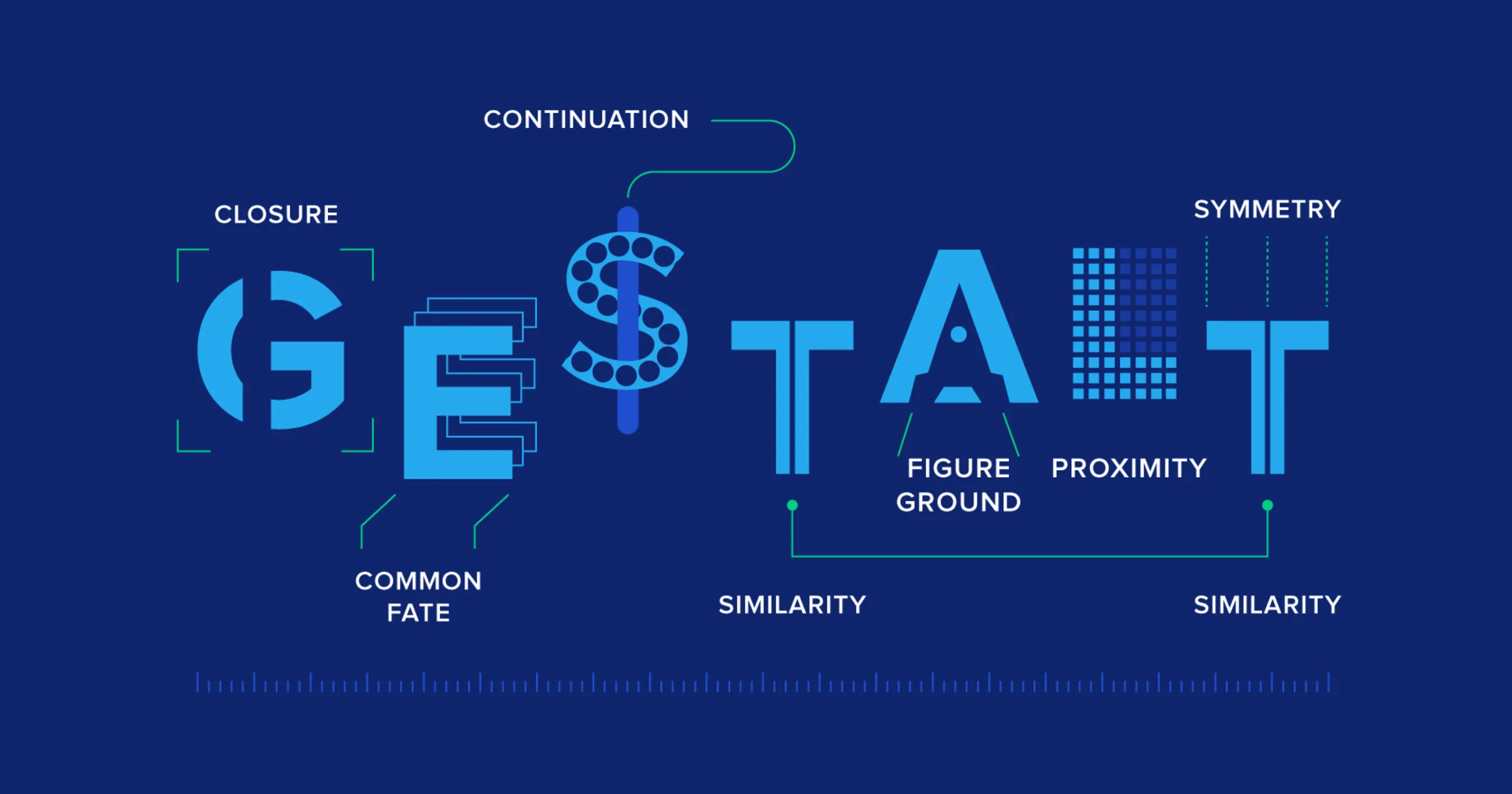
Imagine walking into a room full of scattered puzzle pieces. Instantly, you start grouping pieces by colour or pattern, trying to make sense of the chaos. You’re not consciously thinking about it—your brain is automatically organising the information for you. This is the essence of Gestalt psychology, which explains how humans naturally perceive patterns and group elements together to create a sense of order.
What Are Gestalt Principles?
Gestalt psychology is a set of principles that describe how people tend to organize visual elements into groups, even when those elements are not directly connected. The most commonly used Gestalt principles in design are:
Proximity: Items close to each other are seen as belonging together.
Similarity: Items that look similar are perceived as a group.
Closure: The mind fills in missing parts to complete a familiar shape or pattern.
Continuity: The eye follows lines or curves, seeing them as continuous rather than separate.
Common Fate: Elements moving in the same direction are perceived as related.
Why Does Gestalt Matter in UX Design?
Gestalt principles help designers create interfaces that are intuitive and easy to navigate. When users can quickly group and understand information, they experience less cognitive load and feel more comfortable using a product.
A Simple UX Example: Navigation Menus
Let’s consider a website’s navigation menu. If you list all the menu items in one long, unbroken line, users may struggle to find what they need. But if you group related items together (using proximity) and style similar categories with the same color or icon (using similarity), the menu becomes much easier to scan and understand.
Example:
Suppose you have a travel website with sections for “Flights,” “Hotels,” “Car Rentals,” “Travel Guides,” and “Customer Support.” Instead of listing them all in a single row, you can:
Group “Flights,” “Hotels,” and “Car Rentals” together (proximity and similarity for booking services).
Place “Travel Guides” and “Customer Support” in a separate group (proximity and similarity for information and help).
This simple application of Gestalt principles makes the navigation menu feel organized and logical, reducing user frustration and improving the overall experience.

Join Vijay on Peerlist!
Join amazing folks like Vijay and thousands of other builders on Peerlist.
0
8
0