

Why One Database Isn’t Enough: Building a Hybrid Architecture for CampusSwap
How I combined MongoDB and PostgreSQL to solve the unique challenges of a high-traffic campus marketplace.
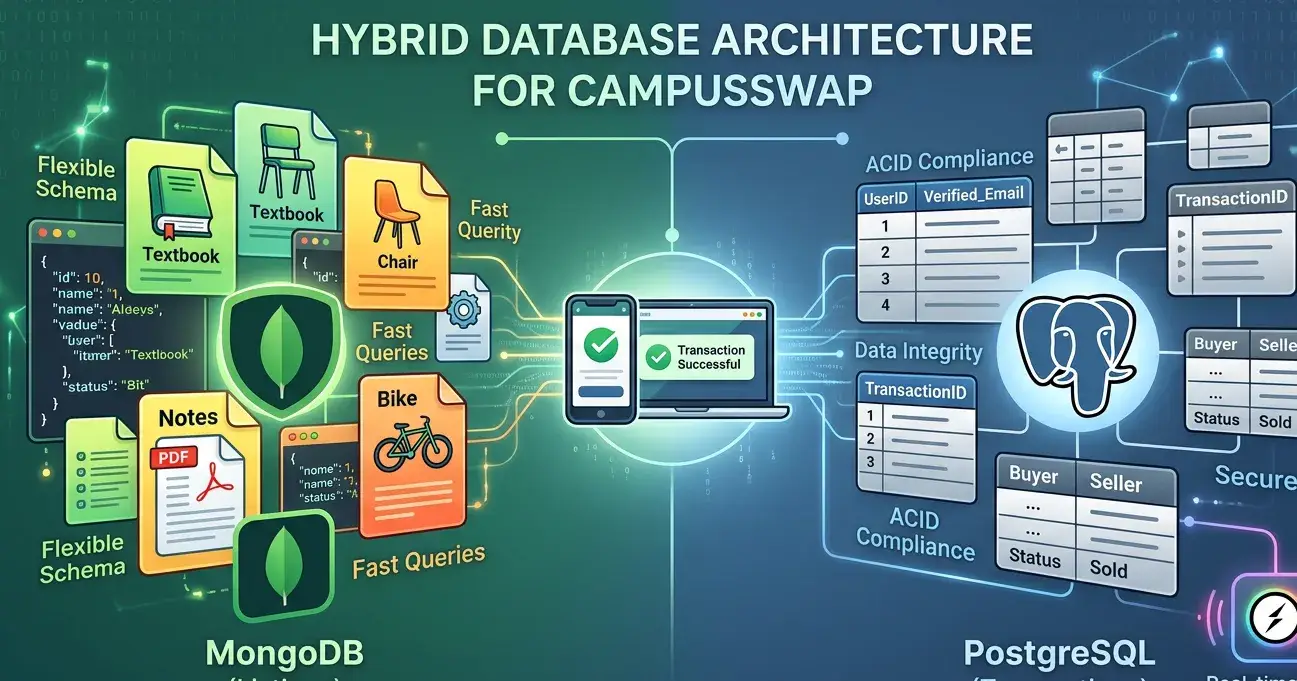
When I started building CampusSwap, a peer-to-peer marketplace for students, I hit a classic architectural crossroads: Relational or Non-relational?
Marketplaces are messy. Product listings change constantly—a textbook has different metadata than a mini-fridge. But when money and trust are involved, transactions need to be rock-solid. Here is why I chose a hybrid database approach to get the best of both worlds.
1. The Flexibility of MongoDB (The Listings)
Student listings are diverse. One student might list a "Dorm Chair" with dimensions and material, while another lists "Calculus Notes" with a PDF preview. Using MongoDB, I could store these as flexible documents without a rigid schema. This allowed for:
Fast iterations on product categories.
Easy storage of diverse metadata.
High-speed retrieval for browsing and searching.
2. The Integrity of PostgreSQL (The Transactions)
When a trade happens or a user verifies their student identity, there is zero room for error. I chose PostgreSQL to handle:
User Authentication: Ensuring every user is tied to a verified
.eduemail.Transactional Data: Using ACID compliance to ensure that a "Sold" status is reflected accurately across the board.
Relationships: Managing the complex web of who bought what from whom.
3. Real-Time Communication with Socket.io
A marketplace dies without communication. I integrated Socket.io to build a real-in-app messaging system. By keeping the chat states separate from the core transactional data, I ensured that a spike in "Is this still available?" messages wouldn't slow down the checkout process.
The Verdict
By engineered a hybrid architecture, I didn't have to compromise. CampusSwap became a platform that is as flexible as a Craigslist-style board but as secure as a modern fintech app.
Key Lesson: Don't try to force one tool to do everything. Use the right tool for the specific data type.

Join Raymond on Peerlist!
Join amazing folks like Raymond and thousands of other builders on Peerlist.
0
6
0