

Why a Curated Services Directory Still Matters in an AI-and-Search-First Web
What Top Services Directory is trying to fix in the way people discover service businesses online
When people need a service provider, the search usually starts the same way: open a browser, type a few keywords, and hope the results are relevant.
But finding a service business is not always the same as finding information.
That gap matters.
Search engines are excellent at surfacing pages. They are not always excellent at helping someone quickly compare service providers in a clean, structured way. The result is often a messy journey through ads, aggregator pages, outdated business profiles, low-quality local pages, and directories that feel abandoned.
That is exactly why a focused, well-maintained services directory can still be useful.
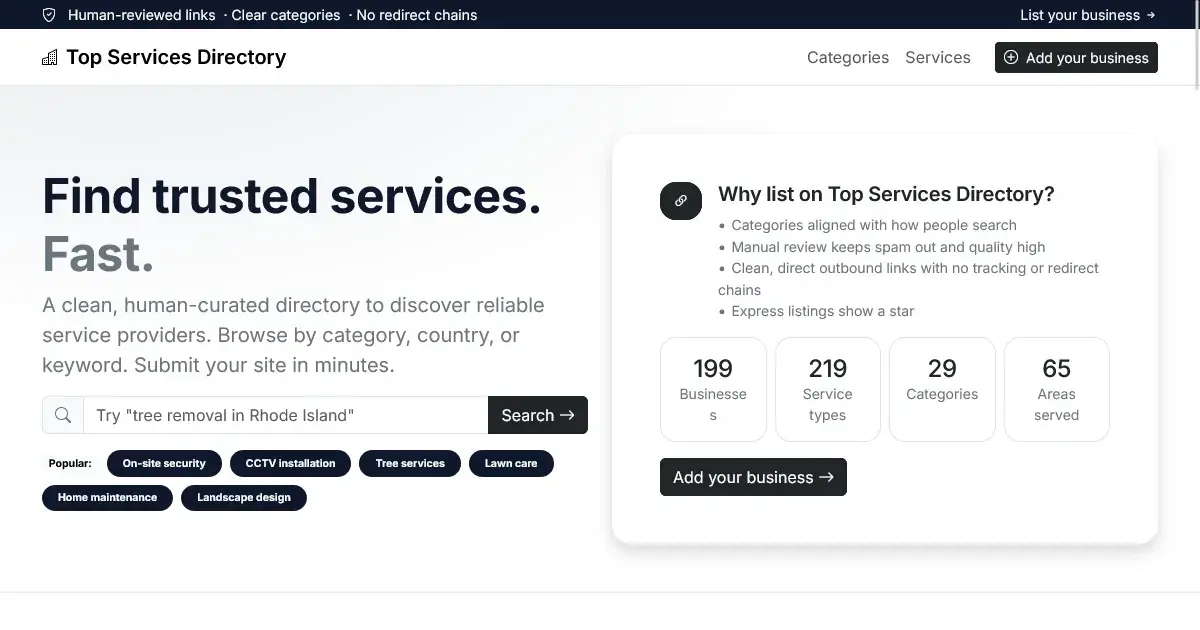
Top Services Directory is built around a simple idea: make it easier to discover service providers by category, service type, and location, without adding unnecessary friction. The site positions itself as a human-curated directory where users can browse trusted services, search by keyword, and contact businesses directly. It also emphasizes manual review, category clarity, and direct outbound links without redirect chains.
What stands out to me is that this is not trying to be everything for everyone.
It is not pretending to replace search. It is trying to improve a specific part of the discovery experience.
That difference is important.
A good directory works best when it reduces noise. On Top Services Directory, the structure is centered around actual service discovery: categories, service pages, and geographic context. The site currently presents businesses across dozens of categories and hundreds of service types, which helps move the experience away from vague browsing and toward more intent-driven discovery.
This matters for users because service decisions are usually practical decisions.
Someone looking for IT services, solar installers, management consulting, CCTV installation, lawn care, or matchmaking is not browsing for entertainment. They usually want a faster path to a shortlist. Pages on the site are organized around that kind of intent, with category and service-level navigation that makes comparison easier than starting from a blank search bar every time.
It also matters for businesses.
A lot of business owners still underestimate how much presentation and placement affect trust. A listing is not just a backlink or a citation. In the best cases, it is a structured profile that helps a potential customer understand what a business does, where it operates, and whether it is relevant before they ever click through.
Top Services Directory leans into that by using category-led discovery, manual review, and listing pages that present a business in a straightforward way. That kind of structure is useful because it creates context around the listing instead of just dropping a company name into a giant database.
I also think this kind of product fits the current web better than people assume.
We are in a moment where AI tools can summarize almost anything, and search results are increasingly crowded by SEO patterns that all look the same. In that environment, curation becomes more valuable, not less. A directory that is actually reviewed, categorized well, and kept clean can act as a better starting point than a random result page filled with competing incentives.
That is probably the real case for directories now.
Not scale for the sake of scale.
Not endless pages.
Not low-quality submission dumps.
Curation.
That is where directories still earn their place.
Top Services Directory makes that case in a fairly practical way. Its homepage messaging emphasizes human-reviewed links, aligned categories, and a cleaner discovery path, and the site backs that up with browsable category and service pages across areas like professional services, IT, industrial services, and more.
The broader takeaway is simple: directories are still useful when they are opinionated about quality.
The old web had too many directories because almost anyone could launch one without thinking about usefulness. The modern web still has room for directories that solve a real navigation problem. Service discovery is one of those problems.
That is why I think platforms like Top Services Directory still make sense today. They work best not as a replacement for search, but as a cleaner layer on top of it: one that helps people move from “I need a service” to “here are relevant providers” with less noise in between.
And honestly, that is a meaningful product decision.
Because on today’s web, clarity is a feature.

Join Naif on Peerlist!
Join amazing folks like Naif and thousands of other builders on Peerlist.
1
2
0