

How to Identify Serious Clients During Initial Discussions
In software and IT business, the ability to identify the right clients early can save months of wasted effort, improve project quality, and create healthier long-term growth.
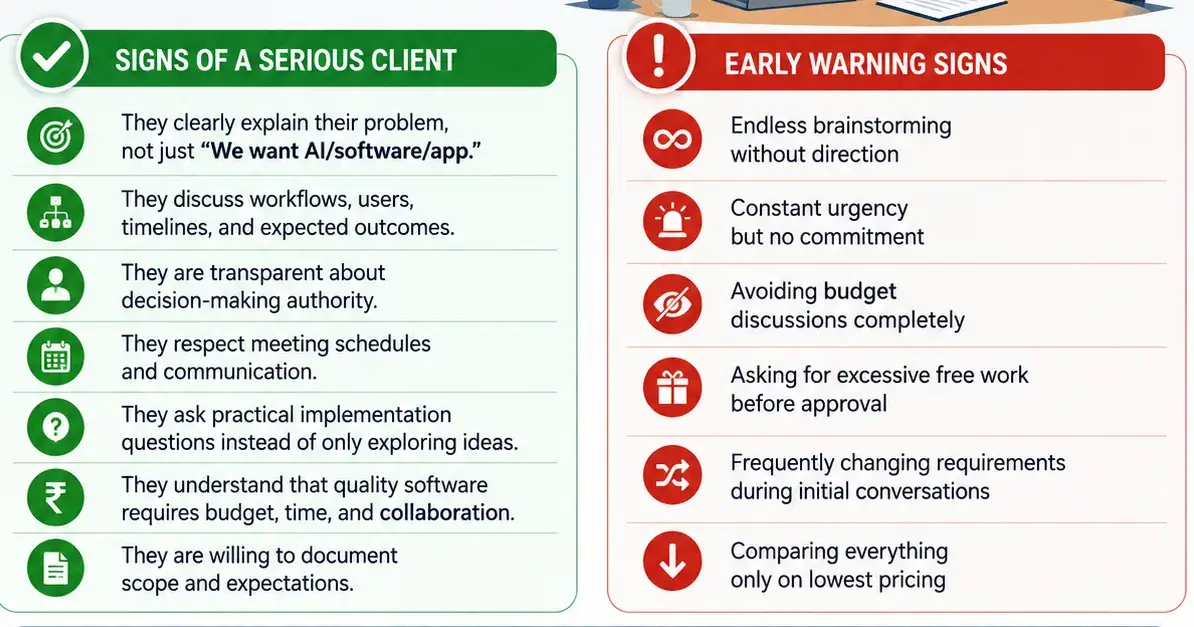
In the early stages of building an IT services company or SaaS business, many founders believe that every inquiry is an opportunity. Every phone call feels important. Every demo feels like potential revenue.
But over time, experience teaches something critical:
Not every inquiry is a real business opportunity.
One of the most valuable business skills is learning how to identify serious clients during the initial discussions itself.
This is not about being judgmental or selective for ego. It is about operational discipline, time management, and protecting the long-term health of your business.
The Hidden Cost of Non-Serious Discussions
Many IT founders unknowingly spend weeks or even months in:
Endless meetings
Repeated demonstrations
Constant brainstorming sessions
Scope revisions
Free consultations
Unstructured discussions
Only to realize later that:
The client had no defined budget
The project was never approved internally
Decision-makers were absent
Requirements were unclear
The inquiry was only for market research
The client was comparing dozens of vendors only on pricing
This drains not only time, but also energy, focus, and momentum.
For small teams, solo founders, and growing companies, this cost becomes even more dangerous because every hour invested in the wrong opportunity is an hour taken away from genuine business growth.
Serious Clients Usually Talk About Problems, Not Buzzwords
One of the earliest signs of a serious client is clarity of problem statement.
Non-serious discussions often sound like:
“We want AI.”
“We need automation.”
“We want an app.”
“We need a portal.”
Serious clients usually explain:
Existing workflow problems
Operational bottlenecks
Manual effort involved
Current challenges
Expected outcomes
Users involved in the system
They focus on solving business problems rather than only discussing technology trends.
This difference is extremely important.
Clients who understand their own operational challenges are usually far more prepared for implementation.
Serious Clients Respect Structure
Another important sign is respect for structure and communication.
Serious clients generally:
Attend meetings on time
Respond consistently
Share documents when requested
Clarify expectations
Involve relevant stakeholders
Respect professional boundaries
They understand that software projects require collaboration from both sides.
On the other hand, disorganized communication during the initial stage often becomes a preview of future project challenges.
Budget Discussions Should Not Be Avoided
Many founders hesitate to discuss budget because they fear losing the client.
But avoiding budget conversations completely can lead to major problems later.
A serious client may not always reveal exact numbers initially, but they usually:
Understand that quality software has costs
Are open to discussing investment ranges
Want clarity around pricing models
Discuss implementation priorities
Clients who continuously avoid all budget discussions while demanding detailed planning, repeated meetings, and extensive free consulting often create difficult engagements later.
Excessive Free Work Is an Early Warning Sign
One common mistake in IT sales is giving too much before commitment.
This can include:
Detailed solution architecture
Extensive custom demos
Multiple revisions
Free proof-of-concepts
Full project planning
Deep consulting without agreement
A reasonable level of pre-sales effort is necessary in business.
However, when discussions become heavily one-sided without commitment, it usually indicates low seriousness or low respect for the vendor’s time.
Healthy business relationships require balanced engagement from both sides.
Serious Clients Think Long-Term
Good clients do not only ask:
“How much will this cost?”
They also ask:
How will this scale?
What will implementation look like?
How will support work?
What risks should we plan for?
What dependencies exist?
How can adoption improve internally?
These questions show long-term thinking and implementation intent.
Such clients often become:
Better collaborators
Repeat customers
AMC clients
Referral sources
Strategic relationships
Lowest Pricing Should Never Be the Only Decision Factor
Every business wants reasonable pricing. That is normal.
But clients who compare everything only on lowest price often ignore:
Quality
Stability
Scalability
Security
Long-term maintenance
Support responsiveness
Domain understanding
In software business, the cheapest project often becomes the most expensive operationally later.
Serious clients understand that value matters more than only initial cost.
Clarity Creates Better Business Relationships
The best projects usually begin with:
Clear expectations
Mutual respect
Transparent communication
Defined responsibilities
Practical timelines
Realistic budgeting
When both sides are serious, projects move faster, communication becomes smoother, and long-term trust develops naturally.
Final Thoughts
In entrepreneurship and IT services, growth is not only about acquiring more clients.
It is also about identifying the right clients.
Learning to recognize seriousness early helps businesses:
Improve efficiency
Protect team energy
Increase project success rates
Build healthier client relationships
Grow sustainably
A good client relationship is not built on pressure, confusion, or endless discussions.
It is built on clarity, commitment, trust, and mutual respect from both sides.
And often, the quality of a business is deeply connected to the quality of clients it chooses to work with.

Join Rohan on Peerlist!
Join amazing folks like Rohan and thousands of other builders on Peerlist.
0
0
0