

Why Software Sales Is One of the Biggest Wealth Opportunities of the Next Decade
As businesses across every industry move toward digital transformation, the ability to connect technology solutions with real business problems may become one of the most valuable skills
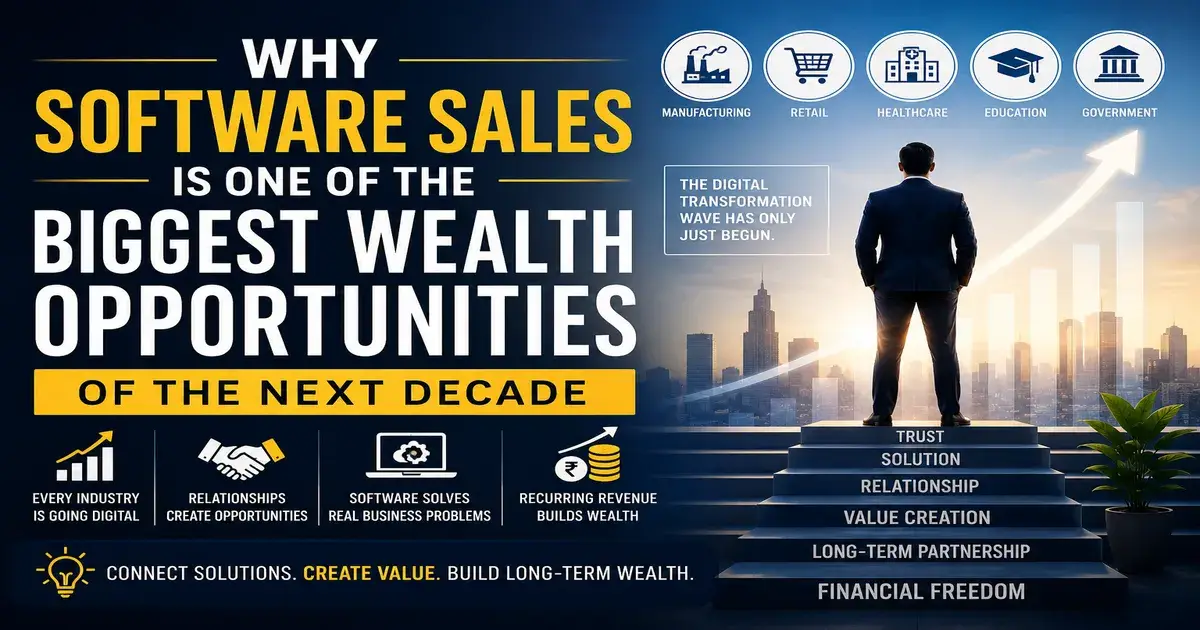
When people think about the software industry, they usually imagine developers, engineers, AI experts, or startup founders.
But one of the biggest opportunities in the coming decade may not belong only to those who build software.
It may belong equally to those who can understand businesses, build relationships, identify operational problems, and help organizations adopt the right technology solutions.
In simple words:
The future opportunity is not only in software development.
It is also in software sales, solution consulting, and business transformation partnerships.
Every Industry Is Becoming a Technology Industry
Today, almost every industry is slowly becoming dependent on software.
Manufacturing companies need workflow automation.
Hospitals need digital records and operational systems.
Schools need management platforms.
Retail businesses need analytics and online integration.
Government organizations need digitization and automation.
MSMEs need operational efficiency tools.
Service businesses need customer management systems.
Even industries that traditionally operated manually for decades are now under pressure to modernize.
This transformation is not temporary.
It is a long-term structural shift.
And whenever large structural shifts happen in the economy, massive business opportunities are created around them.
Businesses Do Not Simply Buy Software — They Buy Solutions
One important reality in the IT industry is this:
Most businesses do not actually care about technology itself.
They care about:
Reducing operational effort
Saving time
Improving visibility
Increasing efficiency
Reducing errors
Improving control
Scaling operations
Managing data better
This is where software sales becomes powerful.
A good software sales professional or business partner is not someone who only “sells software.”
They help businesses understand:
What problem exists
What operational impact it creates
What improvement is possible
What implementation may look like
What long-term value can be achieved
That role becomes extremely valuable in a digital economy.
The Demand for Trusted Technology Advisors Will Increase
As software options increase, businesses often become confused.
Many business owners are not technical experts.
They may not know:
Which solution is suitable
Whether custom software is needed
Which SaaS platform is reliable
What implementation risks exist
What pricing is reasonable
How scalability should be planned
Because of this, trust becomes extremely important.
The future belongs not only to software vendors, but also to trusted technology advisors and relationship-driven business partners.
People who can simplify technology and connect it with real business value will become increasingly important.
Software Sales Is More Scalable Than Many Traditional Businesses
Traditional businesses often require:
Inventory
Warehousing
Logistics
Physical infrastructure
Large operational teams
Geographic limitations
Software business models are different.
A single SaaS product can serve thousands of clients.
A custom software relationship can generate years of recurring revenue through support and AMC.
A strong client relationship can create referrals across entire industries.
This creates a unique form of scalability.
In many cases:
One successful client relationship can create multiple future opportunities
One implementation can generate recurring income
One referral can open an entirely new market segment
That is why software ecosystems can grow exponentially when trust and execution quality are strong.
You Do Not Need To Be a Programmer To Participate
This is one of the most misunderstood aspects of the software industry.
Many people assume:
“If I cannot code, I cannot participate in the technology industry.”
That is no longer true.
The technology ecosystem now needs:
Business development professionals
Industry consultants
Relationship managers
Sales partners
Domain experts
Trainers
Onboarding specialists
Operational advisors
Customer success teams
In fact, many successful software partnerships happen because someone deeply understood the client’s operational problems — not because they wrote the software themselves.
Understanding businesses is becoming as valuable as understanding technology.
Indian MSMEs Create a Massive Untapped Opportunity
India has millions of MSMEs and operational businesses.
A large percentage still:
Operate manually
Use spreadsheets extensively
Depend on paperwork
Lack workflow visibility
Face coordination inefficiencies
Struggle with process standardization
This creates enormous opportunity for:
SaaS solutions
Workflow automation
AI-assisted systems
Industry-specific platforms
Custom operational software
The digital transformation wave in India is still in early stages for many sectors.
The next decade may see one of the largest technology adoption cycles across Indian businesses.
Relationship-Based Selling Will Become Even More Valuable
In B2B software business, relationships matter deeply.
Businesses trust:
People who understand their operations
People who communicate clearly
People who behave professionally
People who remain available during challenges
People who focus on long-term outcomes
This is why ethical and relationship-driven software sales can become highly rewarding over time.
Unlike aggressive transactional selling, trust-based software partnerships often create:
Long-term clients
Recurring business
Referrals
Industry reputation
Sustainable growth
And trust compounds.
The Biggest Opportunity Is Not Just Money — It Is Value Creation
Software sales becomes meaningful when it genuinely improves businesses.
Helping a company:
Save thousands of hours
Improve operational control
Reduce manual work
Improve accuracy
Increase productivity
Scale effectively
creates real economic value.
Technology is becoming one of the core engines of modern business growth.
And those who help businesses successfully adopt technology are participating in that transformation itself.
Final Thoughts
The next decade may create one of the largest business opportunities in software, SaaS, AI, and operational automation.
But the biggest winners may not only be the companies building technology.
They may also be the people who:
Understand industries
Build trust
Identify operational pain points
Connect businesses with the right solutions
Focus on long-term relationships
Help organizations modernize successfully
Software sales is no longer just “selling software.”
It is becoming a form of business transformation leadership.
And for those willing to learn, build relationships, and solve real business problems, the opportunity ahead may be enormous.

Join Rohan on Peerlist!
Join amazing folks like Rohan and thousands of other builders on Peerlist.
0
0
0