

Why Your Outreach Isn’t Working (It’s Not the Copy)
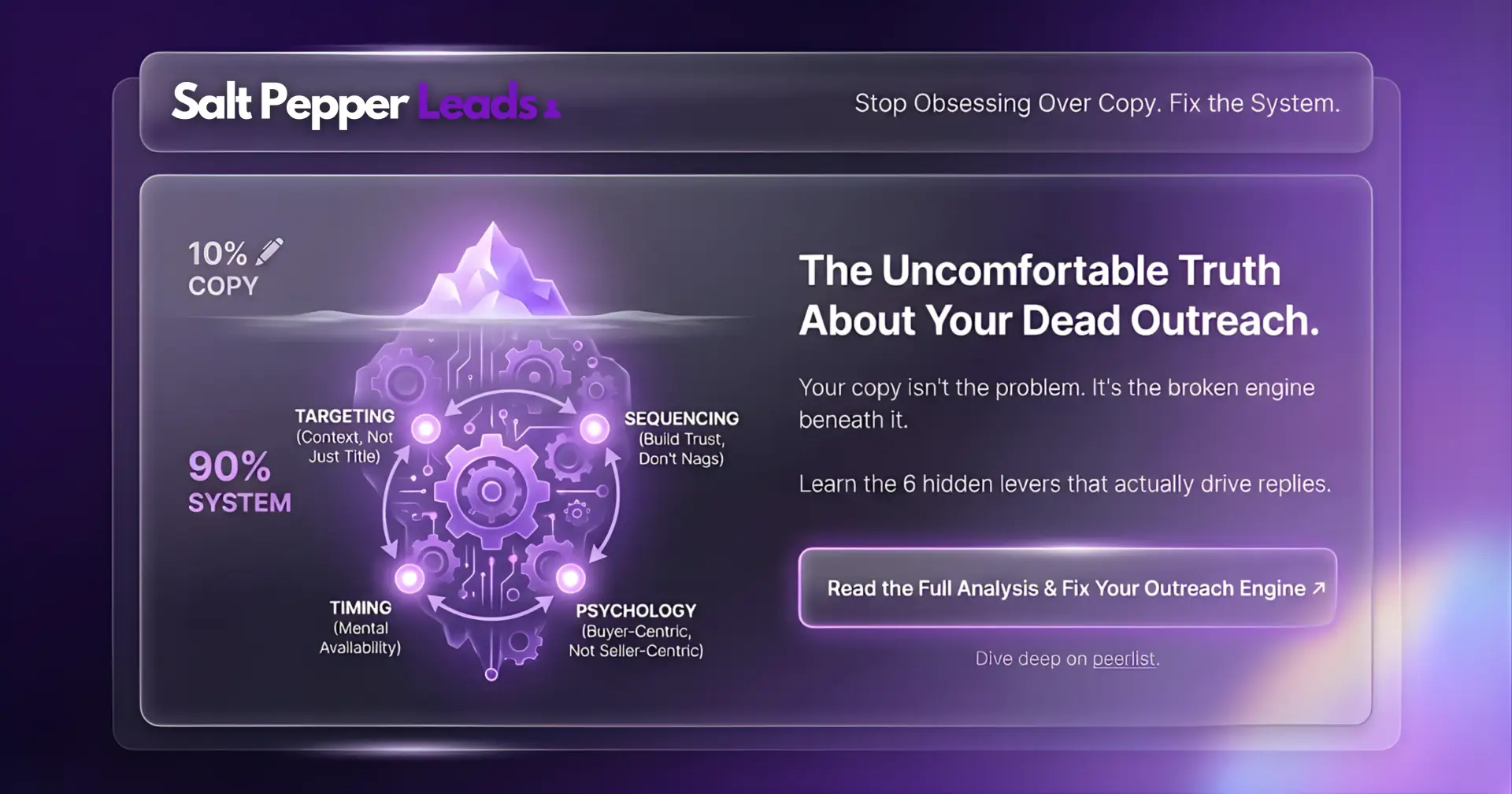
The Copy Obsession That’s Costing You Leads
If you’re running cold email or LinkedIn outreach and not getting replies, chances are you’ve already tried this:
Rewriting your copy
Testing different subject lines
Adding personalization tokens
Making it “shorter” or “friendlier”
And yet…
The results barely change.
Here’s the uncomfortable truth most founders don’t want to hear:
Outreach doesn’t fail because of bad copy.
It fails because the system around the copy is broken.
Copy is only the last 10% of an outreach engine.
The other 90%, targeting, sequencing, timing, and psychology is where most outreach quietly dies.
Let’s break this down properly.
1. Bad Targeting Makes Good Copy Useless
You can write the best outreach message in the world, but if it’s sent to the wrong person, it will still fail.
The Most Common Targeting Mistakes:
Targeting by industry only, not context
Messaging founders who don’t feel the problem yet
Pulling leads from databases without validation
Treating “decision-maker” as a single persona
Outreach works when the recipient already has the problem not when you’re trying to convince them they should care.
Example:
A SaaS founder struggling with stagnant demos will read your message differently than a SaaS founder who just raised funding.
Same copy.
Completely different mindset.
Good outreach starts with relevance, not persuasion.
2. Sequencing Is More Important Than the First Message
Most people judge outreach by the first email or LinkedIn message.
That’s a mistake.
Modern outreach is not about one perfect message, it’s about a sequence of small, low-friction touches.
What Usually Goes Wrong:
One message → one follow-up → stop
Follow-ups that feel like reminders, not continuations
Every message asking for a call
What Actually Works:
Each touch adds context, not pressure
Messages evolve naturally (observation → insight → question)
Calls are suggested after trust is built
People rarely respond to the first message.
They respond when timing + familiarity + relevance align.
3. Timing Is a Hidden Conversion Lever
Outreach isn’t just what you send, it’s when it lands.
Common Timing Errors:
Sending outreach during peak busy hours
Messaging prospects during off season decision cycles
Ignoring time zones and work patterns
Following up too aggressively or too late
Outreach works best when it reaches people during:
Mental downtime
Decision windows
Transitional phases (growth, hiring, restructuring)
This is why mass scheduling without strategy kills response rates.
4. Most Outreach Ignores Buyer Psychology
This is the biggest miss.
Most outreach messages are written from the sender’s perspective:
“We help companies do X”
“We offer Y”
“Would you like a quick call?”
But buyers don’t wake up wanting a sales call.
They respond when outreach aligns with how they think, not how you sell.
Effective Outreach Understands That:
People avoid risk before they seek gain
They respond to familiar pain, not features
Trust is built through clarity, not hype
Simplicity feels safer than sophistication
The goal of outreach isn’t to sell.
It’s to start a conversation that feels natural.
5. Personalization Is Not What You Think It Is
Adding someone’s name, company, or LinkedIn headline is not personalization.
Real personalization is about:
Referencing context, not profile data
Speaking to situations, not titles
Showing understanding, not flattery
Most prospects can tell within seconds whether a message was:
Thoughtfully written
Lightly customized
Fully automated
And they respond accordingly.
6. Outreach Fails When There’s No System Behind It
This is where most founders struggle.
They treat outreach as:
A task
A campaign
A short-term push
Instead of what it actually is:
A repeatable system that compounds over time.
A working outreach system includes:
Clear ICP definitions
Validated lead sources
Structured sequences
Message logic (not just copy)
Tracking and iteration
Without a system, outreach becomes guesswork.
Where Most Teams Get Stuck
At Salt Pepper Leads, we see this pattern repeatedly:
Founders blame copy
Agencies tweak words
Tools get switched
Results stay flat
Not because outreach doesn’t work but because it’s being run without a strategy-first foundation.
Fix the System, Not the Sentence
If your outreach isn’t working, resist the urge to rewrite the message again.
Instead, ask:
Are we targeting the right people at the right moment?
Does our sequence build familiarity before asking?
Are we respecting buyer psychology?
Do we have a system or just activity?
When those are fixed,
the copy suddenly starts working.
If you’re unsure where your outreach system is breaking whether its targeting, sequencing or timing a short strategic review can often uncover more than weeks of copy tweaks.
Book your discovery call here to understand our approach.

Join Swarup on Peerlist!
Join amazing folks like Swarup and thousands of other builders on Peerlist.
0
2
0