

The Hidden Tax on Every Founder's Brain
What parole judges, Steve Jobs, and cognitive psychology can teach founders about protecting their most valuable resource.
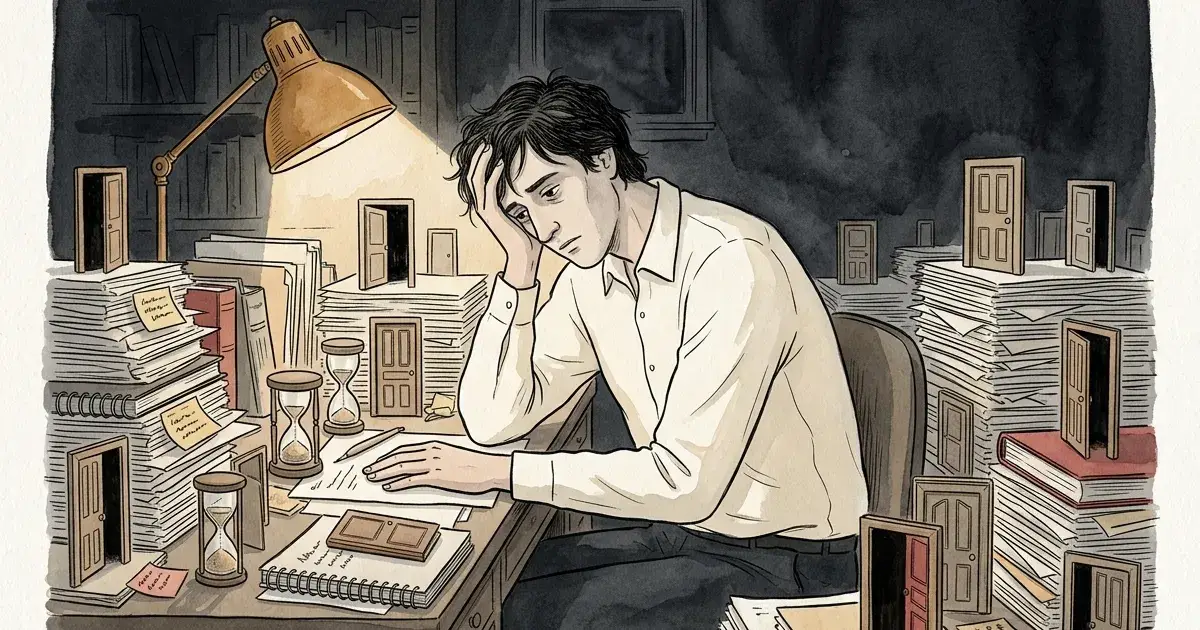
It's 4 PM. You've already decided what to build, who to hire, what to say to an investor, how to respond to a pissed-off customer, and whether to kill a feature that took three weeks to ship. Now your co-founder asks you something simple: where should we eat? And you want to lie down on the floor.
That's not hunger. That's not weakness. That's your brain running on fumes because you've been spending its most precious resource all day, and nobody told you it was finite.
Your Brain Has a Budget
Every decision you make draws from the same cognitive account. Doesn't matter if it's picking a font or firing someone. The brain spends willpower currency on both.[1]
This is the core finding behind decision fatigue: the quality of your decisions deteriorates the more you make in a row.
The most famous evidence comes from a 2011 study by Shai Danziger and colleagues at Ben-Gurion University. They analyzed over 1,100 parole board rulings across a single day. Prisoners who appeared early in the morning were granted parole roughly 65% of the time. Those who appeared late in the session? About 20%.[2]
Same board. Same legal standards. Completely different outcomes, based on nothing but when the case was heard.
The judges weren't corrupt or lazy. They were depleted. When the brain gets tired of weighing evidence and nuance, it defaults to the safest, easiest answer: no.
Now imagine that judge is you. And instead of rulings, the decisions are: which customer segment to prioritize, whether to extend runway by cutting a team member, what to say in a pitch that's two hours away.
By the time you reach the ones that matter most, you're running on empty.
The Startup Tax Nobody Talks About
Most founders know burnout is a threat. Far fewer realize that decision fatigue is distinct from burnout, and in some ways more dangerous.
Burnout is chronic. Decision fatigue is acute. It resets (partially) with sleep. But it accumulates faster than sleep can recover it when the environment keeps demanding choices at startup speed.
Roy Baumeister, the psychologist who pioneered ego depletion theory, ran a series of experiments in the late '90s showing that self-control, decision-making, and cognitive effort all draw from a shared resource.[3] When one goes, the others follow.
A 2019 meta-analysis in Psychological Bulletin confirmed that ego depletion effects hold across 200+ studies, despite earlier debates about reproducibility.[4]
What makes startups a perfect storm for this:
High decision volume. Early-stage companies lack process. No process means no automation, and no automation means every micro-choice goes through the founder.
High stakes. The weight of each decision, especially those tied to money, people, or survival, accelerates depletion faster than trivial ones.[5]
Constant context switching. Product meeting to investor call to customer complaint to HR issue, all before noon. Each switch costs a cognitive toll beyond the decisions themselves.[6]
No institutional memory. In a mature company, SOPs and precedent do the deciding for you. Startups have neither.
The result: founders make their worst decisions late in the day, under pressure, on topics that are exactly the ones that will define whether the company survives.
Researchers at Cornell estimate the average adult makes roughly 35,000 decisions per day.[7] As a founder, you're making a disproportionate share of the consequential ones, at a pace no human cognitive system was built for.
What It Actually Looks Like
Decision fatigue doesn't announce itself. It masquerades as other problems.
You start procrastinating on decisions you'd normally make quickly. Not because the decision is hard. Because deciding takes energy you don't have.
You get impulsive. Baumeister's research found that depleted subjects don't just make worse deliberative choices. They sometimes swing the other way, making reckless, short-term decisions to escape the discomfort of deliberation.[3] That's the founder who says yes to a bad partnership at 6 PM because saying no requires explaining, negotiating, and thinking, and they can't face any of it.
You get irritable. Small things feel enormous. The team asks a reasonable question; you snap. Not because they're wrong. Because you've already spent everything.
You avoid the hard thing and do more of the easy thing. Answer emails instead of writing the strategy doc. Fix a tiny bug instead of having the difficult conversation with your CTO.
Sound familiar? That's the machine telling you it's out of gas.
The Fix Isn't Meditation
Every article about decision fatigue eventually tells you to take breaks, eat lunch, and practice mindfulness. Fine advice. Also insufficient for anyone running a company.
The real solution isn't recovery management. It's decision architecture: redesigning how, when, and how many decisions actually reach you.
Three levers matter.
1. Reduce
The fastest win is eliminating decisions that shouldn't require you at all.
Steve Jobs wore the same outfit every day. Mark Zuckerberg still does. Obama famously limited his wardrobe to gray and blue suits. These are people who understood the math: every trivial decision is a withdrawal from the same account as a critical one.[8]
In a startup, this looks like:
Default rules for recurring decisions. If a tool costs under $X, the team decides. Over $X, it comes to you.
Templates for repeatable communications. Investor updates, hiring rejections, customer escalations. Write the template once, update the variables, send.
Saying no faster. Most founders deliberate too long on things that should be an immediate no. Build a shortlist of automatic rejection criteria and use it.
2. Schedule
Not all decisions are equal. Some require full cognitive firepower. Some require almost none. Most founders schedule their days by urgency rather than cognitive cost, which means their best thinking goes to whoever messages first.
Daniel Kahneman's System 1 and System 2 framework is useful here.[9] System 2 (slow, deliberate, analytical) depletes fast. System 1 (fast, intuitive) is cheaper but error-prone for novel problems.
The practical application:
Put your two highest-stakes decisions before 11 AM. This is when prefrontal cortex activity peaks for most people.[10]
Block a 90-minute no-meeting window every morning. No Slack, no email, no standups. Just the hardest thing on your plate.
Batch low-stakes decisions into a single block. Vendor reviews, expense approvals, minor product questions. Handle them all at once at 2 PM rather than dispersing them throughout the day.
3. Delegate Structurally
Most founders delegate tasks. The move is to delegate decision rights, with explicit written frameworks so the team doesn't reverse-delegate back through a stream of clarifying questions.
Jeff Bezos' documented principle distinguishes "Type 1" decisions (irreversible, high-stakes, require careful deliberation) from "Type 2" decisions (reversible, low-stakes, should be made fast and corrected if wrong).[11] The explicit goal: prevent Type 2 decisions from consuming attention that should go to Type 1.
A simple decision rights log for an early-stage company:
Minor feature scope changes. Product lead decides. Founder is informed. Escalate only if the change pushes the launch date by more than a week.
IC-level hiring. Hiring manager decides. Founder is informed. Escalate if salary is above band.
Customer refunds under $500. Support lead decides. Logged in a weekly digest. Never escalates.
Strategic pivots and new markets. Founder decides, always. Full team is informed. Never delegates.
Vendor contracts under $1k/month. Department head decides. Ops is informed. Escalate only for multi-year commitments.
Make this document real, share it with the team, and enforce it. The goal isn't to abdicate. It's to protect your cognitive budget for the decisions only you can make.
The Glucose Thing Is Real (But Complicated)
For years, the conventional explanation for decision fatigue was blood glucose depletion. The brain burns glucose when making decisions; when glucose drops, performance drops with it.
The research is messier than the pop-psychology version. A 2012 study found that even rinsing your mouth with a glucose solution, without swallowing, improved performance on cognitive tasks. That suggests the mechanism is more about signaling than raw fuel consumption.[12]
What this means practically: eating lunch matters, but the bigger variable is probably perceived resource availability. When your brain believes it's running low, it rations. Perceived depletion is nearly as limiting as actual depletion.
This is why your psychological environment matters as much as your physical one. A culture of constant urgency, a Slack that demands instant responses, an open-door policy with no protected thinking time. These don't just tire you out. They continuously signal scarcity to the brain, accelerating depletion even when the actual cognitive load isn't that high.
The Meta-Decision
Here's what almost no founder does: treat the design of their decision-making system as a strategic priority rather than a personal productivity hack.
Most startups treat everything like Type 1. Everything is urgent. Everything requires a meeting. Everything escalates.
That's not seriousness. That's inefficiency dressed up as seriousness.
The founders who build durable companies learn early that protecting their decision-making capacity isn't self-care. It's competitive advantage. Every good decision they save their best thinking for is one their exhausted competitors made badly at 6 PM on a Thursday.
You will never eliminate decision fatigue. The job demands too much for that. But you can stop treating your best cognitive hours as a commons that everyone can graze on freely.
Guard the beginning of your day like it's runway.
Because it is.
The most consequential thing you decide today might not feel like a decision at all. It might feel like finally doing the thing you've been putting off since Monday. That feeling isn't procrastination. That's the difference between a depleted brain and a fresh one. Build a life where the fresh one shows up for the things that matter.
Citations
Baumeister, R. F., Bratslavsky, E., Muraven, M., & Tice, D. M. (1998). Ego depletion: Is the active self a limited resource? Journal of Personality and Social Psychology, 74(5), 1252–1265.
Danziger, S., Levav, J., & Avnaim-Pesso, L. (2011). Extraneous factors in judicial decisions. Proceedings of the National Academy of Sciences, 108(17), 6889–6892.
Baumeister, R. F., & Tierney, J. (2011). Willpower: Rediscovering the Greatest Human Strength. Penguin Press.
Friese, M., Loschelder, D. D., Gieseler, K., Frankenbach, J., & Inzlicht, M. (2019). Is ego depletion real? An analysis of arguments. Psychological Bulletin, 145(6), 626–650.
Hagger, M. S., et al. (2016). A multilab preregistered replication of the ego-depletion effect. Perspectives on Psychological Science, 11(4), 546–573.
Rubinstein, J. S., Meyer, D. E., & Evans, J. E. (2001). Executive control of cognitive processes in task switching. Journal of Experimental Psychology: Human Perception and Performance, 27(4), 763–797.
Wansink, B., & Sobal, J. (2007). Mindless eating: The 200 daily food decisions we overlook. Environment and Behavior, 39(1), 106–123.
Isaacson, W. (2011). Steve Jobs. Simon & Schuster. Lewis, M. (2012, September). Obama's Way. Vanity Fair.
Kahneman, D. (2011). Thinking, Fast and Slow. Farrar, Straus and Giroux.
Goel, N., Rao, H., Durmer, J. S., & Dinges, D. F. (2009). Neurocognitive consequences of sleep deprivation. Seminars in Neurology, 29(4), 320–339.
Bezos, J. (2016). Amazon Letter to Shareholders. Amazon.com, Inc. Annual Report.
Sanders, M. A., Shirk, S. D., Burgin, C. J., & Martin, L. L. (2012). The gargle effect: Rinsing the mouth with glucose enhances self-control. Psychological Science, 23(12), 1470–1472.

Join Suman on Peerlist!
Join amazing folks like Suman and thousands of other builders on Peerlist.
0
4
0