

It’s the comfort of the known that really sticks
What if I told you the most revolutionary designs in tech history share one secret — and it’s the opposite of what you think?
picture this
It’s late. A design team sits around, staring at their masterpiece — a total reimagining of an app used by millions. Tomorrow, users everywhere will wake up, open the app, and bam — everything’s new.
Silence hangs in the room. Everyone’s thinking the same thing but no one says it out loud:
will they love it… or rage-quit and delete us?
unfamiliar places, familiar feelings
Now, zoom out. Imagine landing in Tokyo for the first time. Neon signs you can’t read. Wild sounds. Smells you’ve never smelled.
It’s thrilling… but it’s also a lot.
Then, suddenly, you spot something familiar — maybe a Starbucks logo or a universal subway icon. You exhale.
For a second, your brain goes:
“Okay, I got this.”
That flicker of recognition? It’s not random. It’s your brain releasing cognitive tension. You just found an anchor in the chaos.
Here’s the twist most people miss:
True innovation doesn’t ditch familiarity — it uses it like a secret weapon.
Inside a big-name tech company, researchers ran a test:
They rolled out three versions of a major app redesign.
Version A → 90% new stuff
Version B → 70% familiar, 30% new
Version C → 50/50 new + familiar
At first, testers were hyped about Version A — the wild, experimental one.
But fast forward three weeks, and guess which one crushed the metrics?
Version B.
More daily use.
More feature discovery.
Higher user satisfaction.
Why? Because the balance of novelty + recognition hits a magic spot in our brains.
nothing’s gamble
Look at the Nothing Phone. When Carl Pei (ex-OnePlus co-founder) announced it, people were skeptical. How do you break into an Apple/Samsung-dominated space?
Answer: You play the familiarity-novelty game like a pro.
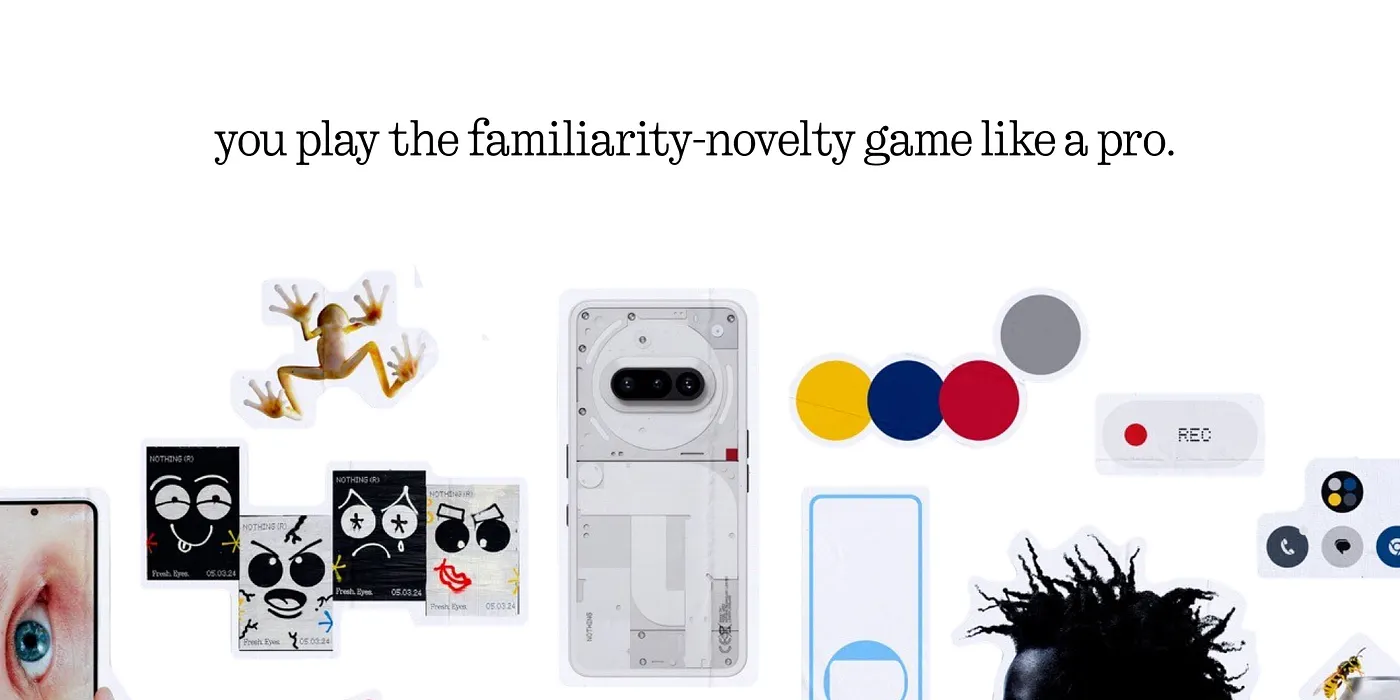
The transparent back showing the phone’s guts? It looked edgy, but underneath, it was classic smartphone structure — just revealed.
The dot-matrix UI? Unique, but built on swipe patterns and flows users already knew.
The Glyph lights on the back? Genuinely new, but layered on top of familiar notification systems, not replacing them.
They weren’t just designing a phone; they were engineering the perfect ratio of disruption to comfort — enough newness to feel fresh, but enough familiarity to feel safe.
the 70/30 revelation
What Nothing — and the most successful disruptors — understand is what we might call the 70/30 Rule of Revolutionary Design:
70% familiar → keeps users grounded
30% new → keeps users excited
This isn’t “playing it safe.”
It’s smart psychological engineering.
Too familiar (90%), and people get bored — no reason to switch.
Too alien (10%), and people bounce — too much effort to relearn everything.
But 70/30? That’s where magic happens.
now think this
Every big redesign faces the same critical moment — when users open the app, their brain has to decide instantly:
Is this a threat or an opportunity?
Before the conscious mind even kicks in, the subconscious is scanning for anchors.
If it finds familiar cues, the brain chills out. Only then does it have the space to appreciate novelty.
Skip this, and even the flashiest redesign can trigger mass user rejection.
If you’re working on a big redesign or rebrand, here’s your playbook:
— Identify the core patterns users rely on — muscle-memory interactions, visual landmarks, tone, etc.
— Don’t erase them. Evolve them.
— Layer your boldest ideas alongside familiar foundations.
— Let visual or interaction echoes from the past ease users into the future.
The most powerful redesigns don’t come crashing in with fireworks.
They slip under the radar — feeling comfortingly familiar even as they quietly reinvent everything.
In the psychology of product design, familiarity isn’t the enemy of innovation. It’s the Trojan horse that smuggles it in.

Join Sriragav on Peerlist!
Join amazing folks like Sriragav and thousands of other builders on Peerlist.
2
21
0