

Semiconductor Sector Realigns Around Intel’s Foundry Surge and AI Infrastructure Expansion
Daily Semiconductor Briefing – June 10, 2026
Daily Semiconductor Briefing – June 10, 2026
Executive Summary
The semiconductor industry is undergoing a pivotal realignment as Intel emerges as a credible Plan B for leading AI infrastructure builders like Google and NVIDIA, signaling a strategic shift in foundry dynamics. Micron Technology’s stock rallied amid confirmed HBM supply agreements with NVIDIA, while SK hynix accelerated its HBM4 ramp with a $28.7M tooling order from Hanmi. Cadence Design Systems’ expanded partnership with Intel Foundry—backed by Stifel’s raised price target to $432—underscores growing EDA-foundry co-optimization at the 14A node. Meanwhile, geopolitical friction intensified as Taiwan, China considers stricter AI chip export controls to mainland China, pressuring TSMC shares. In power semiconductors, Infineon, Bosch, Wolfspeed, and Nexperia advanced SiC adoption across automotive and industrial segments. RISC-V performance has surged 8x in five years, challenging ARM’s dominance in edge AI. This briefing details structural shifts, capital flows, corporate maneuvers, technological inflection points, and policy developments reshaping the global semiconductor landscape.
INDUSTRY LANDSCAPE
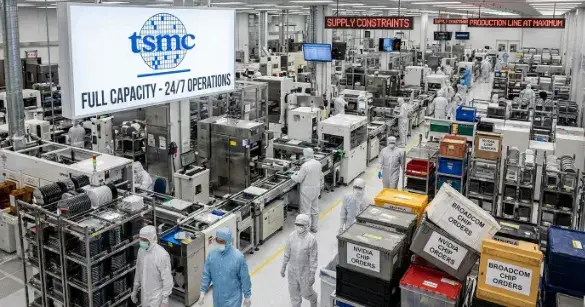
The semiconductor ecosystem is experiencing a strategic bifurcation: on one axis, TSMC remains the undisputed leader in advanced nodes (3nm and below), but capacity constraints and geopolitical risk are accelerating client diversification toward alternative foundries—chief among them, Intel Foundry. As reported by TrendForce on June 9, 2026, Google has reportedly ordered 3 million TPUs fabricated on Intel’s 18A process, while NVIDIA is evaluating the same node for multi-die GPU architectures. This marks a watershed moment: for the first time since the 2010s, a U.S.-based foundry is being seriously considered for high-volume, cutting-edge AI compute—not just as a contingency, but as a primary path.
Simultaneously, supply chain localization is intensifying. Spirit Electronics’ new managed-access program for U.S.-based advanced semiconductor manufacturing targets aerospace and defense—a sector increasingly wary of offshore dependencies. Applied Materials’ plan to grow its Southeast Asia workforce by 25% in 2026 reflects a parallel trend: diversification beyond traditional hubs like Taiwan, China and South Korea. Arizona’s semiconductor technician shortage, driven by TSMC’s $40B fab expansion, has triggered state-funded training programs, highlighting the human capital bottleneck accompanying physical infrastructure build-out.
Memory remains a critical flashpoint. While TSMC reported $35.9B in quarterly revenue, demand still outpaces supply—particularly for HBM3E and upcoming HBM4. SK hynix’s $28.7M order for Hanmi’s TC Bonder 4.5 Griffin—the first public contract for this HBM4 bonding platform—signals aggressive yield ramp timelines. Yet, this momentum faces headwinds: Taiwan, China’s potential export restrictions on AI chips to mainland China could disrupt supply chains for Chinese hyperscalers reliant on TSMC-fabricated accelerators, adding regulatory uncertainty to an already tight market.
Finally, design-manufacturing co-optimization is becoming non-negotiable. Cadence’s deepened collaboration with Intel on the 14A node exemplifies how EDA firms are no longer peripheral but central to process node success. This integration reduces time-to-market and improves PPA (power, performance, area)—a necessity in an era where AI workloads demand bespoke silicon.
MARKET INTELLIGENCE
Capital markets are sending mixed but clarifying signals. Micron Technology’s stock rallied despite earlier volatility following confirmation of its HBM supply deal with NVIDIA—a move interpreted by investors as validation of its AI memory positioning. According to Investing.com, premarket gains were sustained amid broader sector optimism, with analysts citing Micron’s recovery from the 2025 AI selloff as a buying opportunity. Meanwhile, Tower Semiconductor surged 15.5% in May after reporting Q1 revenue of $414M (+15.6% YoY) and strong customer backlog, demonstrating that mature-node specialists remain vital in automotive, IoT, and industrial applications.
Conversely, caution is emerging among some bellwethers. Benzinga noted that three major chip stocks—including ARM Holdings and Intel—issued similar warning signals, suggesting sector-wide valuation concerns despite robust fundamentals. AMD, however, defies this trend: up 130% YTD versus NVIDIA’s 13%, reflecting investor bets on its data center CPU and MI300X GPU traction. Yet, as Barchart.com observes, AMD now trades at a significant premium to NVIDIA, raising questions about sustainability.
Investment flows reveal strategic priorities. Linden Rose Investment LLC added new NVIDIA positions, while Stifel’s upgrade of Cadence Design Systems (CDNS) to a $432 price target underscores confidence in EDA leverage over the foundry renaissance. Synopsys, despite 42% YoY revenue growth, faces skepticism—Yahoo Finance questions whether it can reach $600/share by March 2027, highlighting the market’s focus on execution risk over top-line momentum.
Pricing dynamics remain favorable for leading-edge technologies. HBM4 pricing is expected to command a 30–40% premium over HBM3E, according to industry estimates implied by SK hynix’s capital expenditure. In power electronics, DJI’s entry into GaN chargers—with a 140W dual-port unit priced at just $30—threatens commoditization in consumer fast-charging, pressuring incumbents like Navitas and Power Integrations.
Notably, ASML’s rise to become Europe’s most valuable company reflects investor conviction in EUV’s irreplaceability at 3nm and below. With each EUV system costing over $200M and lead times exceeding 18 months, ASML’s monopoly-like position ensures continued cash flow dominance, even as competitors like Canon push nanoimprint lithography.
COMPANY SPOTLIGHT
Intel’s resurgence dominated headlines this week. On June 8, its stock jumped ~13%—its sharpest single-day gain in 2026—following reports that both Google and NVIDIA are engaging deeply with Intel Foundry. TheStreet Pro framed Intel as the industry’s “Plan B,” but evidence suggests it’s becoming Plan A for specific workloads. Intel’s 18A node (targeting 2027 volume production) is now under evaluation for NVIDIA’s next-gen multi-die GPUs, while Google’s TPU orders signal trust in Intel’s process control and U.S. jurisdictional safety.
Cadence Design Systems solidified its role as Intel’s EDA partner of choice. The multi-year collaboration, focused on the 14A and 18A nodes, aims to co-develop design enablement kits, PDKs, and signoff flows. Stifel called the deal “incrementally positive,” noting it locks in Cadence’s relevance in the U.S. advanced packaging and foundry ecosystem. This follows Cadence’s presentation at the June 9 Nasdaq & Jefferies Investor Conference, where it emphasized AI-driven design automation.
In robotics and edge AI, VinRobotics and Infineon announced a strategic partnership to co-develop core technologies for next-generation robotics. Multiple outlets—from Macau Business to The Manila Times—highlighted this as a move to embed SiC-based power systems and sensor fusion into autonomous mobile robots, aligning with Siemens’ integration of Infineon’s SiC modules into industrial protection systems.
SK hynix doubled down on its NVIDIA alliance, expanding their joint memory development efforts for AI. Beyond the HBM4 bonder order, the two companies are co-optimizing thermal and electrical interfaces for future GPU-HBM stacks—a critical bottleneck as bandwidth exceeds 1.2TB/s per stack.
Meanwhile, Texas Instruments reinforced its role in America’s chip comeback, with The Business Download spotlighting its Utah operations as a pillar of domestic analog and power IC resilience. At $291/share, TXN is drawing renewed investor interest amid defense and EV electrification tailwinds.
Finally, Celera Semiconductor’s acquisition of Portugal’s SiliconGate signals consolidation in analog IC design—a niche but essential layer often overlooked in the AI frenzy. This move enhances Celera’s RF and power management IP portfolio, targeting 5G and automotive clients.
TECHNOLOGY FRONTIER
Process node innovation is accelerating, but advanced packaging is now the true differentiator. While TSMC and Samsung dominate 3nm logic, the race has shifted to chiplet integration, thermal management, and interconnect density. NVIDIA’s exploration of Intel’s 18A for multi-die GPUs underscores this: raw transistor density matters less than how efficiently dies communicate.
HBM4 is entering high-volume prep. SK hynix’s $28.7M investment in Hanmi’s Griffin bonder—the industry’s first disclosed HBM4 tooling contract—confirms 2027 as the ramp year. HBM4 will likely feature 12-high or 16-high stacks, 1.5TB/s+ bandwidth, and hybrid bonding, pushing packaging equipment suppliers like ASM Pacific and Kulicke & Soffa into the spotlight.
In power semiconductors, silicon carbide (SiC) adoption is surging across voltage tiers. Bosch launched its third-generation SiC chips for EVs, emphasizing local ecosystem enablement in Europe. Nexperia expanded its 1200V SiC MOSFET portfolio with the QDPAK package and is exploring a module tie-up with Semikron Danfoss for automotive applications. Wolfspeed unveiled fifth-generation SiC MOSFETs with industry-lowest RDS(ON), targeting 800V EV architectures. ROHM’s top-cooled TSC3PAK package further addresses thermal challenges in onboard chargers and inverters.
RISC-V is closing the performance gap. Phoronix reported an 8x performance leap in five years—from SiFive’s 2020 HiFive Unmatched to SpacemiT’s 2026 K3. This progress, fueled by open-source collaboration and AI-specific extensions, positions RISC-V as a viable alternative to ARM in edge AI, IoT, and even client computing. Apple’s rumored interest in RISC-V for ultra-low-power sensors adds credibility.
EDA-AI convergence is also advancing. Cadence and Synopsys are embedding generative AI into place-and-route and verification flows, reducing design cycles by 30–50%. This is critical as chip complexity explodes: a single AI accelerator now contains over 100 billion transistors.
Finally, GaN is democratizing fast charging. DJI’s $30, 140W GaN charger proves cost curves are collapsing, enabling mass-market adoption beyond premium smartphones. Oxford Instruments’ etch tech enabling ROHM’s 200mm GaN production hints at economies of scale previously reserved for silicon.
EVENTS & POLICY
Geopolitical tensions are escalating. Taiwan, China is considering stricter export controls on AI chips to mainland China, a move that sent TSMC shares down ~1% on June 9. If enacted, these rules could mirror U.S. restrictions, requiring licenses for chips with >4800 GB/s bandwidth—effectively blocking HBM3E/HBM4 exports. This would force Chinese AI firms like Baidu and Alibaba to rely on SMIC’s limited 7nm output or seek third-country intermediaries, increasing costs and latency.
In the U.S., workforce development is a policy priority. Arizona’s semiconductor technician programs aim to fill thousands of roles created by TSMC’s fabs, with community colleges partnering with Intel and GlobalFoundries. Similarly, NY businesses are being urged to prepare for supply chain growth, per the Rochester Business Journal.
Regulatory scrutiny of AI hardware is emerging. NVIDIA CEO Jensen Huang declined a Senate invitation to testify on China-bound chips, signaling corporate resistance to congressional oversight. Meanwhile, Broadcom’s call to “moderate AI excitement” reflects growing concern over speculative valuations detached from real-world deployment.
On the international front, Nebius (backed by VK Group) launched a Physical AI Living Lab in the UK and EU, powered entirely by NVIDIA tech. This initiative—alongside NAVER’s sovereign AI infrastructure expansion with NVIDIA—shows how nations are building AI sovereignty stacks using U.S. hardware but local data governance.
Finally, trade alliances are forming. The Siemens-Infineon-SiC partnership in Germany exemplifies EU efforts to secure power semiconductor supply chains, reducing reliance on U.S. and Asian vendors. Vietnam’s investment review highlighted similar collaborations, indicating ASEAN’s rising role in compound semiconductor assembly.
Key Takeaways
1. Intel Foundry is transitioning from backup to strategic partner—monitor Google’s TPU yields and NVIDIA’s 18A test chips as leading indicators of U.S. advanced manufacturing viability. 2. HBM4 ramp is imminent—SK hynix’s tooling orders confirm 2027 volume production; investors should track Hanmi, ASMPT, and Cohu for packaging equipment exposure. 3. SiC is scaling beyond EVs—Bosch, Wolfspeed, and Nexperia are driving adoption in industrial and renewable energy; expect margin compression as 200mm GaN/SiC fabs come online. 4. Taiwan, China’s potential AI chip export curbs could fragment the global AI supply chain—diversify memory sourcing and evaluate SMIC/UMC alternatives for non-cutting-edge workloads. 5. RISC-V’s 8x performance leap makes it a credible ARM challenger in edge AI—watch for Apple, Qualcomm, or Tesla to announce RISC-V-based microcontrollers in 2027.

Join Alan on Peerlist!
Join amazing folks like Alan and thousands of other builders on Peerlist.
0
0
0