

Content Syndication Lead Validation: How to Ensure You Get Sales-Ready B2B Leads
A framework to enforce ICP match, data accuracy, and compliance in syndication leads.

Content syndication is a powerful B2B demand generation channel—but only when the leads you receive are validated and sales-ready.
Without proper lead validation, marketers often end up with junk leads, fake details, or contacts that never convert.
This blog explains what content syndication lead validation is, why it matters, and how B2B companies can do it right.
What Is Content Syndication Lead Validation?
Content syndication lead validation is the process of verifying and qualifying leads generated through content syndication campaigns before they are handed over to sales.
Validation ensures that:
The lead is real
The contact details are accurate
The lead matches your Ideal Customer Profile (ICP)
The prospect has genuine intent
In short, lead validation separates usable leads from unusable data.
Why Lead Validation Is Critical in Content Syndication
Many B2B teams fail with content syndication because they focus only on lead volume, not lead quality.
Without validation:
Sales teams lose trust in marketing
Follow-ups fail due to wrong data
CPL looks low but ROI is negative
With proper validation:
Sales get opt-in, relevant leads
Conversion rates improve
Marketing and sales alignment becomes stronger
Common Lead Quality Problems in Content Syndication
Here are the most common issues when validation is missing:
Fake or temporary email addresses
Students or job seekers instead of buyers
Wrong job titles or company size
Duplicate leads
No buying intent
Lead validation directly addresses these problems.
Key Steps in Content Syndication Lead Validation
1. Email Verification
Every lead should pass through:
Email syntax check
Domain validation (no free or disposable emails)
Bounce prevention checks
Only deliverable email addresses should be accepted.
2. Firmographic Validation
Each lead should be validated against:
Company name
Industry
Company size
Location
This ensures the lead fits your target account criteria.
3. Job Title & Role Validation
A good lead must have:
A relevant decision-making role
Alignment with your buyer persona
For example, a campaign targeting CMOs should not deliver interns or trainees.
4. Opt-In Confirmation
Leads must:
Know what content they downloaded
Agree to be contacted
This protects:
Brand reputation
GDPR / CCPA compliance
Email deliverability
5. Intent & Engagement Signals
Advanced validation includes:
Content topic relevance
Funnel stage mapping
This helps prioritize leads that are closer to buying.
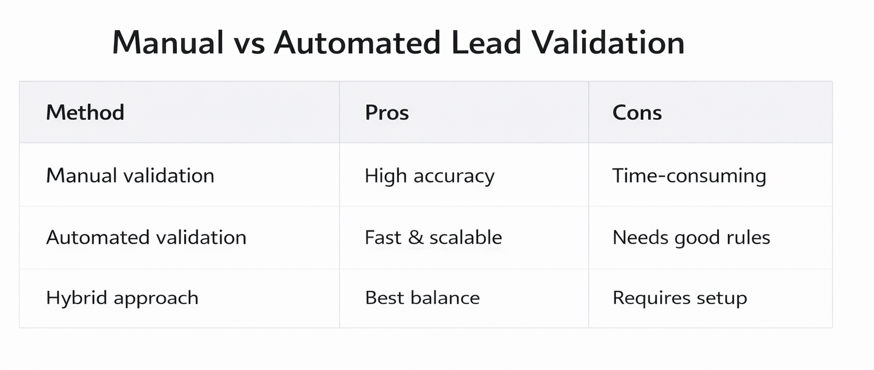
Most B2B teams use a hybrid validation model for best results.
How Content Syndication Lead Validation Impacts ROI
Validated leads result in:
Higher MQL → SQL conversion
Shorter sales cycles
Better CPL vs CAC ratio
Stronger sales confidence
Instead of chasing lead quantity, validation helps teams optimize revenue impact.
Best Practices for B2B Marketers
Define ICP clearly before campaigns
Set validation rules upfront
Reject non-matching leads
Track lead quality, not just CPL
Final Thoughts
Content syndication works best when lead validation is non-negotiable.
Validated leads protect your budget, your sales team’s time, and your brand reputation.
If you want content syndication to drive real pipeline, lead validation must be part of your core strategy-not an afterthought.

Join Seth on Peerlist!
Join amazing folks like Seth and thousands of other builders on Peerlist.
0
0
0