

From Zoom Calls to Research Reports: How Terapage's Interview Import Saves Your Team Hours
Learn how Terapage's Import External Interview feature takes your team from raw Zoom or Teams recordings to polished research reports — faster, with less friction, and better collaboration.
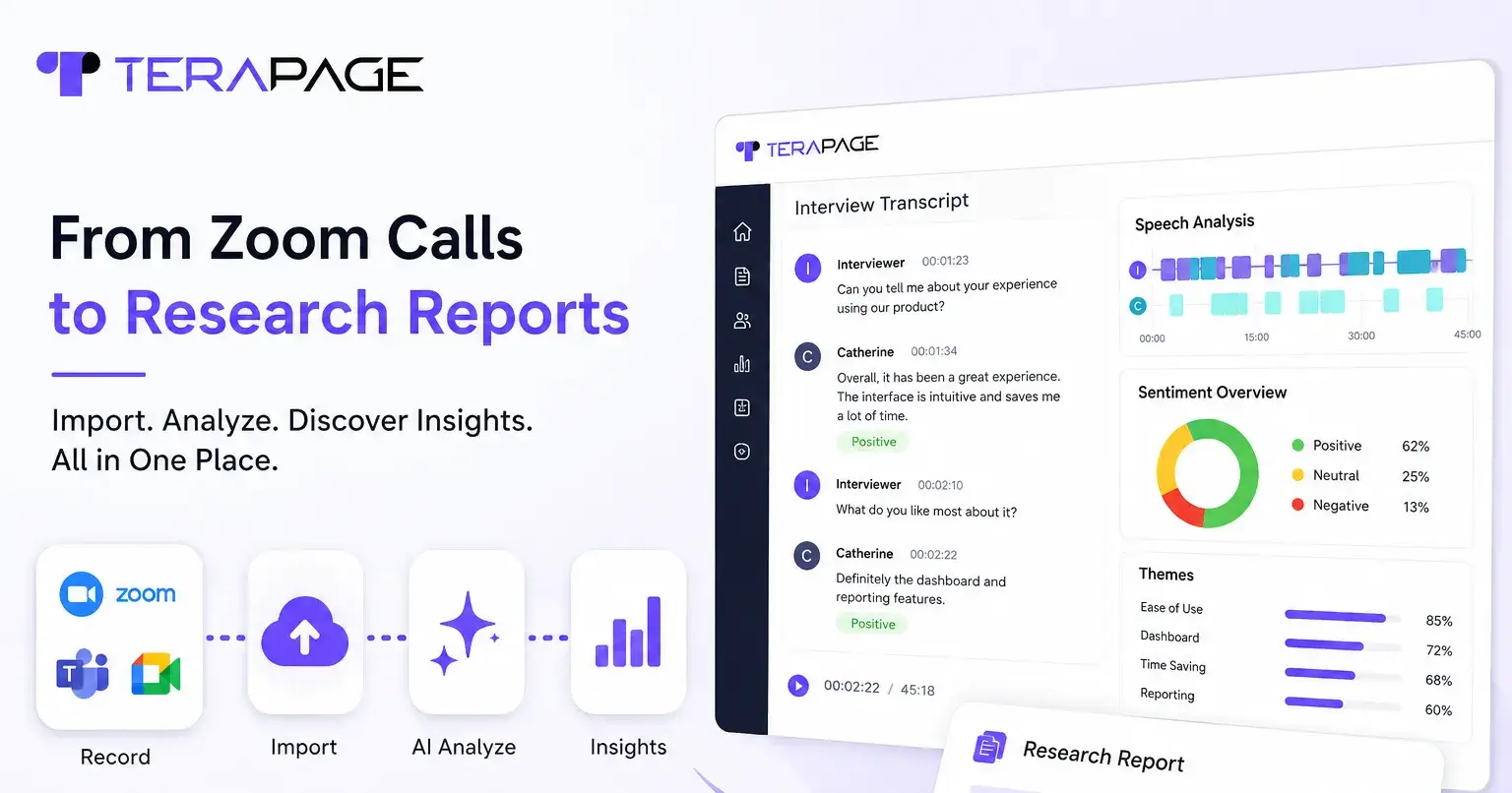
The clock is ticking.
It's 11:36 PM.
The client is waiting for the presentation to be delivered tomorrow.
Sarah, a senior UX researcher, is staring at her laptop screen, four browser tabs open, three half-eaten folders on her desktop, and a Slack thread with seventeen unread messages from her team. She finished her last Zoom interview just 4 days ago.
Twenty participants. Twenty audio recordings. Twenty transcripts are scattered across the Download folder, Google Drive, Zoom drive, etc.
She spent the past two days colour-coding and manually tagging key themes and quotes. Her colleague Jamie sent his annotations as a separate file. Tom's version has different colour codes. Nobody agreed on a tagging system. And somewhere buried in those twenty conversations is the exact insight the client is paying them to find.
This is the hidden cost of unstructured and traditional interviews, where real insights are lost in limited time constraints and human variation analysis.
The moments were nearly lost in the chaos of files, folders, and disconnected tools.
Now imagine Sarah's team had Terapage.
All twenty recordings were uploaded in minutes. In just seconds, the AI-powered tools present the word-to-word transcripts with detailed analysis containing every annotation, tag, and highlight from every team member in one shared workspace.
That's not a dream workflow anymore. That's exactly what Terapage's Import External Interview feature is built to do — and it's transforming how research teams work.
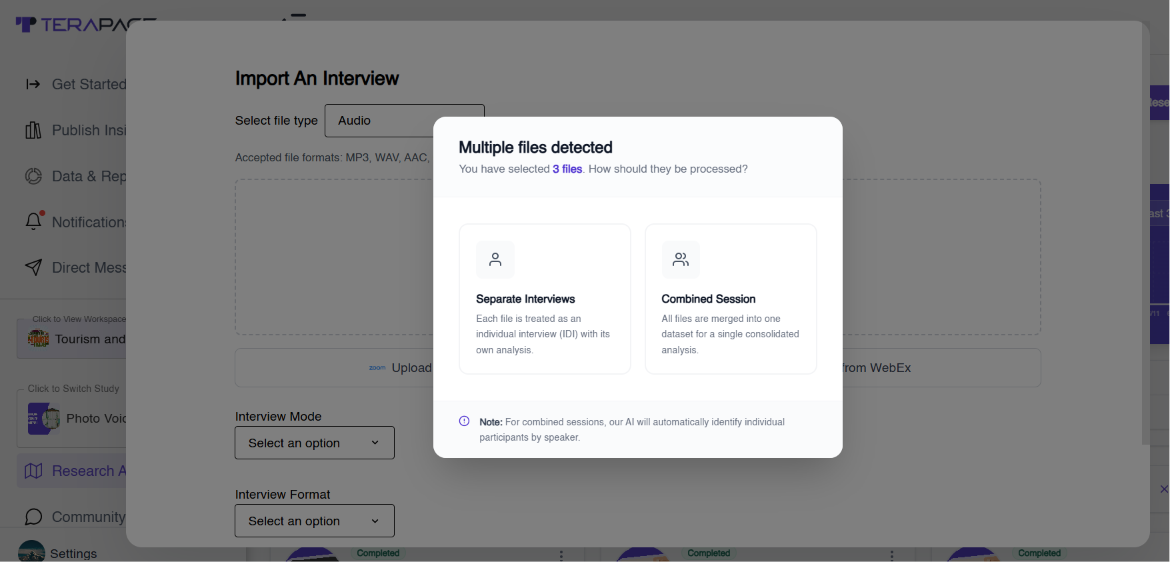
Figure 1: Terapage's Import an Interview feature intelligently detects multiple interview files and allows researchers to analyze them separately or combine them into a single dataset, making qualitative research faster, smarter, and more scalable.
The Challenge of Traditional Interview Analysis
Most research teams face similar obstacles when analysing interviews:
Hundreds of pages of transcripts
Manual coding and categorization
Time-consuming theme identification
Difficulty finding patterns across interviews
Risk of researcher bias
· Delayed reporting and decision-making
Even experienced qualitative researchers can spend countless days organising and interpreting data before extracting meaningful insights.
When deadlines are tight, this process often becomes a bottleneck.
What Is the Terapage Import External Interview Feature?
Terapage is an AI-powered online research platform built for qualitative and quantitative research teams. While it offers powerful tools for running interviews natively, researchers rarely conduct all their interviews in one place. Field interviews, Zoom calls, in-person sessions, and third-party tools all produce data that needs to be analyzed.
The Import External Interview feature bridges that gap. It allows you to bring interview data collected through
Zoom meetings
Microsoft Teams calls
Google Meet sessions
User research platforms
Customer discovery interviews
Employee feedback conversations
Focus groups
In-depth interviews (IDIs)
No more juggling files across platforms. No more losing context between tools. Everything lives in one place.
Key Features That Accelerate Your Research Workflow
1. Import Transcripts in Any Format
Terapage is a highly research-oriented platform that helps researchers to upload interview transcripts in multiple formats. It accepts .txt, .docx, .pdf, .vtt, .tsv, .json, .srt, etc. Researchers only have to upload their files into their project workspace, and they're instantly ready for analysis. This eliminates the tedious reformatting or copy-pasting that typically eats up hours of a researcher's time before any real analysis even begins.
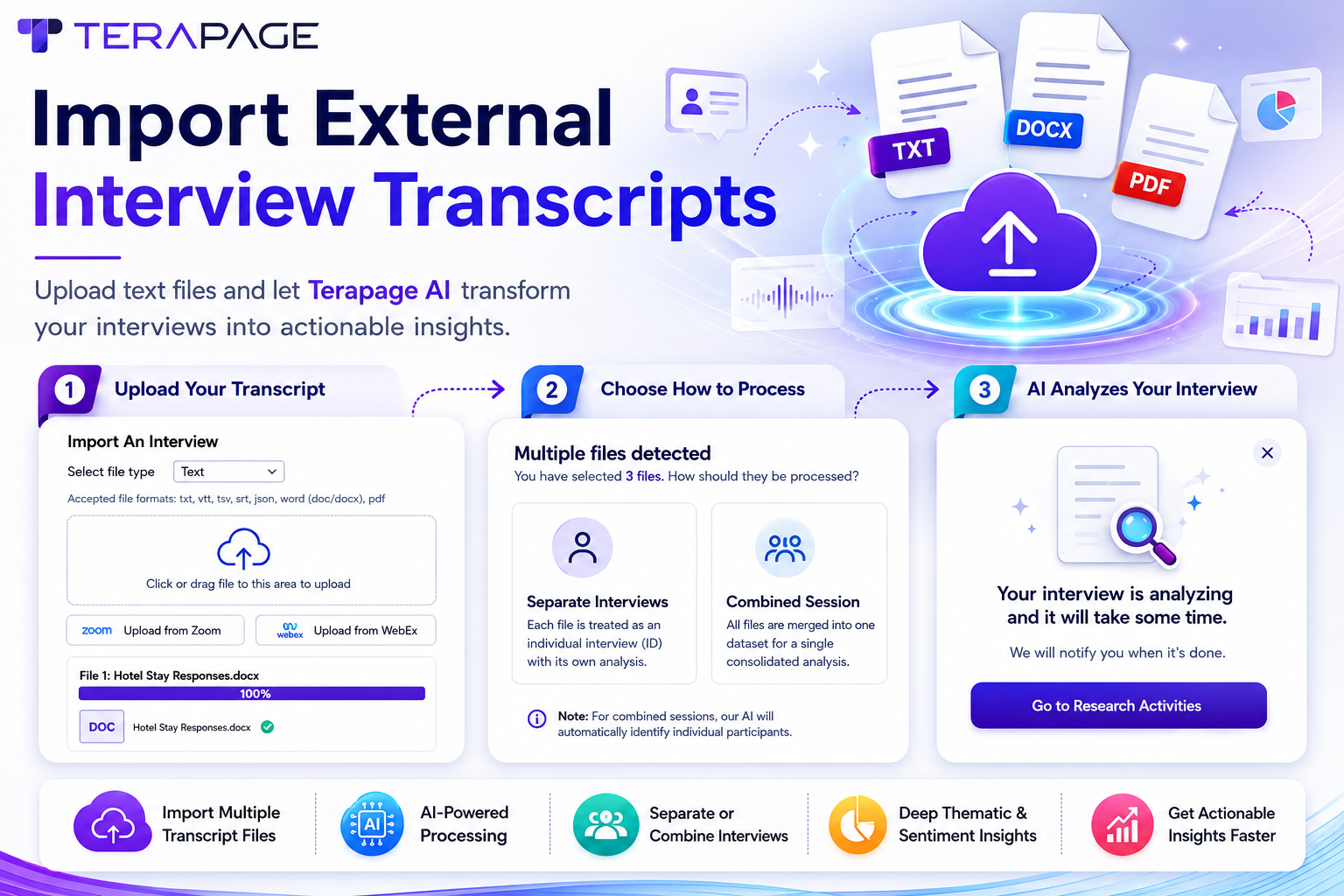
Figure 2: Step-by-step interview importing and analysis at Terapage: Researchers can upload external transcripts, audio recordings, and meeting files, choose between individual or combined interview analysis, and let AI automatically process the data.
2. No Transcript of audio and video interviews? No Problem, Terapage provides AI-Powered Transcription
The research team often struggle with audio and video interview transcripts. If your team is struggling with the same, Terapage has you covered. Simply upload your audio or video recording, and the platform's AI-powered transcription engine converts it to text automatically. This means you can go straight from a raw recording to a coded, annotated document without paying for a third-party transcription service or waiting days for manual transcripts.
For research teams managing dozens of interviews, this alone can save hours per project cycle.
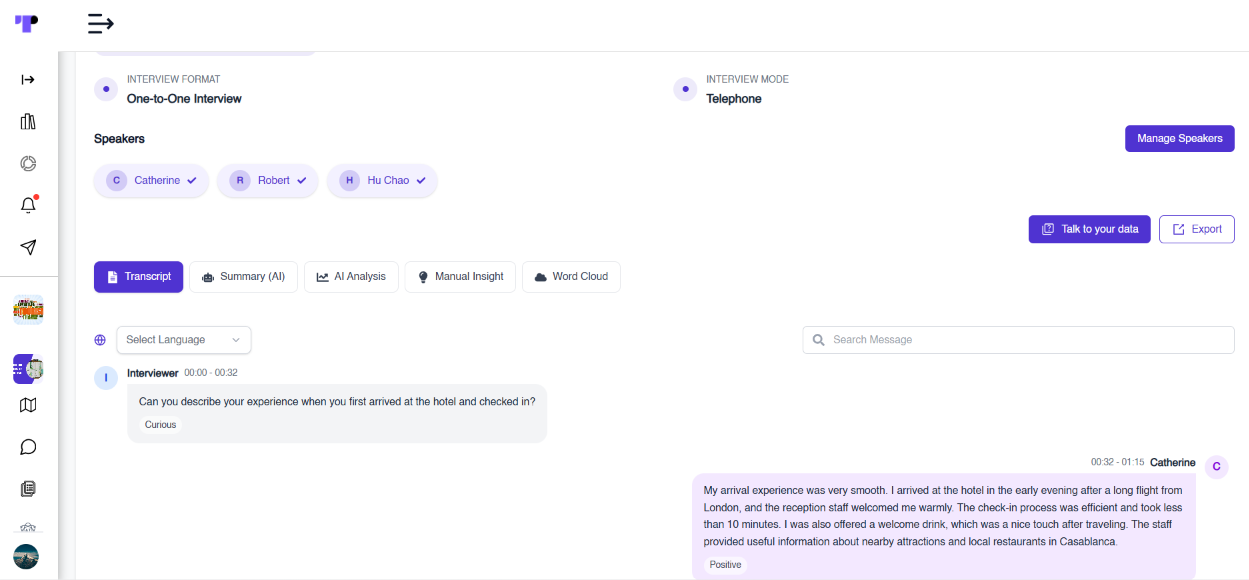
Figure 3: Terapage's AI Transcript view — speakers are auto-identified (Interviewer, Catherine), responses timestamped to the second, and sentiment tags like "Positive" and "Curious" applied in real time
3. Detailed Speech Analysis — Every Word, Every Emotion, Every Moment
Words alone don't tell the whole story. Terapage's Speech Analysis visualises your entire recording as a colour-coded interactive timeline — click any segment and instantly jump to that exact transcript moment. No scrubbing. No guessing. No replaying recordings from the start. Every speaker, every pause, every exchange — mapped visually across the full length of your interview.
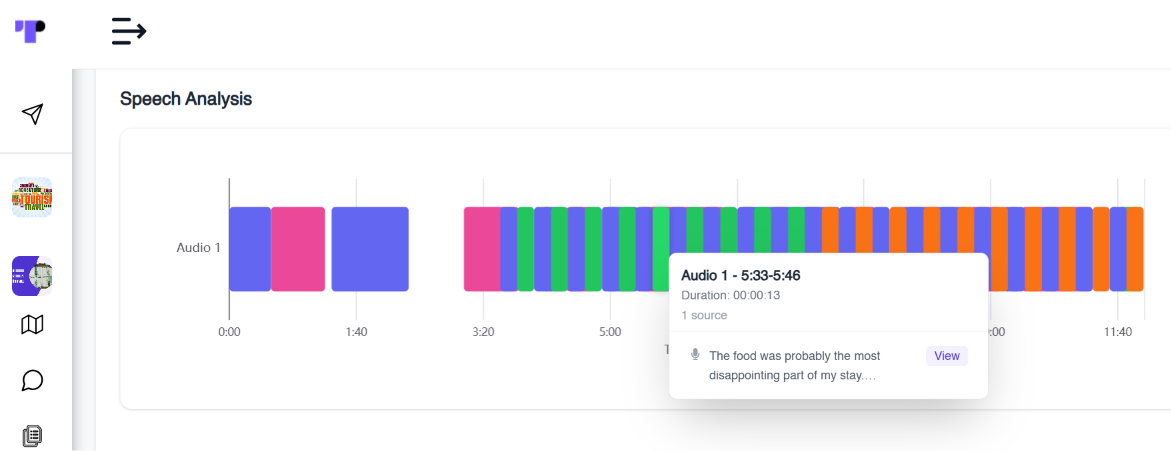
Figure 4: Terapage's Speech Analysis dashboard — colour-coded speaker segments mapped across the full recording timeline. Click any block to instantly surface the exact transcript excerpt, timestamp, and source.
4. Real-Time Translation Across 138 Languages — Research Without Borders
Global research teams no longer need separate translators. Terapage translates your entire interview transcript in real time — directly inside the platform — across 138 languages, including Chinese Mandarin Simplified, Cantonese Traditional, Mandarin Traditional, and beyond. Switch languages from the transcript view instantly using the language selector. Your participant's original response in English transforms into flawless Mandarin with one click — sentiment tags and speaker labels fully preserved. Whether your participants speak Arabic, French, Japanese, or Swahili, every voice is accessible to every team member, anywhere in the world. True global research, finally without the language barrier.
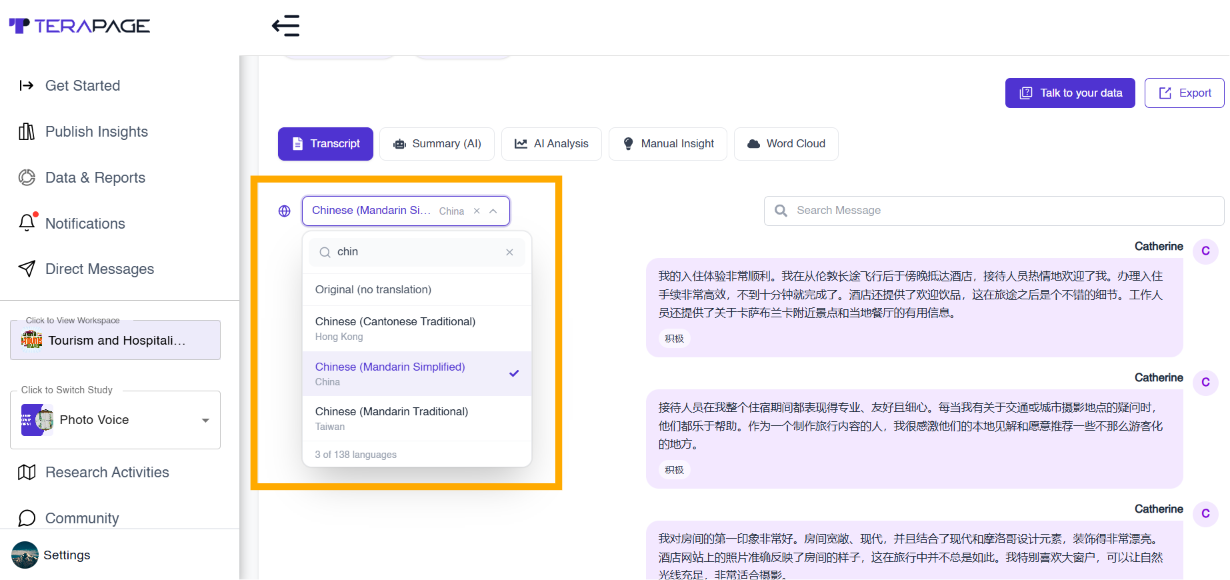
Figure 5: Terapage's real-time translation in action — Catherine's English responses instantly translated into Chinese Mandarin Simplified, with sentiment tags fully preserved. The language selector supports 138 languages. One Click, Zero External Translation.
5. Manage Speakers — Full Control Over Who Gets Analysed
Multi-speaker interviews introduce a common research headache: you don't always need every voice in your analysis. Terapage provides full control to research teams in managing their participants for analysis. They are at liberty to include or exclude any participants under the managed speakers option. Save changes and your transcript, sentiment tags, and analysis views update immediately to reflect only the voices that matter. Precise, clean, focused analysis — exactly the way your research requires it.
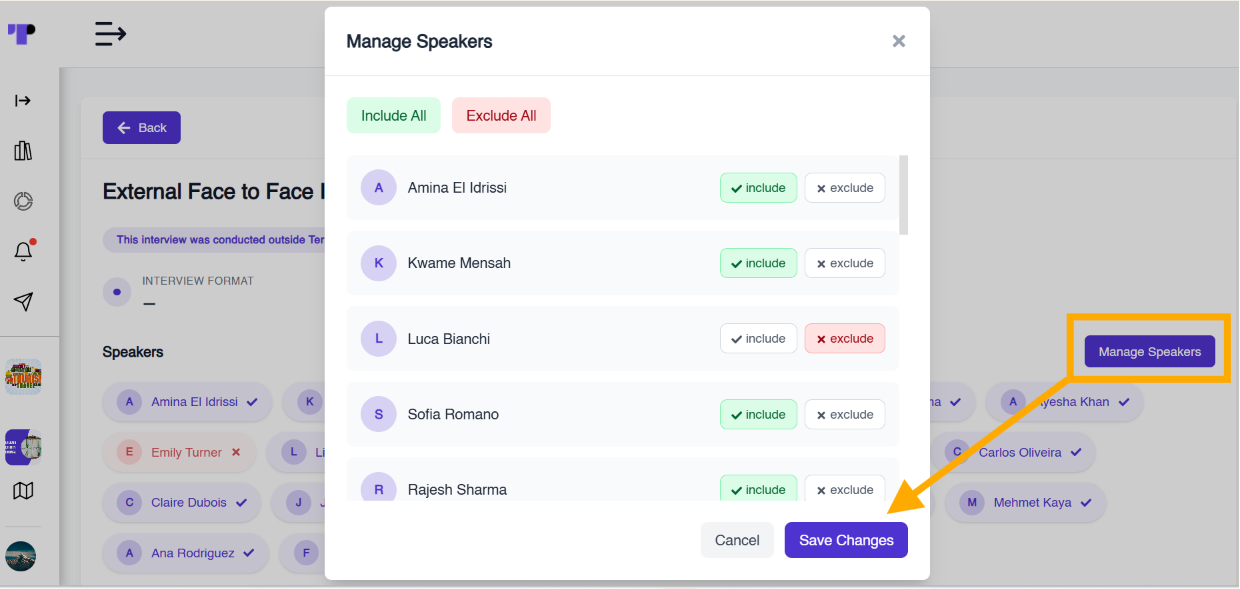
Figure 6: Terapage's Manage Speakers panel — researchers can include or exclude any speaker individually, or use bulk Include All / Exclude All controls.
6. Automatic Sentiment Analysis — Know How They Felt, Not Just What They Said
Understanding how participants feel is just as important as understanding what they say. Terapage’s Import External Interview feature automatically analyses participant sentiment and emotional tone throughout interviews.
Researchers can quickly identify:
Positive reactions
Negative experiences
Frustration points
Satisfaction drivers
Emotional triggers
Areas requiring attention
This allows organisations to better understand customer experiences and prioritise improvements based on real feedback.
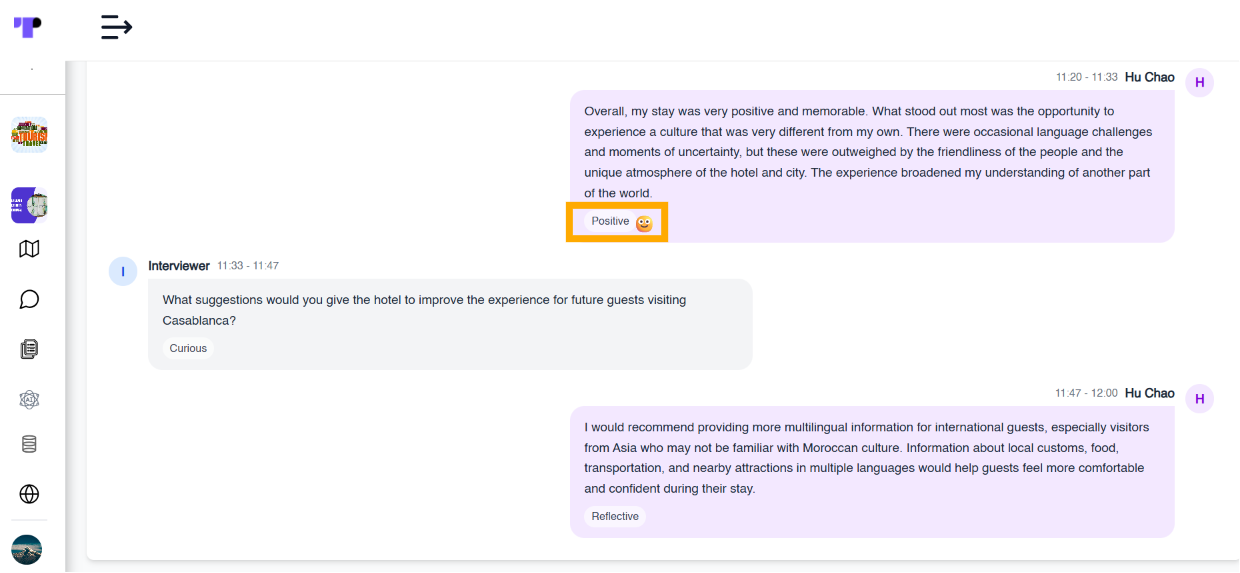
Figure 7: Terapage performs individual sentiment detection for every participant response within an interview transcript, automatically identifying the emotional tone, attitude, and intent behind each statement to provide researchers with deeper, response-level
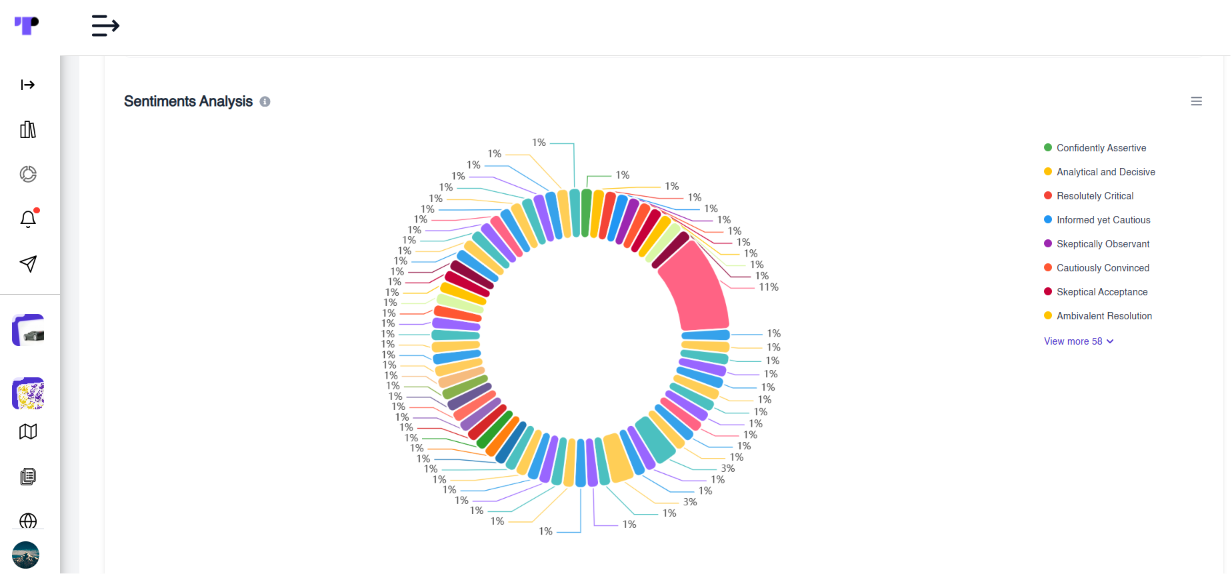
Figure 8: Terapage transforms combined interview transcripts into detailed sentiment maps, enabling researchers to explore complex emotions, participant perceptions, and behavioural drivers through automated AI-powered qualitative analysis.
7. Code, Tag, and Extract Key Insights
Once the transcripts are uploaded in Terapage, the real analytical work begins. The platform provides robust coding and tagging tools that let you highlight key sections, apply thematic codes, and extract meaningful quotes or excerpts, all within the same interface.
This replaces the colour-coded highlighter chaos of Word documents and the complexity of spreadsheet-based analysis frameworks. Instead, your entire coding structure is organized, searchable, and shareable directly inside Terapage.
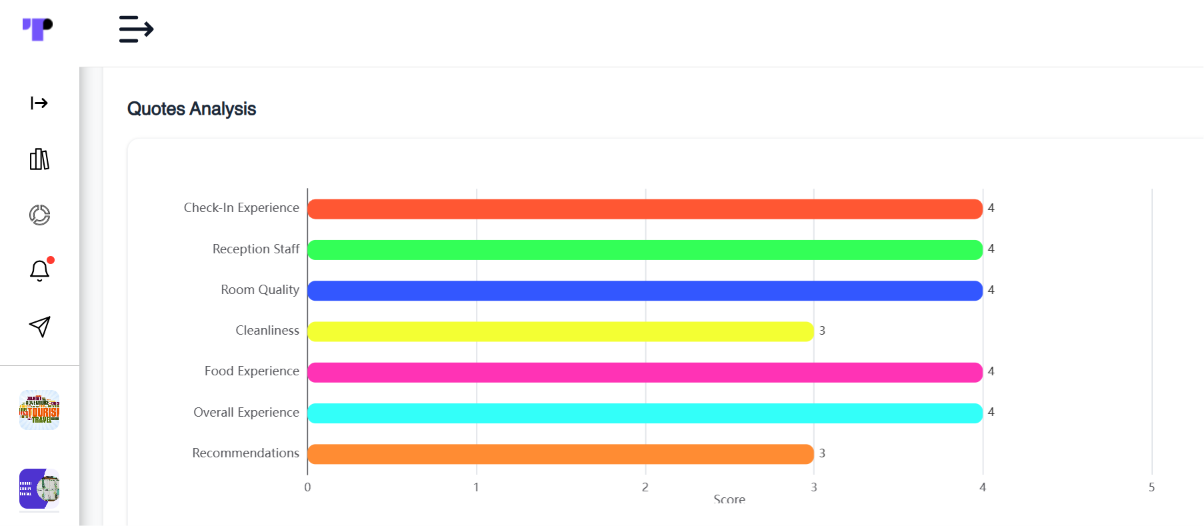
Figure 9: From raw transcripts to actionable insights, Terapage's quote analysis feature visualizes thematic frequencies, helping researchers understand what matters most to participants at a glance.
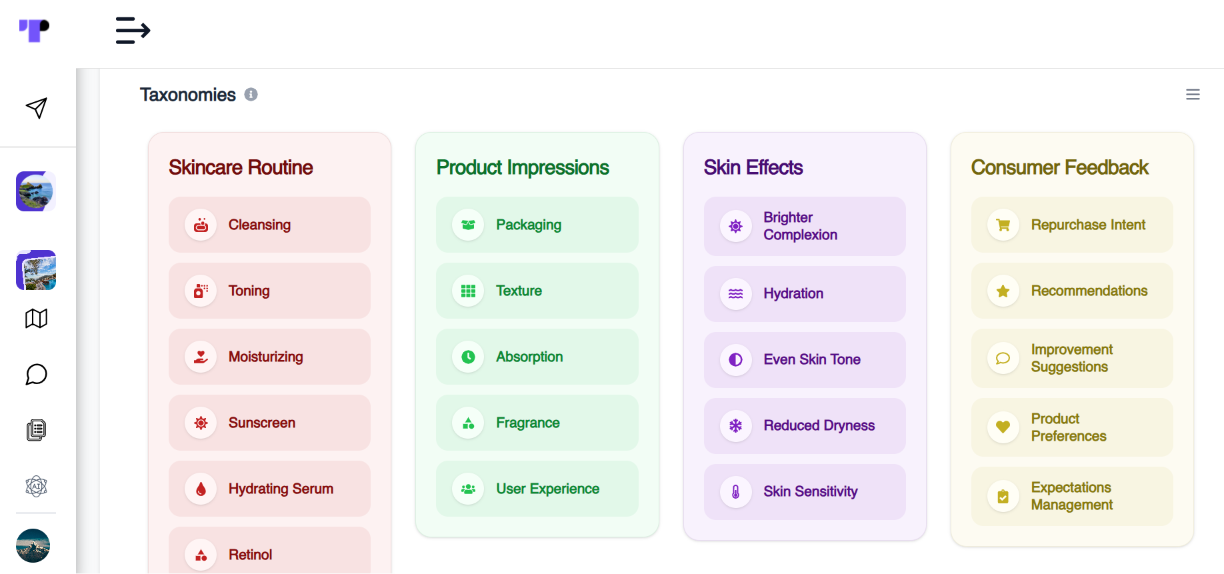
Figure 10: AI-powered taxonomy generation at Terapage automatically organizes interview responses into structured themes and categories, accelerating qualitative analysis and insight discovery.
8. Real-Time Team Collaboration
Qualitative research is rarely a solo sport. Terapage's interview import feature is built for team-based research workflows. Multiple team members can annotate the same transcript, leave comments, flag key moments, and vote on emerging themes all in real time.
This is a game-changer for research teams working across time zones or departments. Instead of emailing a marked-up document and waiting for feedback, your whole team works together inside a single source of truth.
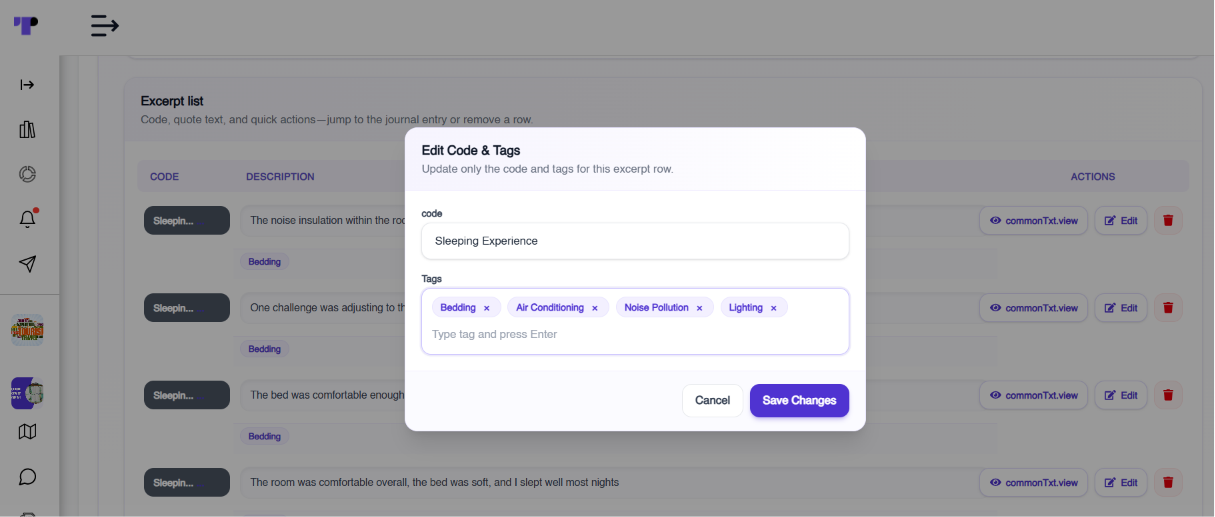
Figure 11: Beyond AI-powered coding, Terapage allows researchers to manually create, edit, and assign codes and tags to interview excerpts, ensuring greater analytical accuracy, methodological rigor, and deeper qualitative insights.
Who Benefits Most from This Feature?
· Market Research Agencies managing client interview programs across multiple platforms
· UX and Product Teams running user interviews on Zoom or in-person and needing a central analysis hub
· HR Departments conducting exit interviews and tracking themes over time
· Academic Researchers collecting field interviews and needing collaborative coding tools
· Consulting Firms synthesising insights from stakeholder interviews across projects
Get Started with Terapage's Import External Interview Feature
Collecting interviews is only the first step in qualitative research. The real value comes from transforming conversations into meaningful insights.
If your research team is still spending more time organizing interview data than analyzing it, it's time for a better workflow. Terapage's Import External Interview feature is designed to eliminate the friction between data collection and insight generation — so your team can focus on what actually matters: understanding your audience.
Try the Import External Interview feature on Terapage.

Join Shehzadi on Peerlist!
Join amazing folks like Shehzadi and thousands of other builders on Peerlist.
0
0
0