

How the Internet Works: A brief introduction to the history and the key components of the internet—Part 1
Understand the origin, architecture, and key components that power the internet

The internet is a massive network of interconnected machines, connected to each other through a system of hardware and software, that allows them to share data among each other. You can imagine the internet as a giant web of machines chatting with each other.
Today, the Internet lets billions of people connect, serves as the backbone of countless multi-million dollar businesses, and allows you to consume brain rot content from all over the world.
As of 2024, approximately 402.74 million terabytes of data were created, captured, copied, or consumed daily. Video content alone accounts for 53.72% of all internet data traffic. YouTube alone hosts over 720,000 hours of videos daily, which adds up to about 4.3 petabytes (PB) of data. Pretty impressive, right?
As software engineers, we should all know this concept, but it has many details and complexities. As developers, we mostly work on data transfer and optimization, which involves understanding protocols, data formats, and the efficiency of algorithms used in these processes. This article is a simplified and high-level version of how the internet works, which should be the gateway to even more depth for us to explore later on. The possibilities are boundless.
A Brief Journey Through the History of the Internet
The history of the Internet is a fascinating journey of how it came to be with decades of research. The US military demonstrated its nuclear prowess to the world during World War 2, particularly with the bombing of Hiroshima and Nagasaki in 1945. However, the Soviet Union launched Sputnik 1, the world's first artificial satellite, into orbit on October 4, 1957. To ensure that the United States doesn't fall behind in the technology race, the US military established an institution called ARPA (Advanced Research Project Agency) to fund and manage all science and technology research projects in the country.
ARPANET was one such project created by the US Department of Defense during the 1960s, during the Cold War, with the purpose of serving as a communication network that could survive a nuclear attack. Initially, the US Department of Defense connected only a few computers from various university complexes across the country to share research work. What made ARPANET quite revolutionary in its advent was the availability of packet switching. This process involves breaking the data into small pieces that can travel through different routes to reach their destination—much like multiple delivery trucks taking different roads to deliver packages to the same location. These multiple checkpoints
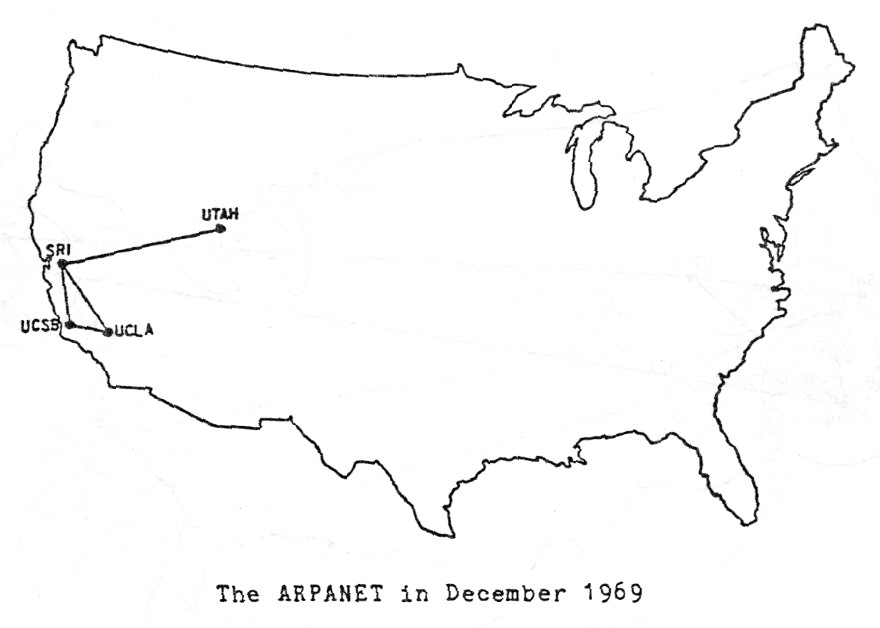
Slowly, after multiple iterations, in 1983, ARPANET officially switched to TCP/IP (Transmission Control Protocol/Internet Protocol)—imagine this step as the moment when everyone agreed to speak the same language. The Domain Name System (DNS) arrived in 1985, allowing us to use memorable website names instead of number sequences, similar to using street addresses instead of geographic coordinates.
A major breakthrough came in 1989 when Tim Berners-Lee invented the World Wide Web at CERN. The Web made the internet accessible to everyday people by introducing websites, hyperlinks, and browsers, which we use to this day.
You can read more about the history of the internet here: https://www.vox.com/a/internet-maps
Components of a network
Before we dive in, let's quickly review some of the important elements of the network that will help us understand the internet better.
Network Edge
In networking, the network edge means the outer part of a network where end devices or local networks connect to the broader internet or to another network. These devices are also called hosts.
It is essentially the boundary closest to users and devices, unlike the network core, which handles transport and services deeper inside the network. The host machine includes laptops, desktops, mobile devices, IoT devices, etc.
There are two different types of host machines—the client and the server. A client is essentially a machine that requests data from a server, while a server is a machine that provides this data to the client.
While client machines these days are powerful, the servers are much more powerful since they store and distribute data, stream videos, serve web pages, relay emails, etc. These servers reside in large data centers. These data centers can contain thousands of interconnected servers serving as the backbone of many internet services we use daily.
Access Networks
An access network is the part of the network that connects an end device, like your laptop or phone, to the first router on the path toward the internet, often an ISP’s edge router. There are three main types of access networks:
Home Access Network: This network enables the connectivity between devices in a residential environment, e.g., your laptop, phone, etc. They typically use technologies like DSL, fiber optic cables, and cable internet.
Institutional Access Network: This network enables the connectivity between devices in a large organization or business. This type of system is a highly optimized network consisting of multiple routers, high-speed fiber optic cables, and devices used to support multiple users and data-intensive applications.
Mobile Access Network: This network enables our smartphones to connect to the internet. This includes technologies like cellular connectivity, 5G networks, etc.
Network Core and Packet Switching
The network core consists of an interconnected network of routers whose main job is to forward a packet of data from one point to another efficiently.
Whenever we're consuming or sending data, it doesn't go to the destination in a single continuous stream. It gets broken up into pieces, also known as a data packet. Each data packet consists of three important parts: a source, a destination, and a portion of the data.
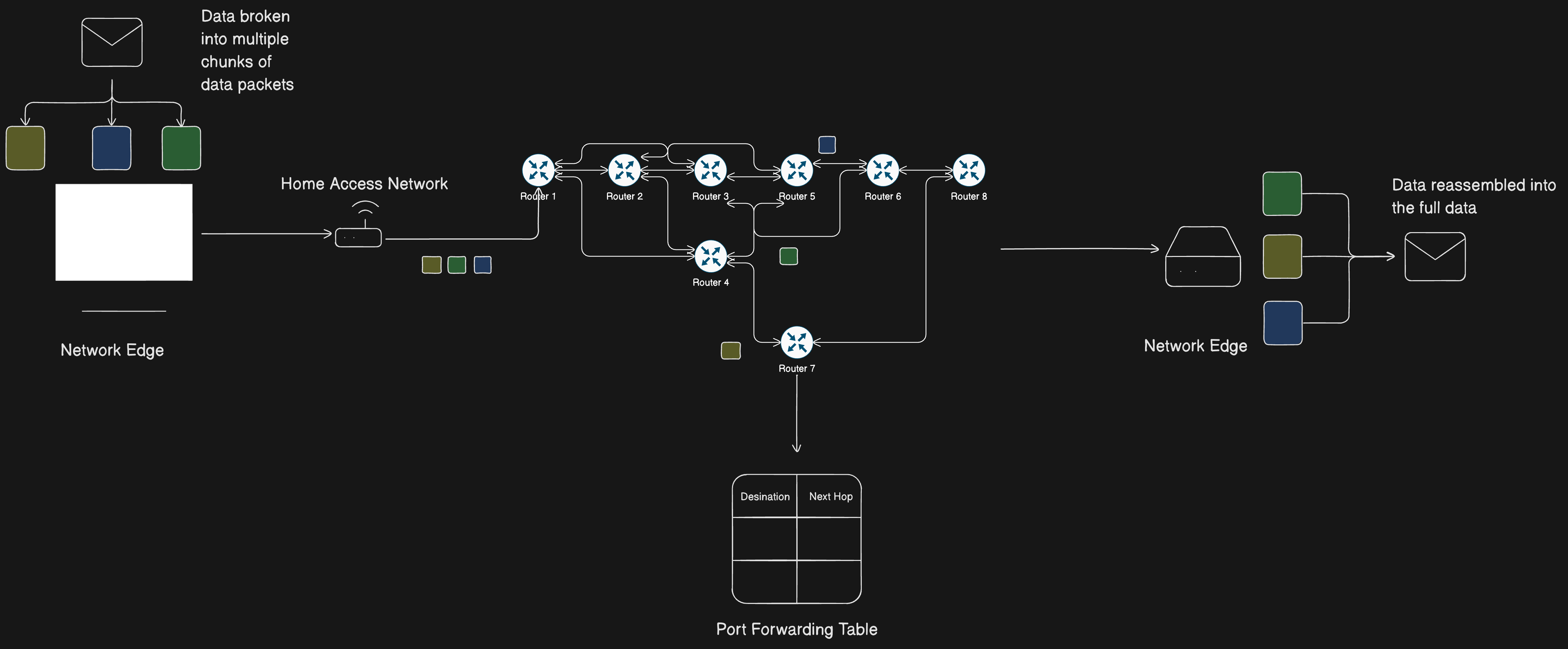
Each packet of data travels independently through the routers, and once all the data packets arrive at the destination, the data packets are reassembled into the final message. This has two key advantages:
This method allows the network to handle multiple communications simultaneously and efficiently.
This also provides resilience to the network; in case a route is congested or fails, the data can be routed through another route.
There are two key functions performed inside a network core:
Forwarding: This is the action of moving a data packet from one link to another, which is done via a port forwarding table inside each router. Based on the destination of the data packet, a router forwards the packet to the next router based on the entry in the forwarding table.
Routing: This technique is the global process of determining the packet's journey from the source to the destination. This is done via an algorithm that calculates the shortest and the most efficient path between a source and the destination.
Network Protocols
A network protocol defines the set of rules that govern the messages used for communication between a client and a server. This can be thought of as the language and the grammar via which two machines communicate, e.g., TCP/IP, UDP, HTTP/HTTPS, etc.
This, however, is a big topic in itself, and we will understand this in a future article.
You can check out the various components of networks in-depth in this video: https://www.youtube.com/watch?v=sMHzfigUxz4
Conclusion
The Internet is both a technical marvel and a living system: a vast, layered collection of hardware, protocols, software, and human effort that has evolved from academic experiments into the global platform we rely on today. At its core are simple ideas—addressing, routing, reliable data transfer, and standard formats—that, when combined, enable everything from low-latency messaging to streaming petabytes of video every day. Understanding the history helps explain why the Internet is designed the way it is, and recognizing the key components (physical links, routers/switches, DNS, TCP/IP, HTTP, CDNs, and application-layer services) gives you the mental model needed to reason about failures, performance, and security.
In the next article we will look at IP addresses, URLs, and what happens when we enter the URL of a website in our browser.

Join Shivayan Anand on Peerlist!
Join amazing folks like Shivayan Anand and thousands of other builders on Peerlist.
2
7
0