

The End of the Web: From HTML Pages to AI-Driven Interfaces
We don't think about the web anymore the way we did ten years ago.
Once, searching meant typing a phrase, clicking a link, and manually digging through page after page of HTML. Today, I start by asking an AI: “Find the best budget gaming laptop under ₹80,000 with 16 GB RAM and good battery life.” Within seconds, I get a concise comparison — specs, pros and cons, and recommendations — without opening a single tab.
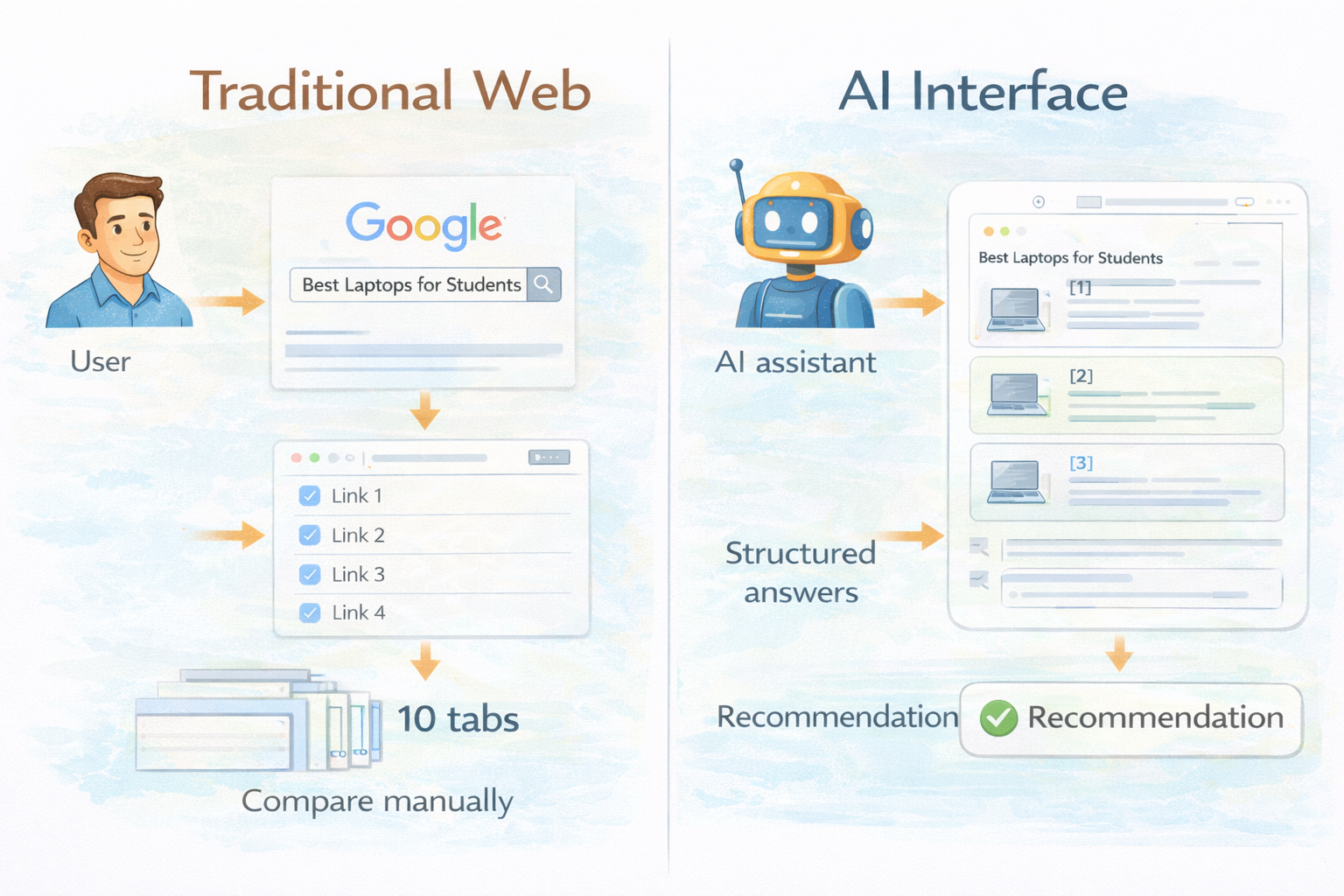
This shift isn’t just convenience. It’s pointing to something deeper: the way we access information is changing fundamentally — and our current web infrastructure, built around HTML, might no longer be the best fit for an AI-driven future.
HTML Was Designed for Humans — Why Machines Struggle
HTML was never meant to be a language that machines would understand semantically. It tells a browser how content should appear — which heading is large, which word is bold — but it doesn’t explain what the content means. For machines, interpreting meaning requires scraping, pattern recognition, and some degree of guesswork. That’s manageable at a small scale, but inefficient when AI agents become the default interface.
Imagine you’re building a travel comparison tool. A human might scan three airline sites and compile prices. An AI agent must scrape HTML from each page, interpret table rows as prices, extract contextual links such as “₹2000 discount code,” and synthesize these into structured insights. That’s a lot of overhead — especially when the goal is to answer a question accurately and quickly.
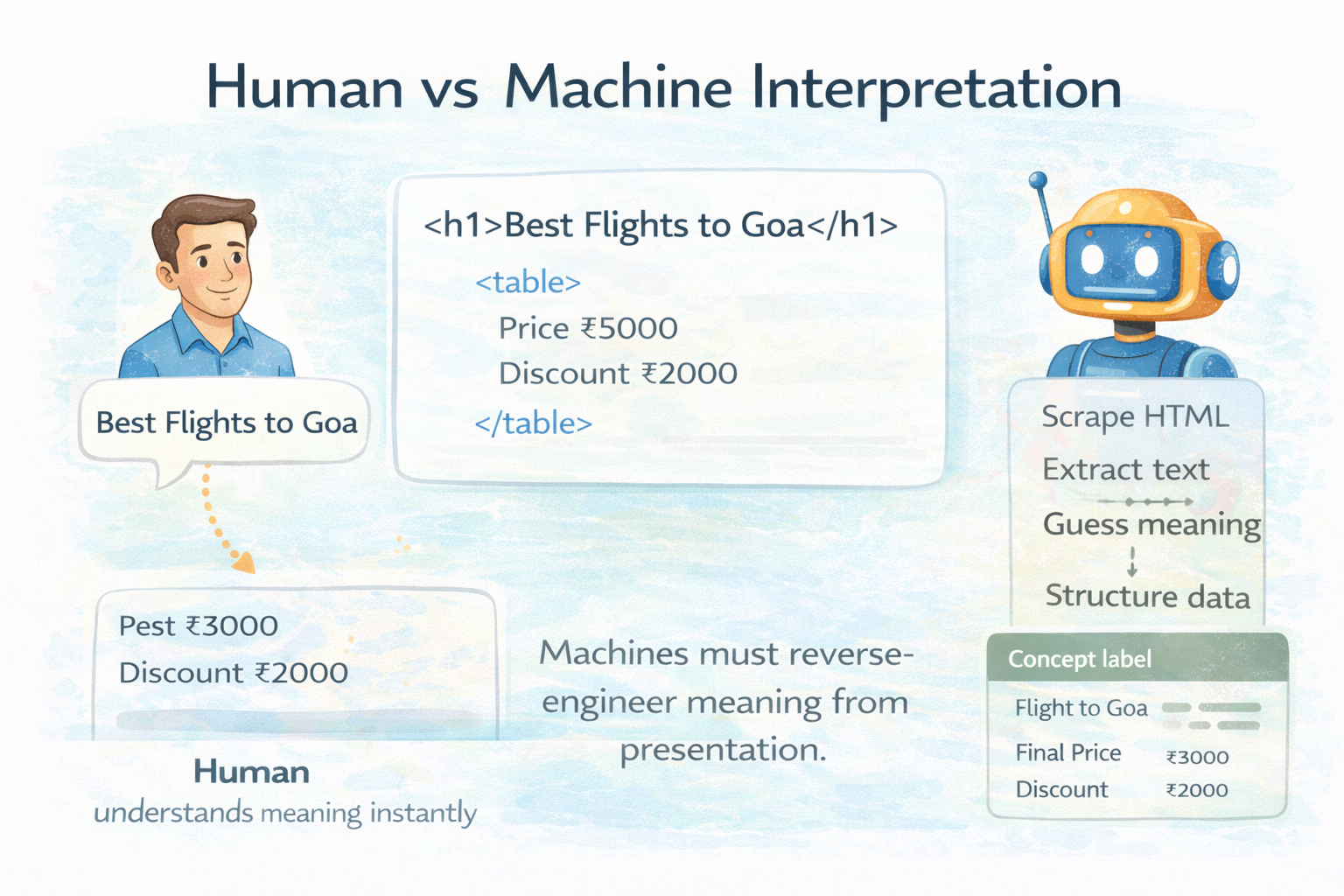
Structured data — schemas, JSON-LD, microformats — partially helps. But even years after their introduction, most sites either don’t implement them or do so inconsistently, meaning AI still has to infer their meaning.
AIDI: A New Interface for a New Era
To understand why AIDI matters, it is helpful to examine what changes at the technical level.
Today, when you visit a website, the server returns an HTML page—headings, paragraphs, layouts, buttons, and styling. All of this is optimized for human reading. Machines have to reverse-engineer meaning from a presentation.
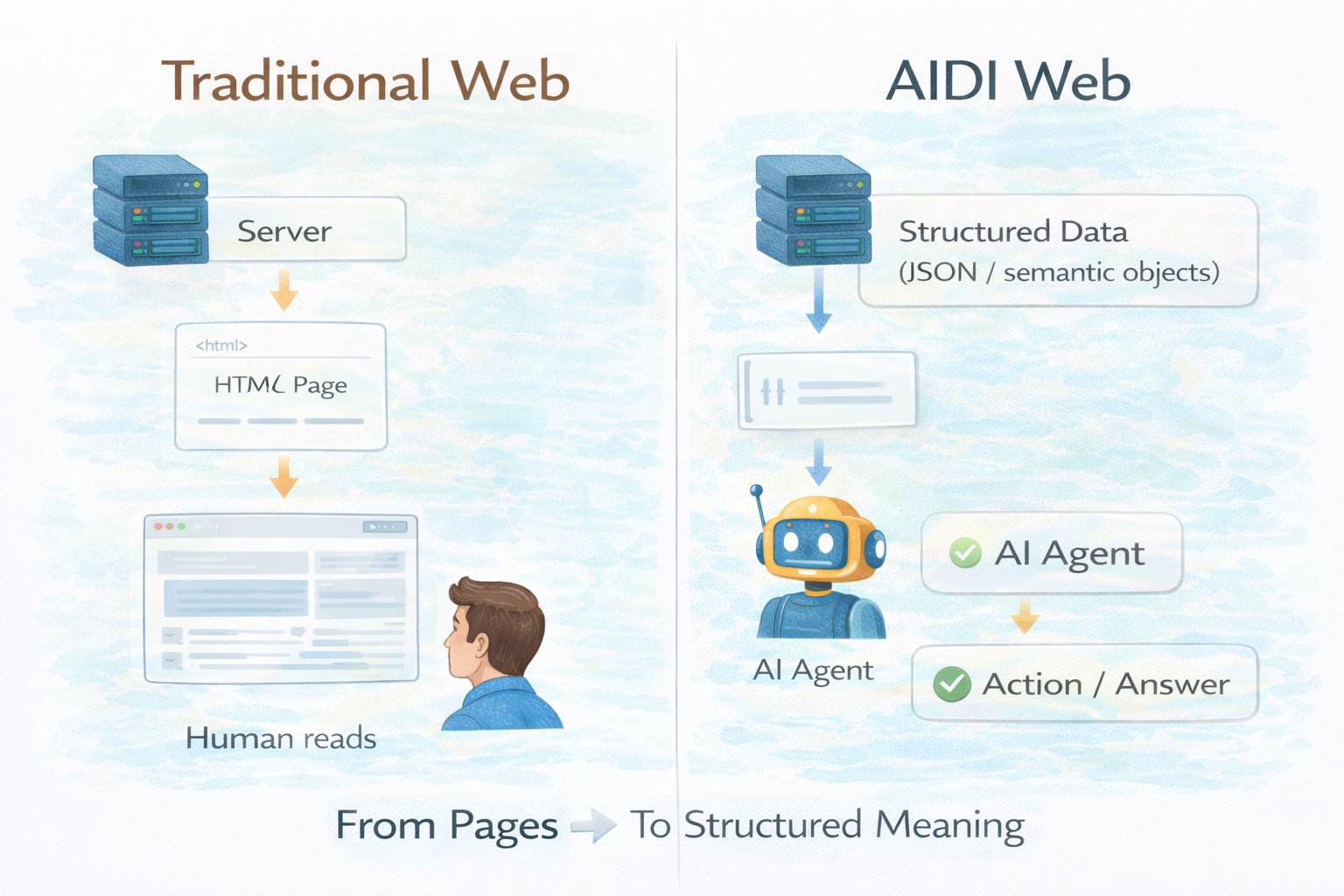
In an AIDI-driven future, the response could look very different.
Instead of sending a full page, a server might return pure, structured meaning, something like:
There’s no layout. No decoration. No guessing.
For an AI agent, this is instantly usable. It knows exactly what each value represents and can compare it with thousands of similar responses without scraping or interpretation.
This is the quiet but powerful shift AIDI introduces: the web stops sending pages and starts sending facts.
That distinction changes everything.
What AIDI means for designers, builders, and creators
AIDI isn’t a programming language in the traditional sense. It’s an AI-native interface: a blend of natural language, structured meaning, and contextual design. Instead of writing code to place elements on a page, you express intent — and the system generates the experience dynamically.
This feels familiar if you’ve worked with prompt engineering. In a way, you’re shifting from markup that tells a browser what to show to intent that tells a machine what you want to accomplish. In that sense, AIDI is a hybrid of data modeling and conversational design.
Adaptive engines and personalized data streams make interfaces feel almost organic — responsive not because of buttons and menus, but because they understand you.
Less Browsing, More Intent
When intent replaces navigation, three things change almost immediately:
Less browsing
You no longer hop between dozens of sites. You express intent once.Silent commerce
AI agents can complete purchases on your behalf — sometimes without you ever seeing a store page.Data-first experiences
Interfaces respond to user input, not to where you click.
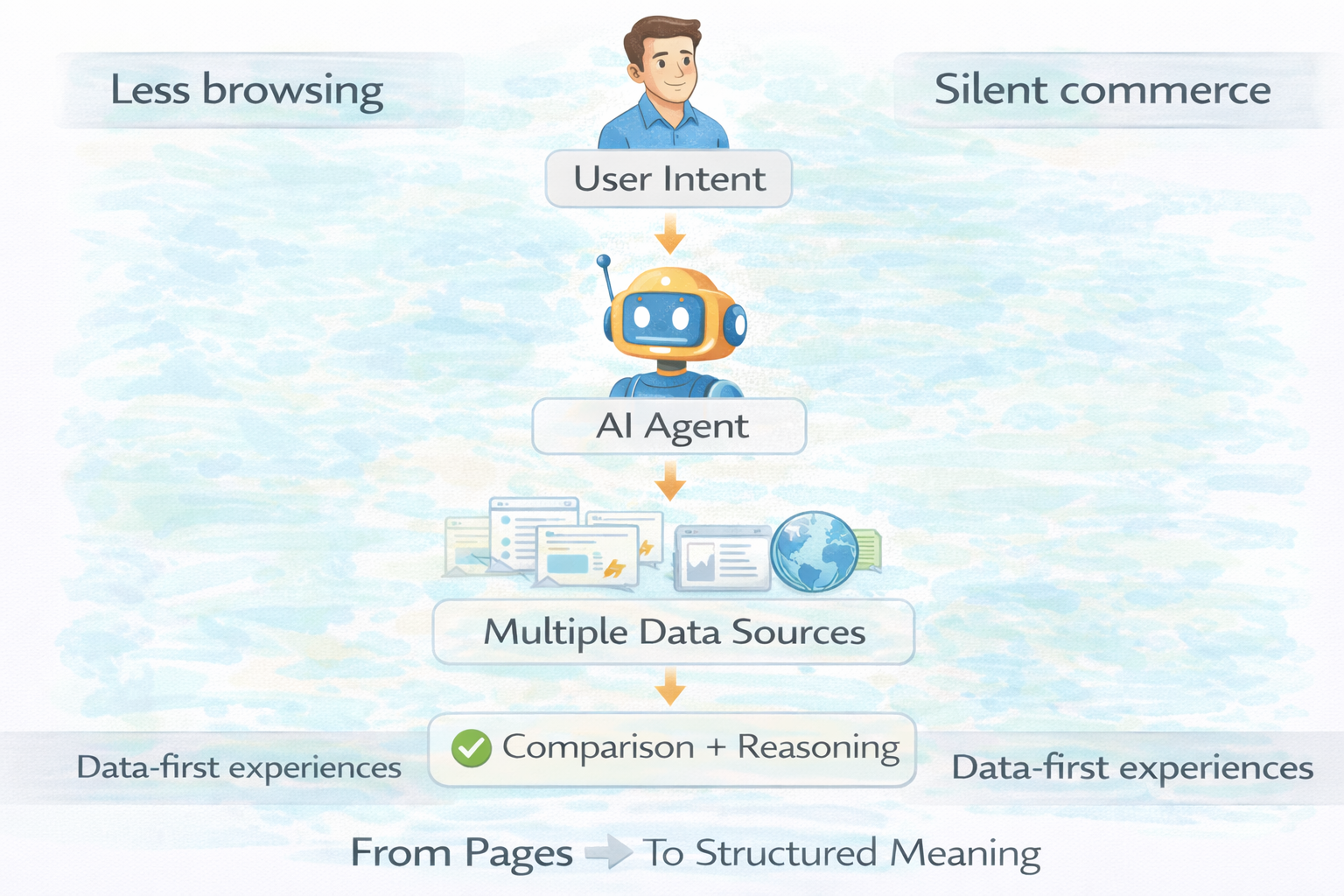
This doesn’t mean the internet disappears. It means access becomes invisible.
Websites still exist, but they may no longer be the primary surface through which we interact with digital services.
Do Humans Lose Out? Not Really
This is an important clarification.
AIDI doesn’t kill the web — it rebalances it.
Humans still want:
Beautiful articles
Thoughtful blogs
Interactive tools
Games, communities, social feeds
All of these thrive on HTML, CSS, animation, and visual storytelling.
But when the task is:
Finding information
Comparing options
Making decisions
AIDI becomes the backbone.
A simple way to think about it:
HTML pages = human-friendly stories
AIDI = machine-friendly facts
Both layers can coexist. But AI agents will naturally default to structured data because it’s faster, cleaner, and more reliable — especially for commerce, search, and personal assistance.
AI Agents Are Getting Smarter — And More Autonomous
Already, AI assistants can answer complex queries like:
Show me three retreats in Goa with yoga classes and sea views for under ₹15,000/night.
Instead of providing URLs, they provide structured answers. Soon, these agents could operate in the background — automatically tracking price drops, negotiating bookings, managing routine tasks, even initiating actions on your behalf.
It’s not far-fetched. Consider how digital wallets automatically apply coupons or how smart assistants suggest calendar slots — agents already cross-reference data on your behalf. AIDI accelerates this trend.
Silent Commerce and Shifting Business Models
One of the most intriguing implications: silent commerce.
In an AIDI world, you might never visit a retailer’s site again. Instead, your AI agent could handle choice, checkout, and delivery — all through structured data feeds. That’s a massive shift from web traffic-driven economics:
Page views and ads could matter less
Revenue might come from data access agreements or pay-per-query models
Brands may need to compete not for SERP rank, but for agent trust and data quality
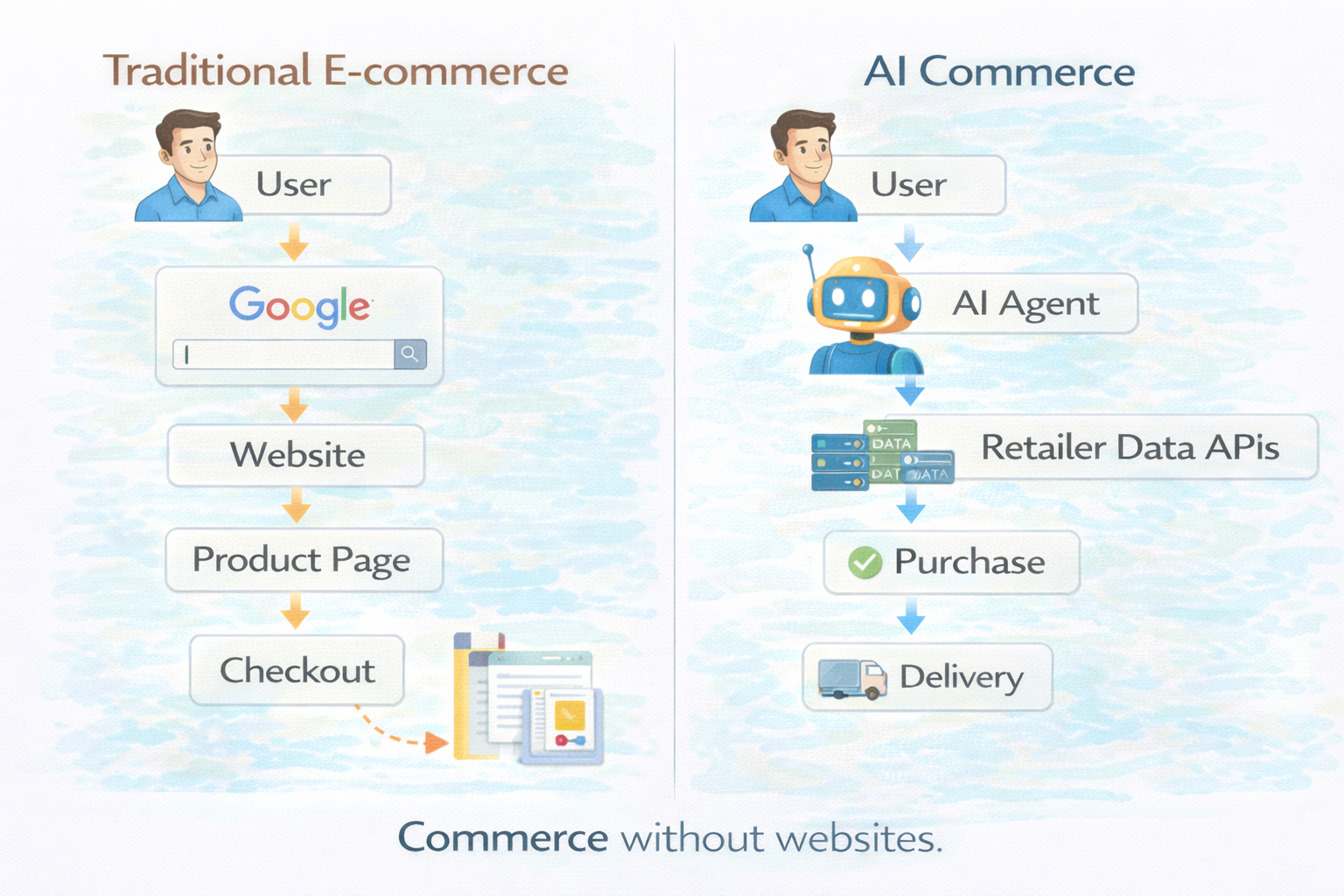
This is early speculation, but the direction is clear: as AI becomes the primary decision interface, traditional ad-based models may struggle to adapt.
The Challenges We Can’t Ignore
Of course, this future isn’t frictionless.
If AI agents become the primary consumers of data, three big questions emerge:
Standards
Who defines AIDI protocols? Who ensures interoperability?Security & Privacy
How do we protect structured data from misuse, scraping, or manipulation?Trust
How do AI agents verify that data is accurate, up-to-date, and authentic?
These aren’t edge cases — they’re foundational questions for an agent-driven internet. Without answers, efficiency can quickly become fragile.
The Paradox of Simplicity
AIDI makes interaction feel effortless — but that ease is deceptive.
In the HTML era, complexity was visible: tangled markup, CSS hacks, sprawling JavaScript. With AIDI, that complexity doesn’t disappear; it retreats. It lives inside models, semantic layers, and inference systems that interpret intent rather than clicks.
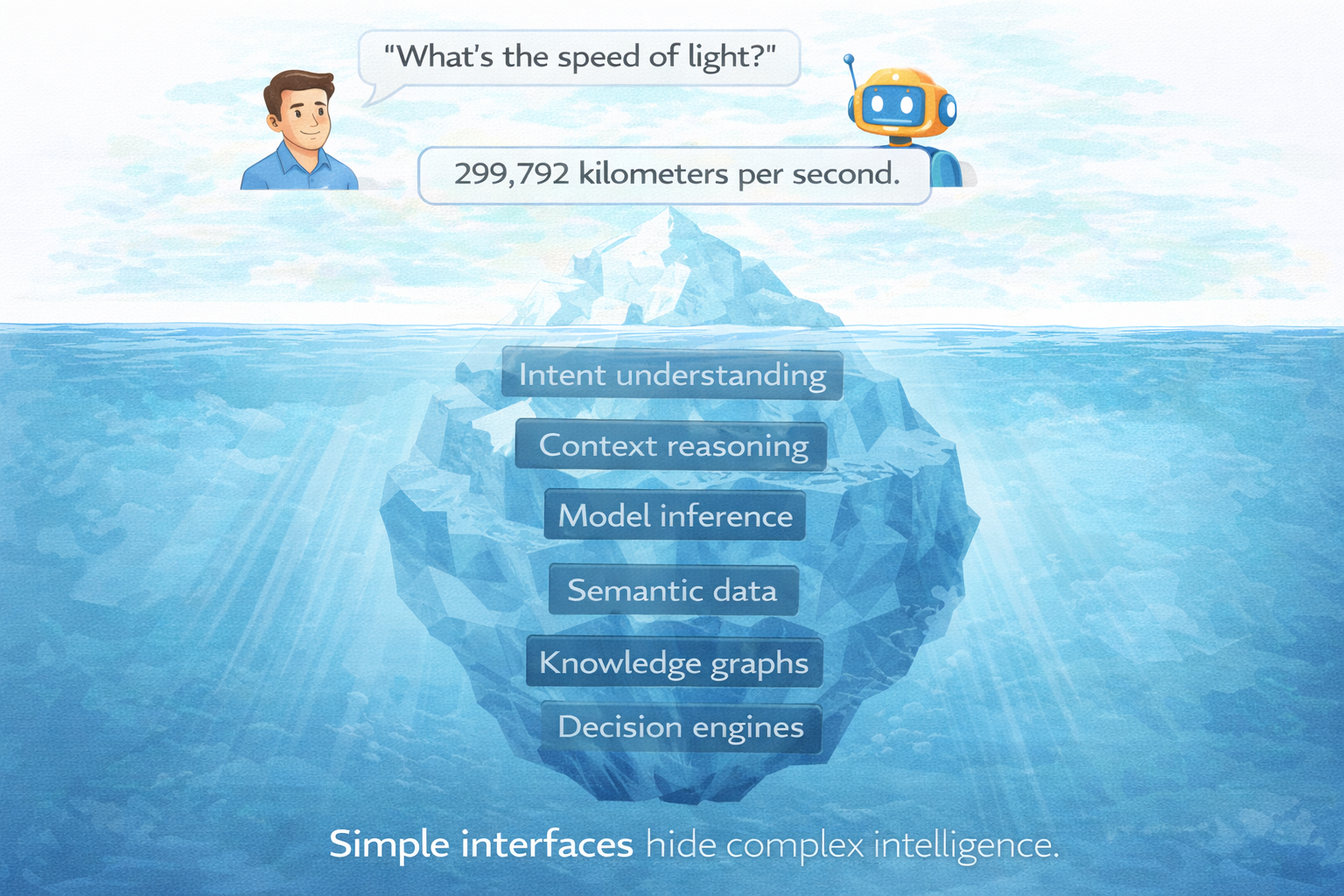
From a user’s perspective, the interface appears simpler—just ask, refine, decide. But behind that plain language is a system doing heavy cognitive work: resolving context, weighing trade-offs, and translating human intent into structured outcomes.
This is the paradox at the heart of AI-driven UX: the cleaner the experience becomes, the more complex the system must be. Simplicity isn’t the absence of complexity — it’s the result of hiding it well.
Who Controls the Experience?
When interfaces shift from pages to agents, control becomes less visible — and more consequential.
In a traditional web model, the relationship is clear: creators publish, platforms host, users choose. However, in an AIDI-driven world, experiences are increasingly assembled in real time—shaped by structured data, model interpretation, and user intent simultaneously.
The question isn’t just who owns the data, but who shapes the outcome. A brand may expose clean, accurate information, yet an AI agent decides what to surface, what to omit, and how to frame it. The user interacts with a response — not a source — often without knowing where one voice ends, and another begins.
This subtle shift concentrates influence within the systems that perform the interpretation. And while that can make experiences feel seamless and personalized, it also means decisions about relevance, credibility, and priority happen behind the curtain.
AIDI has the potential to democratize access and reduce friction—but it also asks us to rethink authorship, accountability, and agency in a world where the interface is no longer a page but a decision-making system.
A New Chapter, Not a Full Stop
So, is this the end of the web?
Not exactly.
HTML won’t vanish. People will still want richly designed articles, immersive videos, and exploratory interfaces — the human-centric experiences the web was made for. We may be seeing the end of the web as the primary interface for information retrieval and decision-making.
For tasks like finding information, comparing options, and making decisions, the dominant interface could soon be a conversation with an AI agent — not a browser tab full of HTML.
The future isn’t HTML or AIDI.
It’s HTML plus AIDI — like moving from a library where you browse books yourself to having a research assistant who reads every book and tells you exactly what you need to know in seconds.
And just like every major shift before it, this one won’t feel dramatic at first.
It’ll just feel… easier.
Just like that moment when you asked for a laptop — and never opened a single tab.

Join Shweta on Peerlist!
Join amazing folks like Shweta and thousands of other builders on Peerlist.
1
6
0