

Why Your Organisation Should Choose an AI-Driven Hiring Platform Over Traditional Job Portals
But a monopoly does not mean innovation. And popularity does not mean privacy.
The hiring landscape has changed.
But many organisations are still using outdated systems.
For years, traditional hiring platforms have dominated the market. They built strong distribution, created dependency, and became the “default” choice for sourcing candidates.
But a monopoly does not mean innovation.
And popularity does not mean privacy.
We are now in the era of AI agents, and recruitment must evolve with it.
The Problem With Traditional Hiring Platforms
Most traditional platforms function as large resume marketplaces.
They collect massive amounts of candidate data, including:
Date of birth
Current organization
Contact details
Government ID information in some cases
But where does that data go?
Who controls it?
How securely is it handled?
Candidates often have limited visibility and little privacy control.
At the same time, recruiters are forced to manually scan hundreds of resumes matching keywords instead of evaluating true skill alignment.
Manual screening is outdated.
Data exploitation is unacceptable.
And inefficiency is expensive.
Manual Hiring Is No Longer Competitive
HR managers today are overwhelmed.
Traditional systems require recruiters to:
Manually review each application
Match job descriptions with resumes line by line
Shortlist candidates without intelligent scoring
Schedule interviews manually
Filter irrelevant applicants one by one
This process is time-consuming, repetitive, and inefficient.
In a fast-moving market, slow hiring means losing top talent.
Welcome to the Era of AI Agents in Hiring
We are entering a new phase where AI agents don’t just assist hiring, they optimise it.
An advanced AI-driven platform should:
Automatically match candidates to job requirements
Provide structured scoring and ranking
Instantly reject mismatched profiles
Schedule interviews intelligently
Reduce screening time dramatically
Give HR managers data-backed hiring insights
AI doesn’t replace recruiters.
It removes repetitive tasks so they can focus on strategic hiring decisions.
But The Future Is Not Just Recruiter-Focused
The real transformation happens when candidates also get AI tools.
In the era of AI agents, candidates should have access to:
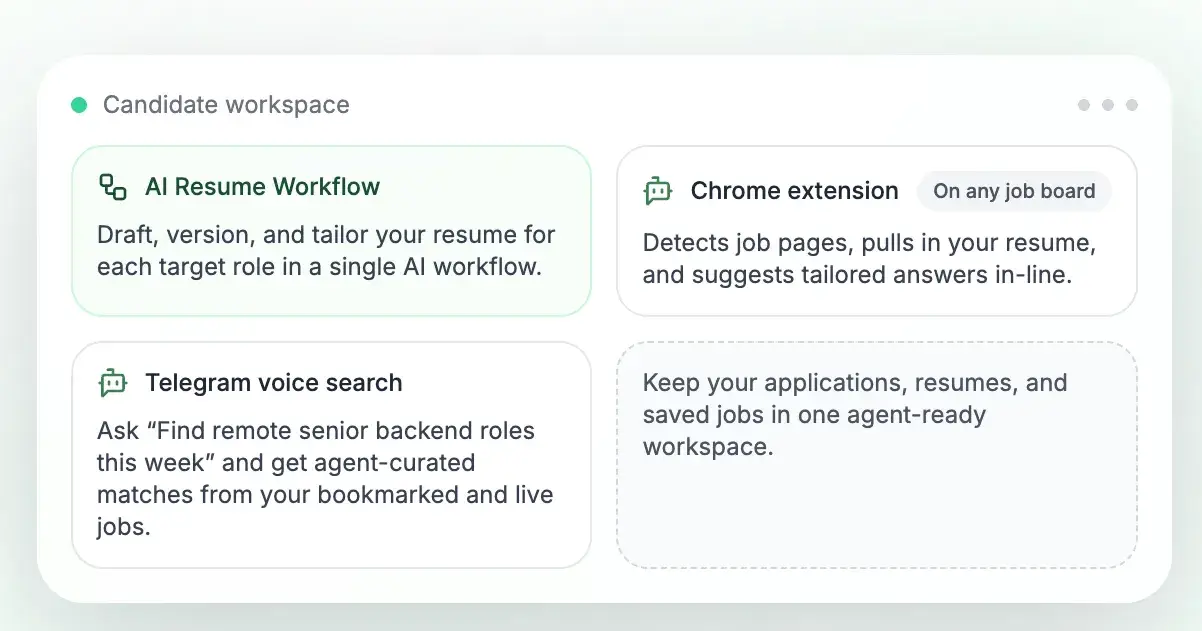
AI Resume Workflow
Draft, version, and tailor your resume for each target role inside a single intelligent workflow.
No more manually editing resumes for every application.
Chrome Extension, On Any Job Board
While browsing jobs:
Detect job pages automatically
Pull in your resume
Suggest tailored answers inline
Assist from search to signed offer
Keep agents and humans in the loop
This transforms the job application process entirely.
Telegram Voice Search
Imagine asking:
“Find remote senior backend roles this week.”
And receiving agent-curated job matches instantly filtered from live jobs and your saved bookmarks.
That’s AI working for the candidate. especially the blue-collar candidates.
One Unified Workspace
Candidates should be able to:
Manage applications
Store resumes
Track saved jobs
OOrganiseinterview stages
All in one AI-ready workspace.
Because this is the actual future of recruitment.
Privacy-First + AI-First = The New Standard
The next-generation hiring platform must:
Respect the candidate's privacy
Avoid selling personal data
Minimise unnecessary information collection
Provide intelligent automation
Empower both recruiters and candidates
Recruitment should not be about data extraction.
It should be about intelligent matching.
Why Organisations Must Adapt Now
Organisations that fail to adopt AI-driven hiring tools risk:
Slower hiring cycles
Higher operational costs
Losing top candidates
Falling behind tech-forward competitors
Meanwhile, companies that embrace AI:
Hire faster
Hire smarter
Reduce bias
Improve candidate experience
Protect sensitive data
The hiring process becomes efficient, ethical, and future-ready.
The Bottom Line
Traditional platforms built the hiring market.
AI-driven platforms will redefine it.
In the era of AI agents, both recruiters and candidates deserve intelligent systems, not manual workflows and outdated databases.
The future of hiring is:
AI-matched.
Privacy-respecting.
Automation-driven.
Agent-powered.
The only question is:
Will your organisation lead the shift or chase it later?

Join Vandana on Peerlist!
Join amazing folks like Vandana and thousands of other builders on Peerlist.
0
1
0