

When I started building LibraryAI, I wasn’t trying to create “another app for books.”
Books are scattered across dozens of apps.
You read PDFs in one place.
Listen to audiobooks somewhere else.
Save quotes in another app.
And half the time you forget where you even stopped reading.
The weirdest part?
Books still haven’t become truly social.
Music became social.
Movies became social.
Even fitness became social.
But reading somehow stayed isolated.
That’s how LibraryAI was born.
Not as a “startup for fundraising.”
But as a product I personally wanted to open every single day.
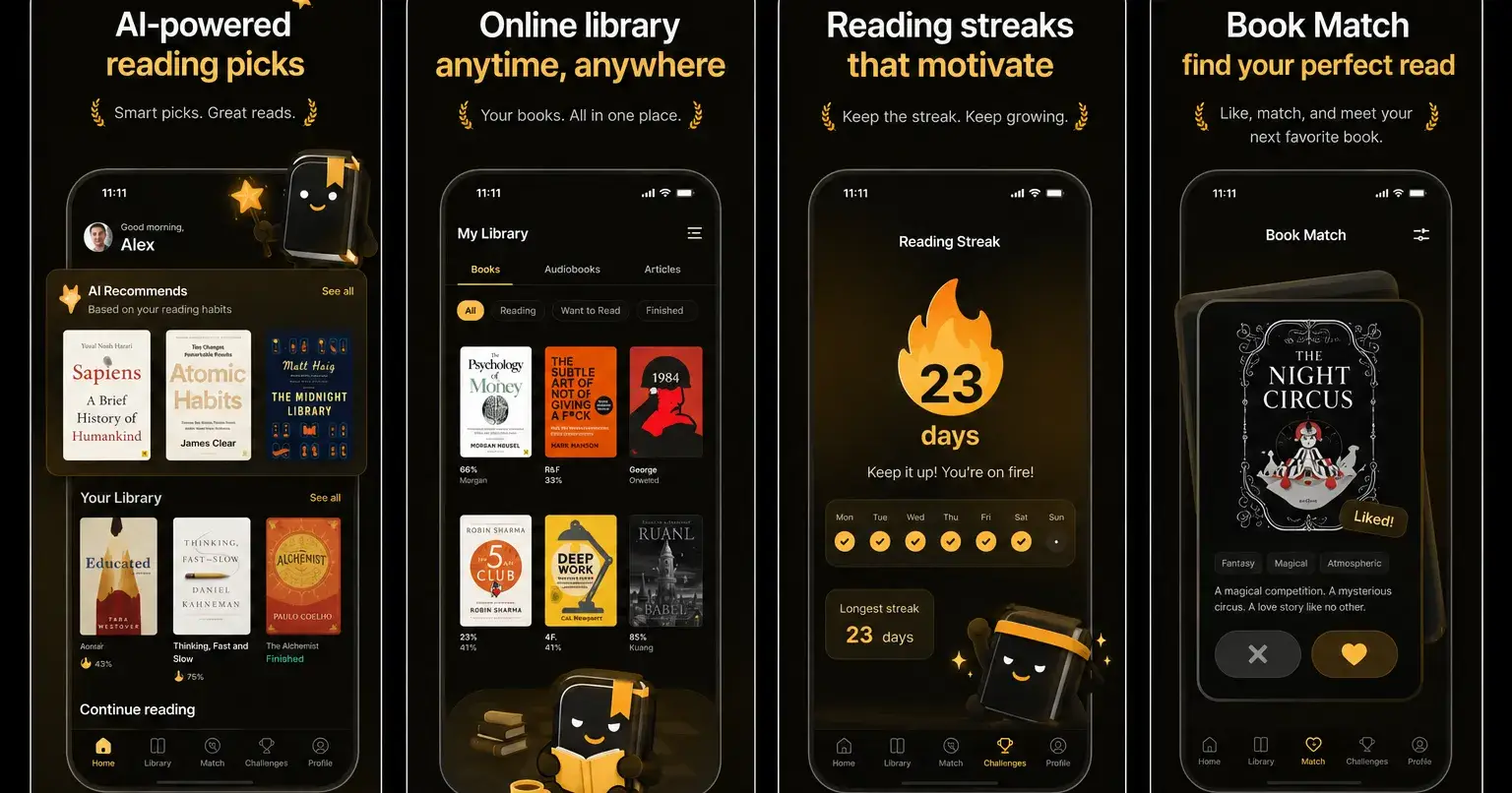
Finally, all your books in one place
I wanted to create the feeling of having one unified library that actually understands you.
It doesn’t matter if you:
read classic novels,
listen to audiobooks,
save articles,
read late at night on your phone,
or only open a book for five minutes between meetings.
Everything should live in one place.
No chaos.
No “where did I stop reading?”
No feeling like you’re using seven disconnected services at once.
LibraryAI isn’t just a reader.
It’s an operating system for reading.
AI recommendations instead of generic bestseller lists
One thing that always frustrated me about book platforms was recommendations.
You read one psychology book — suddenly the app throws 500 identical books at you with the same covers and titles.
That’s not recommendation.
That’s algorithmic spam.
So with LibraryAI, we built recommendations around human behavior instead of just genres.
The AI looks at:
how fast you read,
where you pause,
which quotes you save,
what topics actually hold your attention,
which books you abandon halfway through.
Over time, it starts understanding you as a reader.
Sometimes the app recommends a book you’ve never even heard of — and it hits harder than any “Top 10 Bestsellers of the Year” list ever could.
It stops feeling like an algorithm.
And starts feeling like a friend who genuinely knows your taste.
BookMatch — Tinder for books
The weirdest idea we had — the one almost everyone laughed at in the beginning — was BookMatch.
Then people started spending hours using it.
The concept is simple:
you swipe books the same way you swipe people on Tinder.
Left — not interested.
Right — I want to read this.
Within minutes, the app starts understanding:
what you’re drawn to,
which themes excite you,
what writing style fits you,
which books should never even appear in your feed.
It turned out to feel far more natural than endlessly scrolling through catalogs.
Because people don’t actually want to “search.”
They want to instantly feel:
“This one is for me.”
Reading streaks with friends
But the most important feature of LibraryAI for me is shared reading.
I noticed something simple:
almost everyone starts reading motivated… and quits alone.
So we built paired reading streaks with friends.
You connect with someone.
Set a goal together:
7 days straight,
30-day streaks,
100 pages a day,
one book a week.
And suddenly reading stops feeling like a task and starts feeling like a game.
You see each other’s progress.
Get notifications.
Build momentum together.
Most importantly — you stop feeling alone.
For me, that’s the core idea behind the product:
reading shouldn’t be lonely.
I built this for myself
The funny thing is, I never sat down thinking:
“Let’s build a massive startup.”
I was simply building the product I personally wanted to use.
A place where:
books aren’t fragmented,
recommendations are actually intelligent,
reading feels modern,
and friends can read together.
And I think that’s exactly why people started connecting with it.
Because today there are too many “optimized startups” built for metrics, investors, and growth hacks.
And not enough products built from genuine personal need.
LibraryAI came from that need.
I wanted to fall in love with reading again.
So I built an entire platform around it.
Website - https://libraryai.site/

Join Dan on Peerlist!
Join amazing folks like Dan and thousands of other builders on Peerlist.
0
0
0