

llms.txt: The New Standard for AI-Friendly Websites
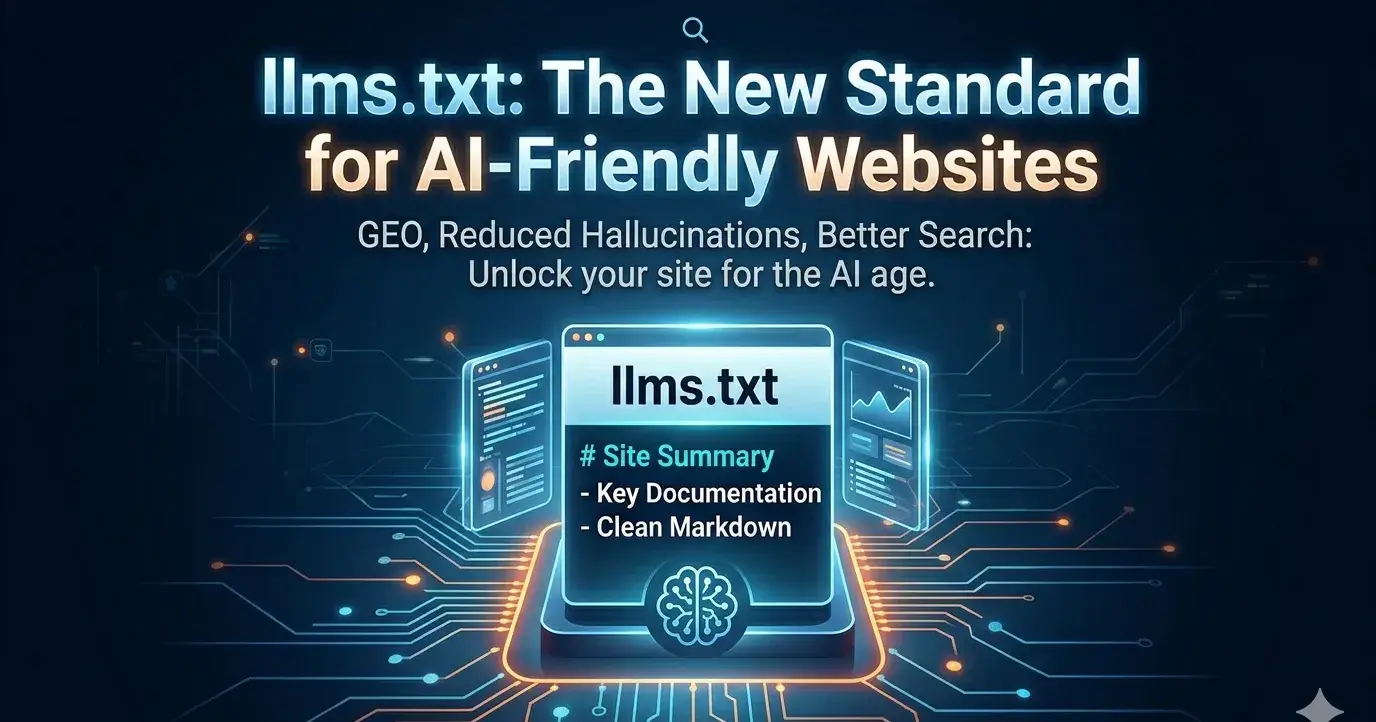
In the rapidly evolving world of artificial intelligence, a new standard is quietly emerging at the root of savvy websites: llms.txt.
Think of it as the "Robots.txt for the AI Age." While robots.txt tells bots where they can't go, llms.txt tells AI models exactly where they should go and how to interpret what they find.
What is llms.txt?
The llms.txt file is a proposed standard for a plain-text Markdown file located at the root of your domain (e.g., yourwebsite.com/llms.txt). Its purpose is to provide a highly distilled, machine-readable summary of your website’s most important information.
Modern AI models—like GPT-4, Claude, and Gemini—often struggle with the "noise" of a standard webpage (ads, headers, navigation menus, and tracking scripts). The llms.txt file strips all that away, offering:
A concise site summary.
Links to key documentation or content.
Clean Markdown formatting that LLMs can digest instantly without "hallucinating" details from sidebar clutter.
Why You Should Use It in 2026
If you care about how AI perceives your brand, product, or documentation, this file is no longer optional. Here is why you need it:
1. Improved Accuracy & Reduced Hallucinations
When an AI agent (like Perplexity or a ChatGPT search) visits your site, it has a "context window" (a limit on how much it can read). If it spends that limit reading your "Cookies Policy" and "Footer Links," it might miss your actual product specs. llms.txt ensures the AI sees the most accurate, canonical version of your data first.
2. Generative Engine Optimization (GEO)
Move over SEO—GEO is the new frontier. To appear in AI-generated answers, your site must be "crawl-efficient." A structured llms.txt makes it incredibly easy for AI to cite you as a source, increasing your chances of being the "featured answer" in AI search results.
3. Lower Token Costs for Developers
If you provide an API or technical documentation, developers often pipe your site info into their own AI tools. By providing a clean llms.txt (and a more detailed llms-full.txt), you save them from building complex scrapers and reduce the "token noise" they have to pay for.
4. Future-Proofing
Major platforms like Wix, Cloudflare, and Google have already started experimenting with or implementing these files. Adopting it now signals that your site is a first-class citizen in the AI ecosystem.
How to Implement llms.txt
Creating the file is simple. It uses Markdown syntax and should be placed in your root directory.
Step 1: Create the basic structure
Your file should follow this general hierarchy:
# Project Name: A clear title.
Summary: A brief description of what the site/project is.
Sections: Categories like "Core Documentation" or "Product Guides."
Links: Direct URLs to Markdown versions of your pages if possible.
Example llms.txt Template:
Markdown
# My Awesome SaaS

> This is a platform for automating workflow using AI-driven insights.

## Core Documentation
- [Installation Guide](https://example.com/docs/install.md): How to set up the SDK.
- [API Reference](https://example.com/docs/api.md): Full list of endpoints.
- [Pricing](https://example.com/pricing): Current tiers and limits.

## Useful Resources
- [Case Studies](https://example.com/blog/case-studies): Real-world examples.
- [Support](https://example.com/help): Contact and FAQ.
Step 2: Create a "Full" version (Optional but Recommended)
For deep technical sites, you can also host an llms-full.txt file. This is a single, large file containing the entire content of your documentation in Markdown format, allowing an AI to ingest everything in one single request.
Summary: SEO vs. GEO
While a sitemap.xml helps Google index your URLs, an llms.txt helps ChatGPT understand your meaning.
By adding this one small file, you aren't just building for human visitors—you're building for the AI agents that those humans are increasingly using to find you.

Join S M Shohanur Hossain on Peerlist!
Join amazing folks like S M Shohanur Hossain and thousands of other builders on Peerlist.
4
10
2