

Rethinking Wearables Integration: Why We Built Open Wearables
Open Wearables is an open-source, self-hosted platform for wearables integration. Unified API for 200+ wearable devices. No vendor lock-in.

Wearables integration is no longer a differentiator. It’s a baseline expectation.
If you’re building a health, fitness, longevity, or performance product in 2026, users expect their data from Apple Watch, Garmin, Polar, or Suunto to be available by default. Sleep, HRV, steps, workouts. Consistent. Reliable. Ready to be used for real features, not just charts.
Getting there, however, is still harder than it should be.
Most teams either spend weeks integrating individual wearable APIs or rely on SaaS aggregation platforms that trade short-term speed for long-term lock-in.
This week, we launched Open Wearables on Peerlist to introduce an alternative approach.
An open, self-hosted wearable API that gives developers full control over how wearable data is integrated, stored, and used.
What is Open Wearables?
Open Wearables is an open-source, self-hosted platform that provides a unified wearable API across multiple providers.
Instead of building and maintaining separate integrations for each device ecosystem, you deploy Open Wearables inside your own infrastructure and connect your application to a single, consistent API.
From your app’s perspective, wearable data comes in one format, regardless of where it originated.
At a high level, Open Wearables is designed to be:
Open-source (MIT license) – transparent, auditable, and extensible
Self-hosted and single-tenant – your infrastructure, your data
Free from per-user or per-request fees – no SaaS pricing tied to growth
Developer-first – focused on APIs and data models, not dashboards
AI-ready by design – structured, normalized data that’s easy to reason over
This is not a plug-and-play SaaS product.
It’s infrastructure you own and build on top of.
Open Wearables is built by Momentum, a healthcare engineering team with hands-on experience delivering production systems that rely on Apple Health integration, Garmin integration, and complex wearable data pipelines across fitness, wellness, and healthcare use cases.
The project grew directly out of those real-world constraints.
How wearables integration has worked so far
Until now, teams building with wearable data have usually followed one of two paths.
Option 1: Integrate each wearable directly
In this model, you connect to each provider individually:
Apple Health API, which is local and requires a mobile app
Garmin integration via cloud APIs, OAuth, and webhooks
Polar and Suunto APIs with their own access models
Fitbit or other providers if broader coverage is needed
Each integration comes with its own set of constraints:
Different authentication and permission flows
Inconsistent data schemas and naming conventions
Provider-specific rate limits and sync behaviors
Separate error handling and monitoring logic
This approach gives you full control, but it comes at a cost.
Each provider adds weeks of implementation time and increases the long-term maintenance burden as APIs evolve and edge cases accumulate.
Option 2: Use a SaaS aggregation platform
To reduce integration complexity, many teams turn to SaaS platforms that offer a unified wearable API out of the box.
These platforms simplify early development by abstracting away individual providers and exposing a single interface.
However, this convenience introduces new trade-offs:
Recurring per-user or per-connection fees
Vendor lock-in at the data and infrastructure layer
Proprietary schemas that are difficult to migrate away from
Pricing models that scale with user growth rather than actual usage
Limited flexibility to extend or customize the integration logic
Teams often ship faster initially, but over time give up control over how wearable data is stored, processed, and evolved — even though it’s one of the core inputs to their product.
Why Open Wearables is a better way
Open Wearables takes a third approach to wearable integration.
Instead of building and maintaining everything yourself, or outsourcing the entire data layer to a SaaS provider, you run an open integration layer inside your own infrastructure.
You keep ownership of the system while avoiding repeated, provider-by-provider work.
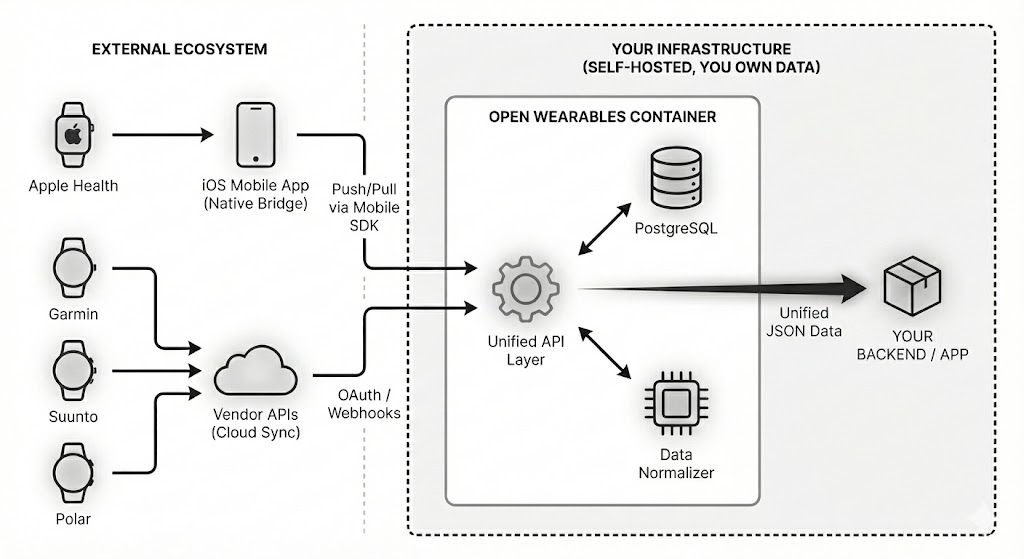
1. You control the infrastructure
Open Wearables is deployed in your environment and operates within your existing stack.
That means:
Your own database and storage
Your cloud account and networking setup
Your security, access control, and compliance model
There is no external processing layer and no dependency on third-party infrastructure for core data flows. You can see how data is ingested, stored, and exposed at every step.
2. No vendor lock-in
Because Open Wearables is open-source, you’re not tied to a closed platform.
You can:
Inspect and audit the code
Extend or adapt integrations as needed
Modify the data model to fit your product
Fork the project if your requirements diverge
If your product or business model changes, the integration layer doesn’t become a constraint you need to work around.
3. One unified wearable API
From your application’s perspective, Open Wearables exposes a single, consistent API.
Health data, activity data, workouts, and time-series metrics follow the same structure regardless of their source.
Apple Health integration, Garmin integration, and other providers are normalized into a shared schema, which simplifies downstream logic, analytics, and feature development.
4. Designed with AI use cases in mind
Most wearables data problems show up after integration, not during it.
Fragmented schemas, inconsistent timestamps, and device-specific metrics make it difficult to build reliable analytics or intelligent features.
Open Wearables focuses on producing clean, normalized data that can be used for:
Analytics and reporting
Health and performance scoring
Event-based alerts
AI-driven reasoning and automation (on the roadmap)
The objective is not just to aggregate data, but to make it usable for interpretation and decision-making.
Current integrations (and what’s coming)
Available today:
Apple Health integration
Garmin integration
Polar integration
Suunto integration
Coming next:
MCP integration and AI layer
Oura
Google Connect
Samsung Health
Fitbit
Strava
We’re shipping incrementally and being explicit about what’s live versus what’s planned.
No inflated device counts, and no “all providers supported” claims before they’re real.
Community-driven by design
Open Wearables is designed to be more than a standalone codebase.
The project is being built in the open, with the intention that the people working with wearable data every day can influence how the foundation evolves.
That includes:
Public GitHub issues for bugs, ideas, and roadmap discussions
Pull requests from the community
Open conversations around architecture, data models, and trade-offs
We’re particularly interested in input from developers, researchers, and founders who have already dealt with the realities of wearable data integration and know where existing approaches fall short.
The long-term goal is straightforward:
Open infrastructure for personal health data, shaped and improved by the people who depend on it.
Get started
If you believe wearable data infrastructure should be:
Open
Self-hosted
Controlled by the teams building on top of it
then Open Wearables is worth exploring.
You can:
Visit https://openwearables.io to learn more
Check out the repository and run it locally
Experiment with it, identify gaps, and contribute improvements
If the direction resonates, an upvote on Peerlist helps more developers discover the project.

Join Piotr on Peerlist!
Join amazing folks like Piotr and thousands of other builders on Peerlist.
2
6
0