

US Insurance Tech Spending 2026: From Modernization to Intelligence
How American Carriers Are Redirecting Capital From Infrastructure Replacement to AI-Driven Operations — and Where Claims and Billing Software Sit in That Shift
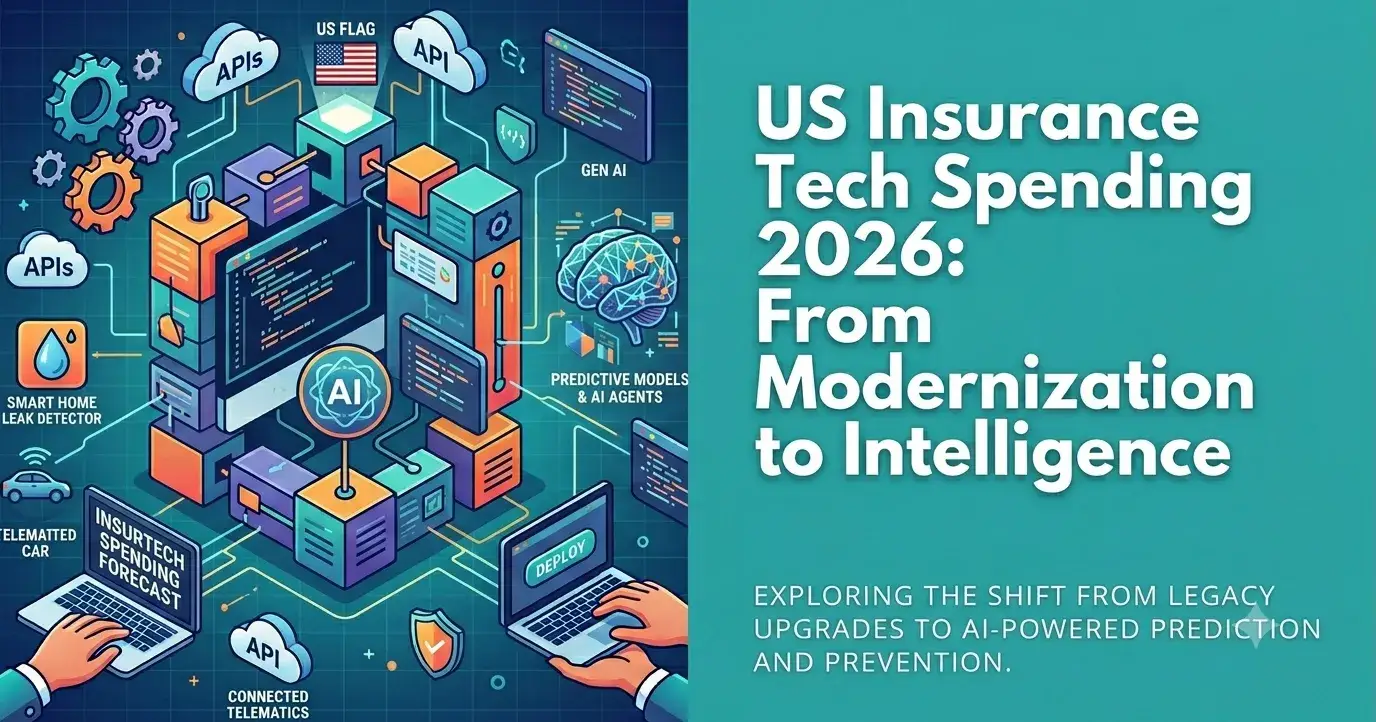
Something changed in how US insurance carriers talk about technology investment in 2026. The conversation stopped being about modernization replacing COBOL systems, migrating to cloud, retiring on-premises infrastructure and started being about intelligence. The question is no longer "how do we get off legacy?" It is "now that we're off legacy, what do we actually build?"
This shift matters because it changes where budget goes, what vendors get selected, and which operational problems finally get solved. Carriers that spent the last decade replacing infrastructure are now in a position to do something with it. Those that didn't are still catching up, and the gap between them is widening faster than it was five years ago.
Understanding where US insurance technology spending is concentrating in 2026 and why, requires looking at the specific systems that have absorbed the most investment, what those systems still cannot do well, and where the next layer of intelligence is being built on top of them.
The Modernization Phase Is Closing, Not Finished
To be precise: modernization is not over for the entire industry. Regional carriers and mutual companies operating below $1 billion in annual premiums are still mid-migration in many cases. Mainframe-dependent policy administration is still running production workloads at carriers that have been "planning to replace it" since 2019.
But at the top of the market national carriers, the large regional groups, the specialty lines players that process serious claims volume the infrastructure replacement cycle is largely done. They have cloud-hosted policy systems. They have API-accessible claims platforms. They have data lakes that consolidate what used to live in operational silos.
The 2026 spending pattern reflects this split clearly. Larger carriers are putting new technology dollars into AI orchestration, predictive modeling, and intelligent automation built on top of the modern infrastructure they now have. Smaller carriers are still spending on the infrastructure itself. The industry averages obscure this divide, but it defines everything about how technology investment is actually behaving right now.
Where the 2026 Budget Is Actually Going
Three categories are absorbing the majority of new insurance technology investment in the US this year.
AI-Assisted Claims Adjudication
Claims processing is the highest-cost operational function in life and property-casualty insurance. It is also the function where AI has moved furthest from pilot to production. Carriers are now deploying machine learning models in live adjudication workflows not as decision-makers, but as triage engines, anomaly detectors, and documentation processors that prepare claims for faster human review.
The investment is concentrating in life insurance claims software platforms that support model integration directly, rather than requiring carriers to build a separate AI layer on top of their claims system. Vendors who built their platforms with open APIs and configurable rules engines are capturing this budget. Vendors whose platforms require a middleware layer to expose any data are losing it.
The business case is straightforward. A large carrier processing 50,000 life claims annually that reduces average handling time by three days per claim generates measurable cost savings and measurable NPS improvement simultaneously. That is the rare technology investment that improves margins and customer experience at the same time which is why board-level approval cycles for these projects have shortened considerably.
Billing Intelligence and Premium Lifecycle Management
Billing has historically been the least-glamorous system in the insurance stack. It processed premium payments, issued invoices, and managed lapses. The data it generated was used for accounting, not strategy.
That is changing. Carriers are now treating billing data as a predictive asset. When does a policyholder's payment behaviour change before a lapse? Which billing friction points correlate with cancellations that could have been retained? Which premium structures generate the highest lifetime value by segment?
Answering these questions requires life insurance billing software that captures behavioral data at the transaction level and makes it available for analysis, not just accounting. The 2026 investment is going into platforms that do this — billing engines with analytics layers, event-driven architectures that log every billing interaction, and integration frameworks that connect billing signals to retention and claims workflows.
This is a meaningful departure from how carriers evaluated billing platforms five years ago, when the primary selection criteria were payment method support and regulatory compliance by state. Those remain table stakes. The differentiator now is what the system can tell you about your customers before they call to cancel.
Data Unification Across the Policy Lifecycle
The third major spending category is less visible but arguably the most important. Carriers are investing heavily in data infrastructure that connects policy administration, claims, billing, and customer interaction records into a single coherent view of the policyholder relationship.
This sounds like a data warehouse project, and sometimes it is. But the 2026 version is more targeted than previous data consolidation efforts. Carriers are not trying to build a universal data platform. They are building specific connections between systems where the lack of shared data creates the most measurable operational cost and claims-to-billing is consistently at the top of that list.
The Intelligence Layer: What It Actually Means in Practice
"Intelligence" is an overloaded word in insurance technology marketing. Every vendor claims their platform is AI-powered. The operational reality is more specific and more useful to understand.
In claims, intelligence means three concrete things in 2026. First, automated straight-through processing for low-complexity claims death benefit claims where the policy is clearly in force, the documentation is complete, and no fraud indicators are present can now close without an adjuster touching the file. Second, predictive severity scoring that routes high-complexity claims to senior adjusters before the complexity becomes a problem. Third, fraud signal aggregation that connects behavioral patterns across the claims and billing history of a policy rather than evaluating each claim in isolation.
In billing, intelligence means something different. It means proactive retention triggers identifying policyholders whose payment behavior suggests lapse risk and initiating outreach before the grace period begins. It means dynamic billing communication, where the channel, timing, and content of premium notices are personalized based on what has actually worked for similar policyholders. It means contestability alerts that surface for the claims team automatically when a new claim falls within the contestability window of a recently issued policy.
None of these capabilities require science fiction. They require clean data, connected systems, and platforms designed to expose their data to analytical models. The carriers investing in this in 2026 are not the ones with the largest AI teams. They are the ones who spent the last five years building the data foundations that make these applications possible.
What the Spending Shift Means for Vendor Selection
The move from modernization to intelligence is reshaping how carriers evaluate and select technology vendors in ways that matter for anyone selling into the insurance market.
Configurability is now a minimum requirement, not a differentiator. Carriers that spent years implementing inflexible platforms will not repeat that mistake. Any new claims or billing platform that requires vendor involvement to change a business rule, add a data field, or modify a workflow is starting the sales conversation with a significant disadvantage.
API depth has become the primary technical evaluation criterion. Carriers are not buying standalone systems anymore they are buying components of an interconnected architecture. A claims platform that cannot publish real-time events to a data pipeline, or a billing system that cannot receive claim status updates from the claims engine, does not fit the architecture carriers are building. Integration capability is evaluated before functionality in most 2026 RFP processes.
Vendor AI roadmaps are being scrutinized in detail. Carriers have learned from experience that a vendor's AI claims are often marketing ahead of engineering. The questions being asked now are specific: Which models do you use for document extraction? How is the training data for your fraud models sourced and validated? What is the process for a carrier to bring their own models into your platform? Vague answers to these questions are eliminating vendors from consideration earlier in the sales cycle than they used to be.
The Carriers Being Left Behind
The intelligence shift is not uniformly accessible. Smaller regional carriers and mutual companies face a structural disadvantage that technology spending alone cannot solve quickly.
Their data is still fragmented across systems that were never designed to share it. Their IT teams are managing the tail end of legacy migrations while simultaneously being asked to evaluate AI platforms. Their budget is constrained by combined ratios that have been under pressure from catastrophic loss events over the past three years.
For these carriers, the 2026 technology priority is still the same foundational work the larger carriers completed in 2021 and 2022: getting claims and billing onto modern platforms that share a common data layer, replacing manual reconciliation workflows with automated event-driven processes, and establishing the data governance standards that make any future AI application reliable rather than dangerous.
The risk is that the window for catching up narrows each year. Carriers operating on AI-enhanced claims and billing platforms are improving operational efficiency faster than those still resolving data integration problems. The cost gap compounds. The customer experience gap compounds. The fraud detection gap compounds.
Final Words
US insurance technology investment in 2026 is not a single story. It is two simultaneous stories running at different speeds larger carriers moving from modern infrastructure into intelligence applications, smaller carriers still completing the infrastructure work that makes intelligence possible.
What is consistent across both stories is the recognition that claims and billing are no longer back-office processing functions. They are the operational core of the carrier's relationship with its policyholders, and the quality of the technology running those functions determines outcomes that matter: how fast a bereaved family receives their benefit, how accurately a lapsing policyholder is identified before it is too late, how completely a fraud pattern is detected before it becomes a loss.
The carriers getting this right in 2026 are the ones who stopped treating technology investment as infrastructure maintenance and started treating it as the engine of their competitive position. That shift from modernization to intelligence is what the spending patterns are telling us.

Join Theo on Peerlist!
Join amazing folks like Theo and thousands of other builders on Peerlist.
0
0
0