

2026 AI YouTube Transcription Guide: From Watching Videos to Reusing Knowledge – The Complete Workflow
1 Introduction
Have you ever experienced this: your YouTube “Watch Later” list is overflowing with videos, yet you rarely manage to finish them? Whether it’s a 40-minute interview or a one-hour technical review, there never seems to be enough time, and certain situations—like commuting or being in a library—make it impossible to play audio. On top of that, many high-quality videos come from creators in different languages.
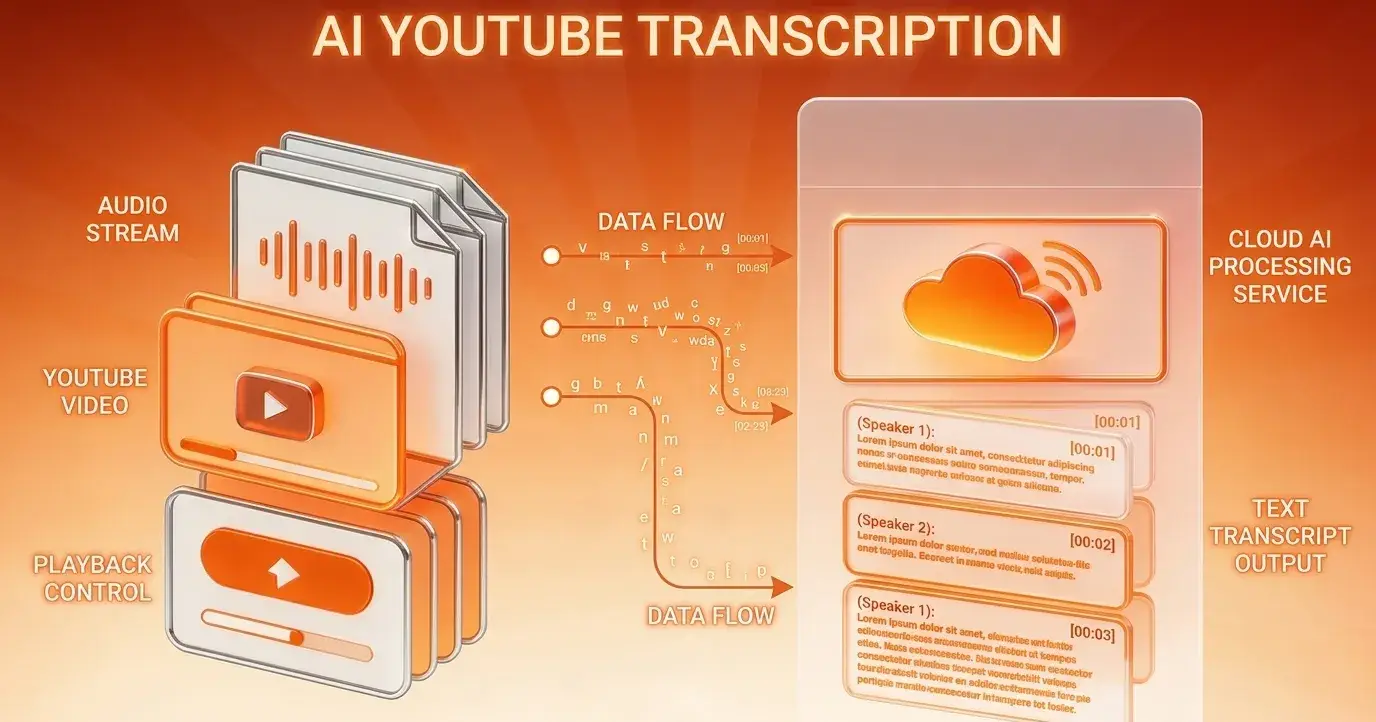
More and more people are turning to YouTube as an important channel for learning, research, and information gathering. However, video content is inherently difficult to search, quote, or repurpose quickly. This is precisely why AI YouTube transcription has become so popular: using artificial intelligence, spoken content in videos can be automatically recognized and converted into text, while also generating subtitles, chapter structures, and even extracting key insights.
Once video content is transformed into text, the way we use it changes dramatically. You can browse the main points of a long video in seconds, quickly locate specific segments, and even directly quote the transcript for research or content creation. In this article, we will systematically explore the applications of AI transcription on YouTube from an information processing perspective, and examine a larger trend: when videos can be transcribed, searched, and summarized, YouTube is gradually evolving into an open, global knowledge database.
2. What is AI YouTube Transcription?
At its core, AI YouTube transcription combines Automatic Speech Recognition (ASR) with large language models (LLMs) to convert a video's audio content into structured text. But it’s not simply “speech-to-text.” By 2026, AI transcription goes beyond merely “hearing” content—it can also “understand” it.
Viewed differently, this represents a modality shift: linear information unfolding over time (video streams) is transformed into structured information (text) that can be read, searched, and organized. This transformation not only improves efficiency but fundamentally changes the way we access and process video content.
Modern AI transcription offers more than just a transcript; it provides a layered information structure:
📝 Full Transcript – Converts video dialogue into text word-for-word with timestamps, allowing videos to be read, searched, and referenced like a document.
🎬 Intelligent Subtitles – Automatically generates synchronized subtitles and supports multi-language translation. Even foreign-language videos become accessible and understandable.
📌 Smart Chapters – Transforms linear video into structured sections. AI automatically divides content into topics and generates a navigable table of contents, making even one-hour videos easy to browse.
✨ AI Summary – Condenses information into core insights and key points. In just seconds, you can grasp the essence of a one-hour video, quickly deciding whether it’s worth a deeper dive.
Videos are evolving from “media” into data—from ephemeral content to searchable, reusable, and manageable knowledge assets. This is why more people are turning to AI transcription: we no longer want to just “consume” content; we want to control it.
3. Applications of AI YouTube Transcription
From an information-processing perspective, AI transcription is transforming the way people use YouTube. The workflow can be divided into three stages: information input, information understanding, and information output/reuse.
3.1 Information Input & Capture: Making Videos More Accessible
Cross-Language Knowledge Acquisition
YouTube hosts high-quality content from around the world—German tech reviews, French in-depth interviews, Japanese lectures—but language barriers often make this content difficult to access. With AI transcription plus translation, users can first generate a transcript in the original language and then translate it into their native language, quickly understanding the video’s content. YouTube thus evolves from being primarily an English-language platform into a true global multilingual knowledge base.
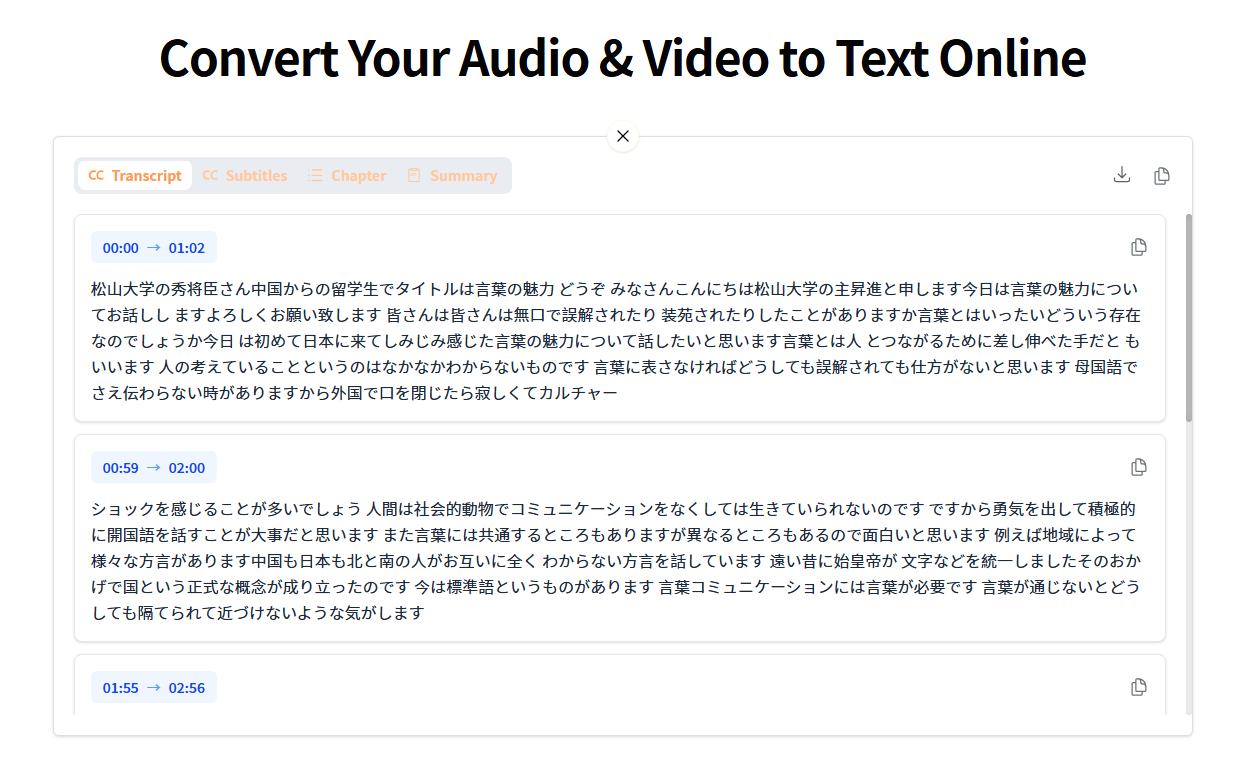
AI transcription example: A Japanese lecture video is quickly converted into an editable Japanese transcript.
Filtering Fragmented Information
Many YouTube videos today are long, with podcasts or interviews ranging from 40 minutes to 2 hours. AI transcription tools can automatically generate summaries, chapters, and key points, allowing users to skim first and decide whether to watch the full video. Screening one hour of content in just 30 seconds represents a leap in information efficiency.

AI transcription example: A multi-hour Elon Musk interview automatically condensed into time-stamped chapters and key highlights.
3.2 Information Processing & Understanding: Making Videos Easier to Learn
Deep Learning Notes
For students and lifelong learners, YouTube offers a treasure trove of lectures and technical talks. AI transcription transforms video content into editable text, allowing users to organize knowledge structures, highlight key points, and copy needed passages. Video learning evolves from passive viewing into active note-taking and deep comprehension.
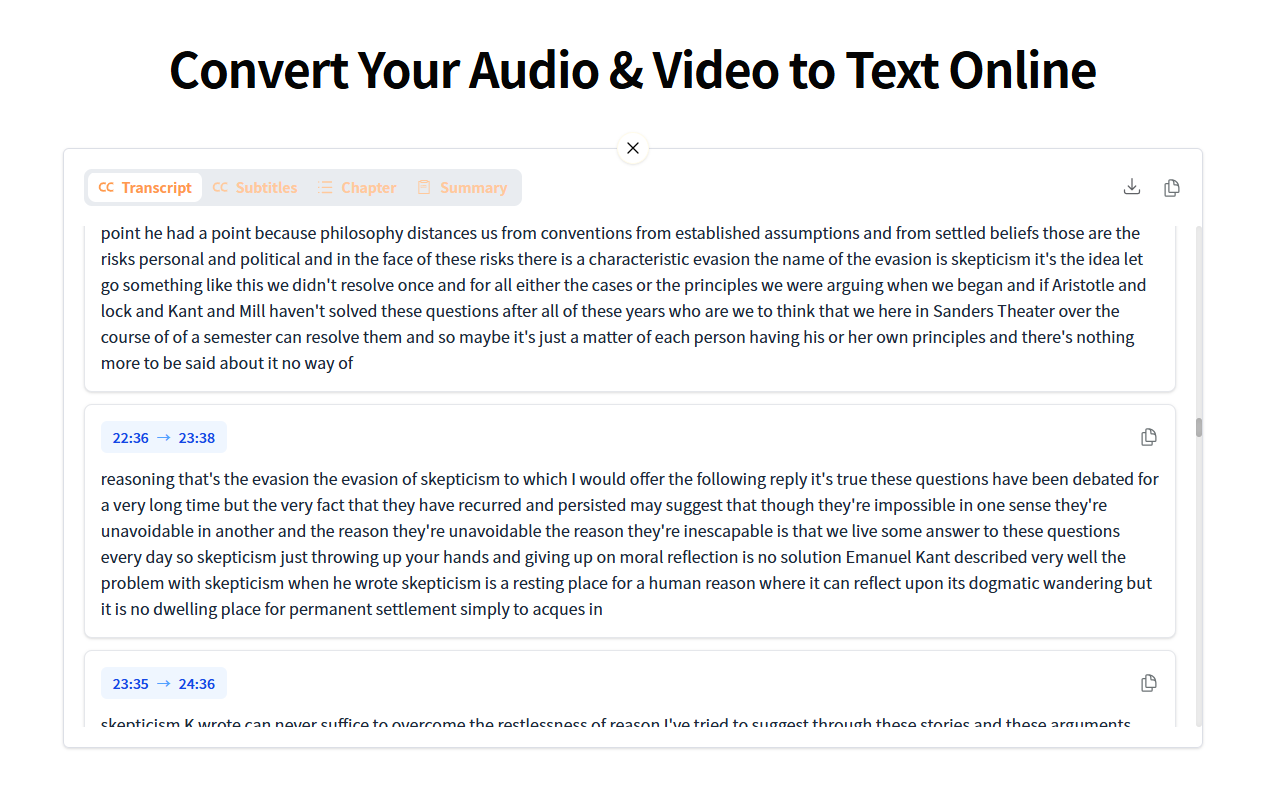
AI transcription example: Harvard’s top courses converted into readable, reusable study notes.
Video Navigation & Content Search
AI transcription can automatically generate video chapters, enabling users to jump directly to specific segments. Full-text search within transcripts allows users to quickly locate any part of the video. Long videos thus gain the experience of a “book-like table of contents + searchable text.”
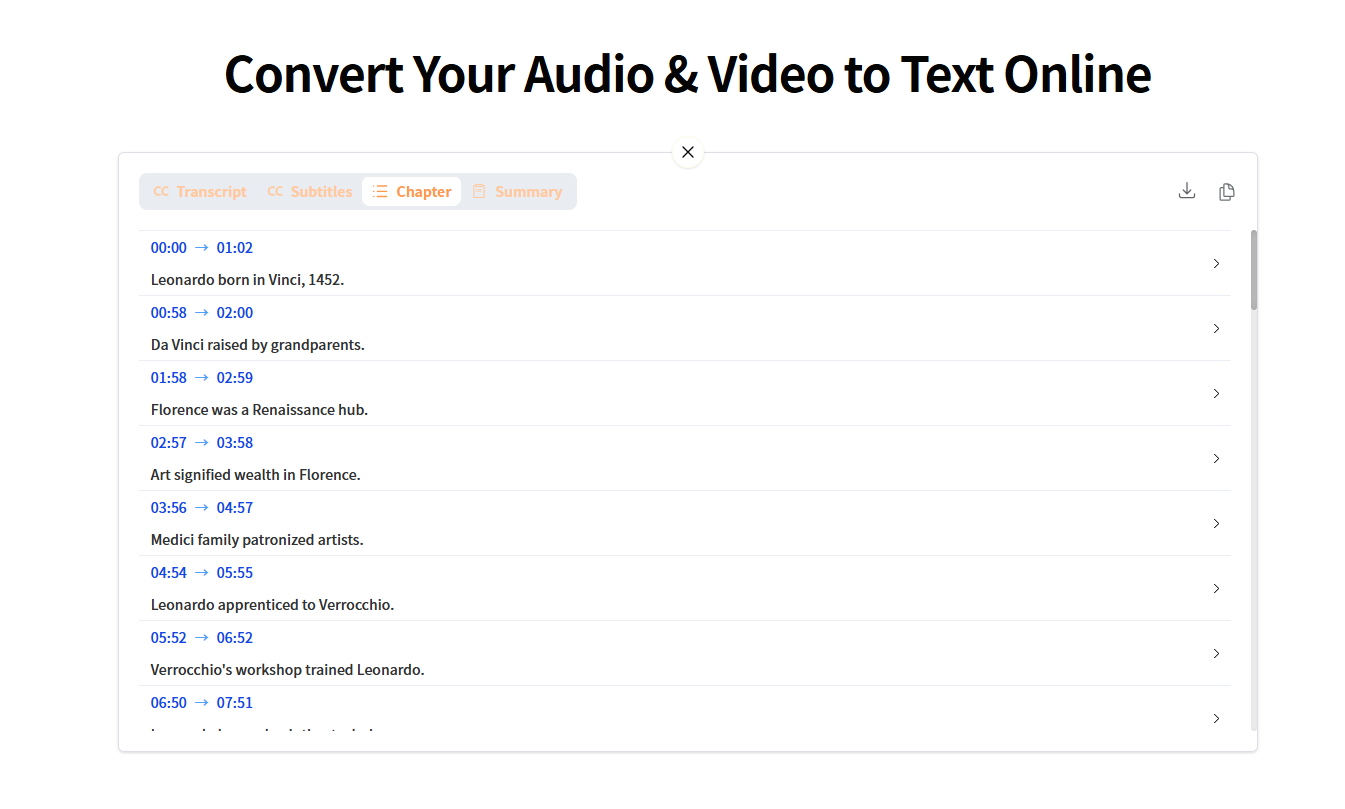
AI transcription example: The documentary Leonardo da Vinci: The Man Behind the Genius automatically generates a full navigable chapter list.
3.3 Information Output & Reuse: Turning Videos into a Knowledge Library
Content Repurposing
For content creators, videos are a rich source of material. Transcribed text enables quick extraction of key points, direct quotations, article rewrites, or short-video scripts. Video content becomes an editable and quotable knowledge repository.
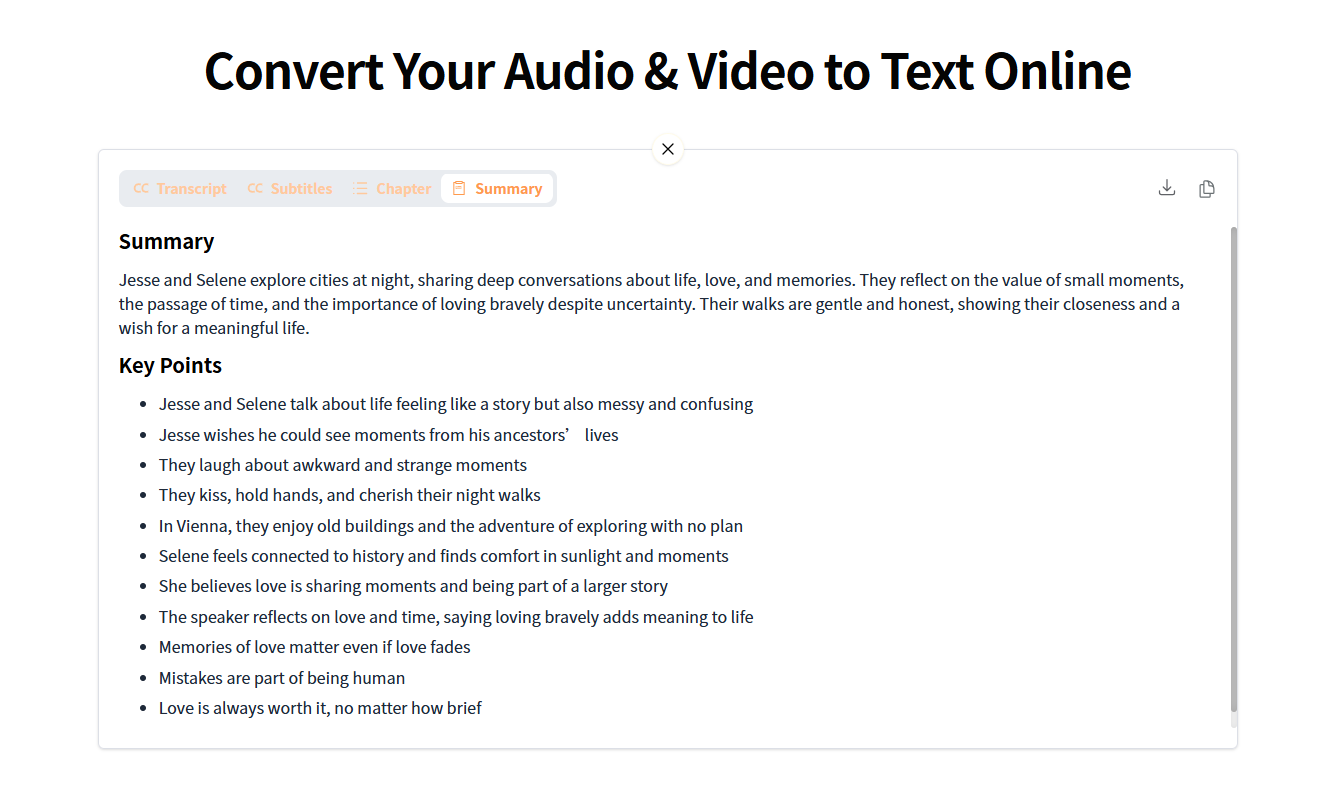
AI transcription example: A deep analysis of the Before trilogy is condensed into key points, letting creators quickly extract insights like “love is sharing moments” and “loving bravely adds meaning to life” for reviews, short videos, or social media.
Team Knowledge Sharing
In workplaces, team members often share industry event videos. Watching a 40-minute or longer video in full is often unrealistic. AI transcription solves this by automatically extracting key points and summarizing core information. A single click allows the content to be shared with the team, and everyone can grasp the essentials in minutes. Personal video collections become team knowledge assets, and information sharing jumps from hours to minutes.
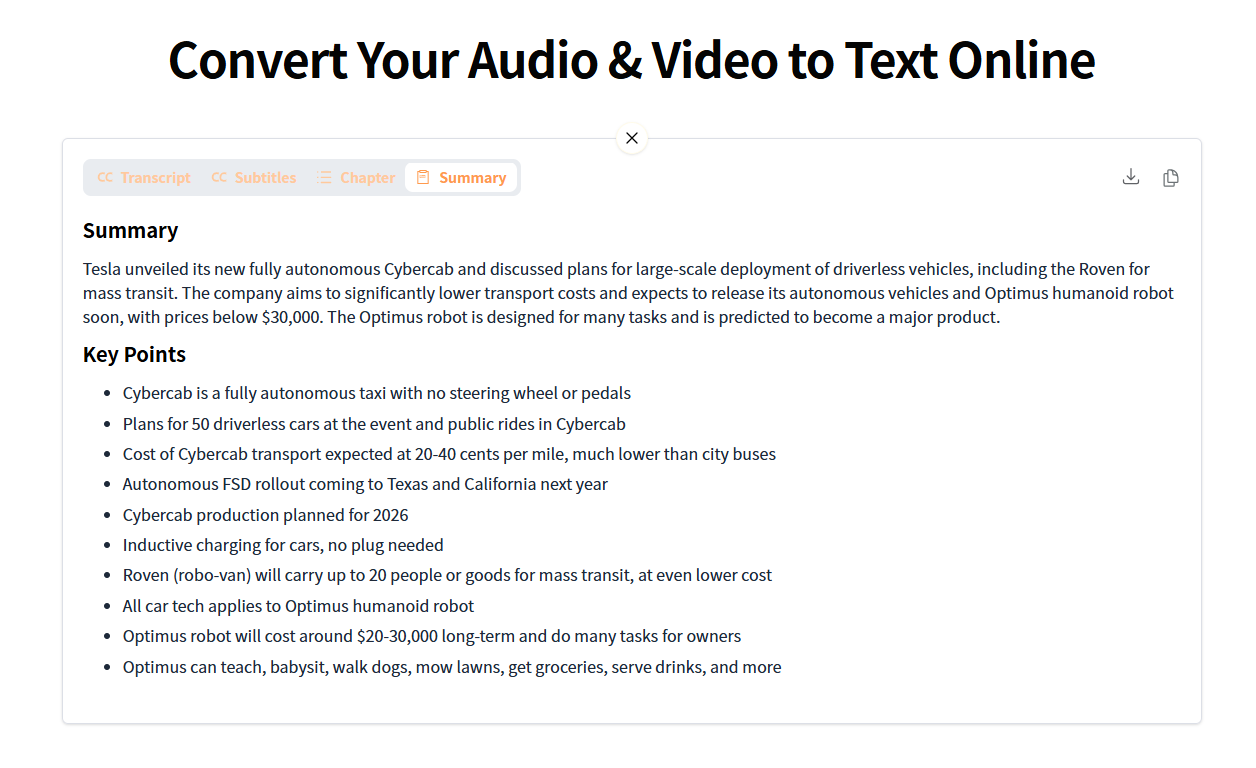
AI transcription example: Tesla Cybercab launch video condensed into a transcript with core summary and key takeaways.
4. How to Use AI YouTube Transcription
Here's a quick guide on how to use AI to transcribe a YouTube video. The process is simple:
Step 1: Copy the video link
Open the YouTube video you want to transcribe and copy the URL from the browser.
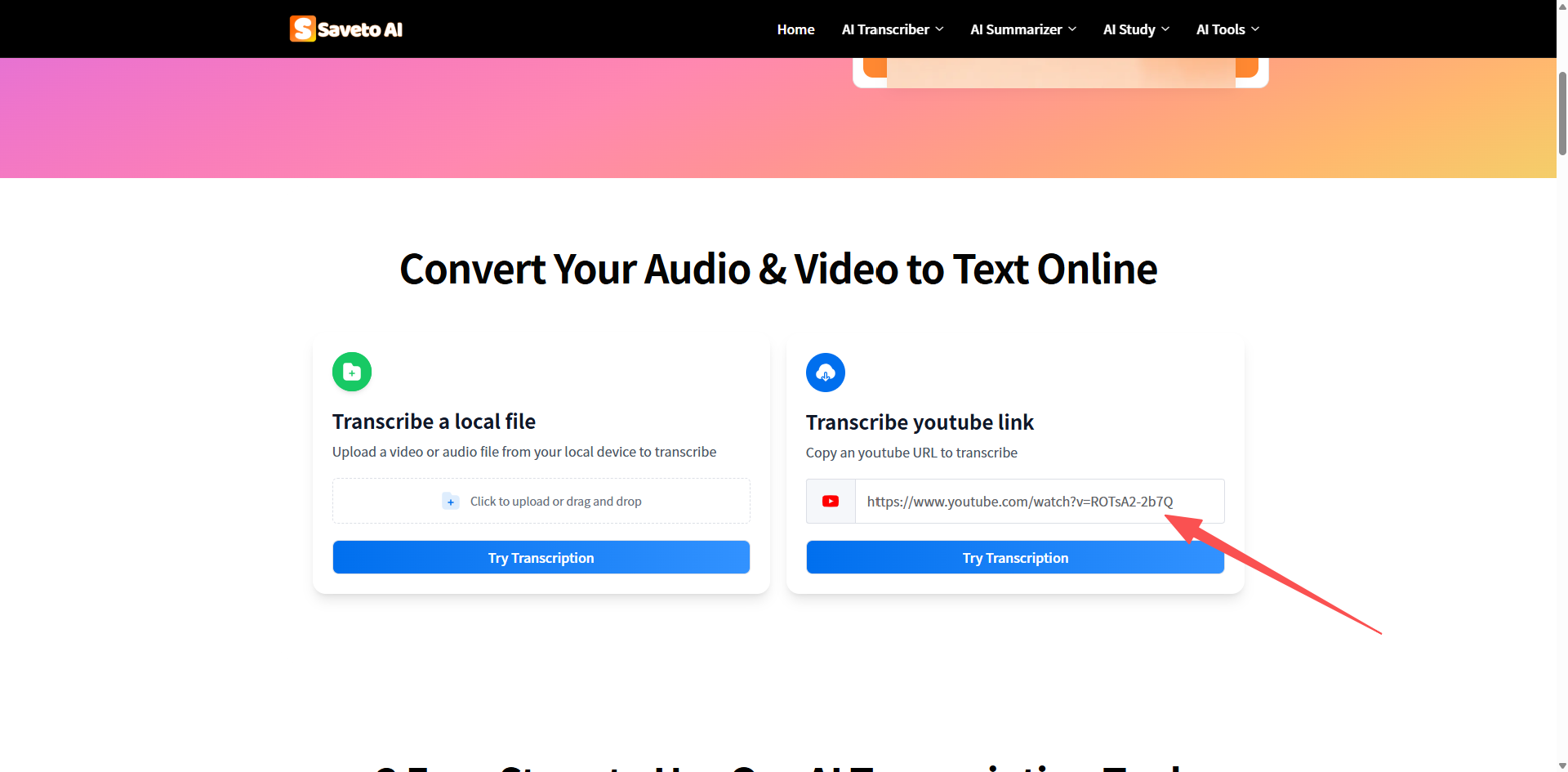
Step 2: Paste into Saveto AI
Visit Saveto AI, paste the video link into the input box, and click “Transcribe.” The AI will analyze the audio and generate a transcript automatically.
Step 3: Get the output
Within minutes, you’ll receive a full transcript, along with intelligent subtitles, chapter navigation, and a content summary—ready for reading, searching, and quoting. Even videos over an hour long can be distilled into key points, greatly improving information processing efficiency.
5. Three Trends Behind AI Transcription
AI transcription’s value goes beyond efficiency; it reflects three major shifts in video content:
Videos are being “textualized.”
Previously, video content was difficult to search, quote, or analyze. AI transcription converts it into structured text, turning videos from passive media into searchable, understandable, and reusable information assets.YouTube is evolving into a knowledge database.
Future information retrieval may follow this path: search a question → find a video → get an answer via AI transcription. With massive video content indexed and searchable, YouTube becomes a multimodal, globally accessible knowledge platform.AI transcription is the entry point for AI-powered workflows.
Once a video is converted to text, it can be summarized, translated, rewritten, and incorporated into knowledge management systems. From video → transcript → summary → knowledge, video content becomes fully understandable, organized, and reusable.

Join tingmin on Peerlist!
Join amazing folks like tingmin and thousands of other builders on Peerlist.
1
1
0