

Supercharging SEO with AI – My Journey to Efficiency
How Gemini and Chat GPT Revolutionize My Daily SEO Efforts
As an AI & SEO Specialist, I'm constantly exploring how cutting-edge technology can amplify our digital marketing efforts. The landscape of SEO is evolving at lightning speed, and for me, artificial intelligence isn't just a buzzword – it's an indispensable partner in achieving remarkable results in less time. I want to share how I leverage AI, particularly Gemini and the ChatGPT API, to revolutionize my daily SEO tasks.
Crafting Engaging On-Page Content with Gemini: The Infographic Advantage
One of the persistent challenges in on-page SEO is creating truly engaging and digestible content. While text is king, visuals like infographics can significantly boost user experience, reduce bounce rates, and improve content stickiness. This is where Gemini has become an absolute game-changer for me.
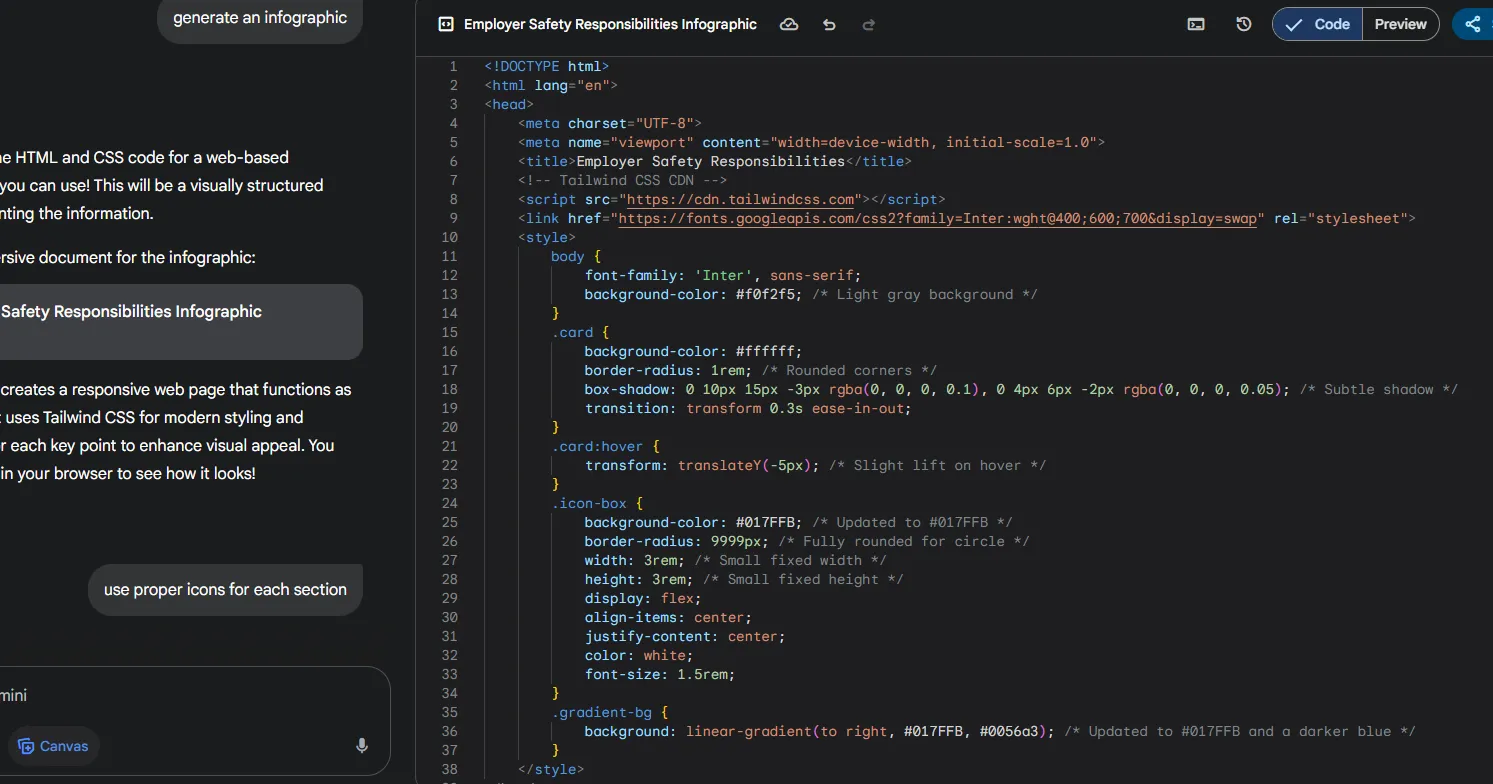
Instead of spending hours designing or outsourcing, I now turn to Gemini. For instance, when I need to visually represent complex data or processes for an on-page section, I provide Gemini with the raw text data – much like the medical negligence information I recently worked with. My prompt would be something like: "Create an infographic using the following data about common types of medical negligence. Provide the output as a complete HTML document with responsive design and Tailwind CSS, including a download option for PNG/WebP."
Gemini then processes this request, understanding the need for a structured, visually appealing output. It generates the entire HTML code, complete with styling and even the JavaScript needed for image downloads. This isn't just about generating text; it's about generating a fully functional, embeddable visual asset. Once I have the HTML, embedding it on a WordPress site is straightforward – usually, a simple copy-paste into a custom HTML block in the classic editor, and voilà, a professional, interactive infographic is live on the page, enhancing the content instantly. This process drastically cuts down on production time, allowing me to focus on strategic content planning rather than execution minutiae.
Automating Internal Linking with Chat GPT API and Link Whisper
Internal linking is the backbone of site architecture and crucial for distributing link equity, improving crawlability, and guiding users through a website. However, manually identifying optimal internal linking opportunities, especially on large sites, can be incredibly time-consuming and prone to oversight.
This is where another one of my projects comes into play, integrating the ChatGPT API with Link Whisper. Link Whisper is already a fantastic tool for internal linking suggestions, but by connecting it with the advanced natural language understanding of the ChatGPT API, I'm able to take automation to the next level.
My custom setup allows me to feed content (or even entire site sections) through the ChatGPT API. Based on the context and predefined rules, the API suggests highly relevant, semantically appropriate internal link anchors and target URLs. This goes beyond simple keyword matching; it understands the intent and relationship between different pieces of content. These intelligent suggestions are then fed into or cross-referenced with Link Whisper, providing automated, highly optimized internal linking recommendations that dramatically improve the efficiency and effectiveness of my internal linking strategies. It transforms what was once a tedious, manual task into a streamlined, AI-assisted process.
See the page medical negligence claim calculator for a reference.
The AI-Driven Shift in SEO: Efficiency is Key
The examples above underscore a critical truth about today's digital landscape: AI solutions are no longer a luxury but a necessity to achieve great objectives in less time. The sheer volume of data, the complexity of algorithms, and the speed at which search engines evolve demand intelligent automation.
The role of SEO professionals is shifting. We're moving away from being purely manual laborers, spending hours on repetitive tasks like basic content generation or link identification. Instead, AI empowers us to become strategists, overseers, and innovators. My time is now freed up to focus on higher-level thinking: understanding user intent, analysing market trends, refining overall content strategy, and experimenting with new AI-driven approaches.
AI isn't replacing SEO; it's supercharging it. It's allowing us to analyse more data, generate more insights, and execute tasks with unprecedented speed and precision. The SEO world is no longer just about keywords and backlinks; it's about leveraging intelligent systems to understand, predict, and influence search behaviour at scale. Embracing these AI solutions is not just about staying competitive; it's about defining the future of digital visibility.

Join Ujwal on Peerlist!
Join amazing folks like Ujwal and thousands of other builders on Peerlist.
0
7
0