

NothingLeft: The To-Do App That Respects Your Time
A minimalist to-do app built on restraint, designed to give you back your time instead of stealing it.
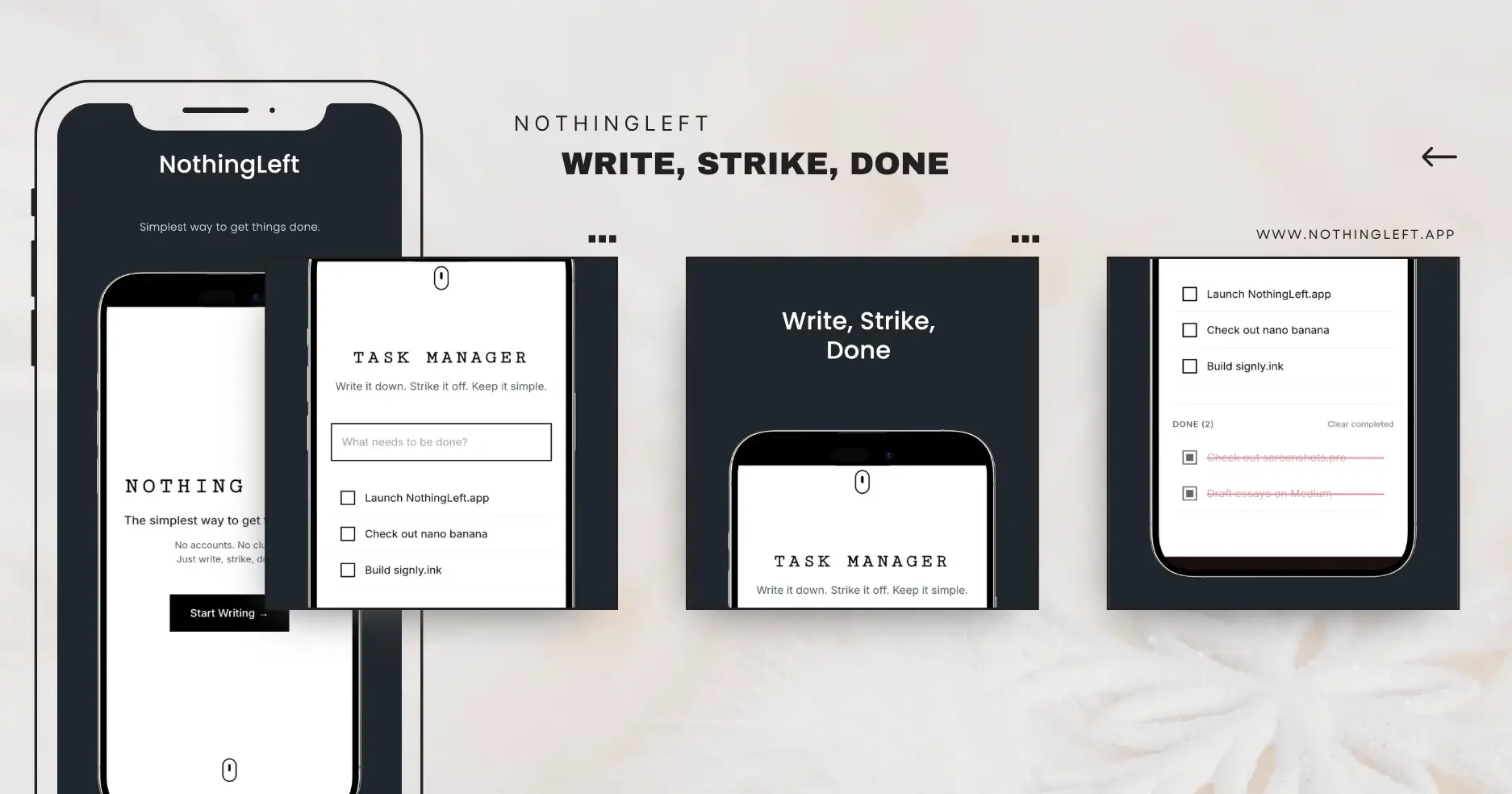
NothingLeft didn’t start as a company.
It started as frustration.
I wasn’t chasing a startup idea. I wasn’t trying to raise funding or build a productivity empire. I just wanted a simple to-do list—something that felt like pen and paper. Write. Strike. Clear.
No accounts. No ads. No dopamine traps.
But on the App Store and Play Store? Every app I tried was bloated. Dashboards. Streaks. Karma scores. Nudges. Productivity apps that seemed less about finishing work and more about keeping me inside the app.
That’s when it hit me: productivity software wasn’t built for productivity anymore. It was built for addiction.
The Slot Machine in Your Pocket
We all know why it’s so hard to put our phones down. TikTok’s infinite scroll. Instagram’s endless reels. Notifications engineered to spark a reflex.
That’s not accidental.
B.F. Skinner proved it decades ago. Animals press levers longer when rewards are unpredictable. Casinos turned that into slot machines. Silicon Valley turned it into app design.
Infinite scroll? A lever.
Red badges? A flashing light.
Streak counters? A jackpot sound.
We expect it from social media. We know Facebook and Instagram want our attention for ads. But when even a checklist app uses the same tricks, the trap feels complete.
Take Duolingo. Its genius isn’t in teaching Spanish—it’s in streaks. Thousands of users grind every day, not to become fluent, but to protect a number. The angry green owl makes sure of it.
Or Habitica. Your tasks become an RPG. Finish them, and your character thrives. Miss them, and you take damage. Fun for some, stressful for others. Either way, your goals are tied to a gamified loop.
Even Notion—the darling of modern productivity—plays softer versions of the same game. You spend hours designing dashboards, tweaking templates, linking databases. But how much of that effort actually moves your life forward? Sometimes the system itself becomes the work.
Then come the nudges. Todoist emails you when your Karma score drops. Google Calendar pushes goal-setting notifications. These aren’t reminders; they’re engineered FOMO. Miss one, and suddenly you feel behind.
The irony is sharp: tools that claim to save time often just colonize it.
The Illusion of More
As a full-stack engineer, I could have gone the same route.
I could have added cloud sync. Team features. Analytics dashboards. AI task suggestions. All the bells and whistles.
That’s the industry playbook: more features, more hooks, more engagement.
But I didn’t need more.
The real discipline wasn’t in writing code. It was in not writing it. Resisting the temptation to add one more “nice-to-have” that secretly steals focus.
Minimal wasn’t a limitation. It was the point.
The Blueprint
Here’s what I wanted:
A single screen.
A single list.
Write tasks, strike them out, clear them.
Local storage only. No accounts. No servers.
That’s it.
No streaks to defend.
No points to earn.
No badges to chase.
Just a tool that respects the truth: productivity isn’t about being more productive. It’s about being done.
When I open NothingLeft, I don’t see charts or dashboards. No confetti for yesterday’s wins. Just today’s list.
And when it’s clear? That silence is the reward.
Restraint Is the Hard Part
Anyone can build features. Few can say no.
No to notifications that re-engage.
No to streaks that manipulate.
No to data collection disguised as cloud sync.
In tech, restraint feels unnatural. Growth is king. Engagement is gospel. The whole industry asks: how long can you keep users inside your app?
But maybe that’s the wrong question. Maybe success isn’t measured in screen time, but in how quickly you can get back to real life.
A hammer isn’t great because you admire it daily. It’s great because it disappears until you need it.
That was the philosophy behind NothingLeft. No ego. No noise. Just empathy.
The Cost of Attention
There’s a phrase you’ve heard: if you’re not paying for the product, you are the product.
That’s why free apps demand your attention. They trade it for ads, upsells, or VC growth metrics. Your focus is their business model.
But focus is finite. Every buzz, badge, and confetti animation chips away at it.
When even a checklist app tries to play slot machine, the cost is too high.
A to-do app should give time back, not take it.
A Different Kind of Tool
I didn’t set out to take on Silicon Valley. I just wanted a tool that worked.
When I couldn’t find it, I built it.
NothingLeft doesn’t try to own your mornings. It doesn’t punish missed days. It doesn’t track how many tasks you log this week.
It doesn’t care.
It just sits quietly, waiting for the next thing you need to write down.
And it works precisely because of what it doesn’t have.
No servers.
No accounts.
No dopamine loops.
Just a list.
The Silence at the End of the Day
Every morning, I open NothingLeft. I write down what matters.
And every night, when I strike the last item off the list, there’s no fanfare. No scorecard. No streak to preserve.
There’s just silence.
The kind of silence only possible when an app steps out of the way.
That silence is the point.
Because productivity isn’t about being busy. It’s about being done.
NothingLeft.app → everything done.
Rebels in a Dopamine Economy
NothingLeft isn’t alone. Quietly, others are pushing back against the dopamine economy.
Email platforms like hey.com refuse to mine data or chase ads. They charge directly, respecting the inbox as private space.
Curation platforms like Are.na reject infinite scroll. No notifications, no algorithmic feeds—just focus.
Messengers like Signal and Threema champion privacy, open-source code, and dignity over engagement metrics.
Browsers like Brave protect against trackers and rethink the economics of the web.
Each is built on the same radical belief: attention is worth protecting.
The Value of Agency
What these tools share is not minimalism for its own sake, but respect.
They treat users not as metrics to manipulate, but as humans with limited time, energy, and dignity.
They design with transparency, even if that means slower growth. They create technology that restores agency instead of eroding it.
In a culture obsessed with engagement, that’s rebellion.
And for the burned-out, distracted, constantly-pinged among us, it resonates.
Why It Matters
The stakes go deeper than apps.
Our tools shape how we think, focus, and relate. When they’re engineered for addiction, they don’t just steal time—they reshape minds.
But tools designed with restraint open a different future. They honor rhythms, respect limits, and free attention for what actually matters.
This isn’t nostalgia. It isn’t Luddism. It’s a demand that technology serve us instead of owning us.
Attention is not infinite. It’s precious.
And any tool that respects that is worth fighting for.
A New Path Forward
The dopamine economy has thrived for a decade. Billions of hours sunk into scrolls, notifications, and streaks.
But pioneers— hey.com, Are.na, Signal, Brave—are pointing toward another way.
A future built on respect, not manipulation.
Where apps are tools, not traps.
Where minimalism isn’t lack, but liberation.
Where productivity means being done, not being busy.
Where your mind and your time belong to you.
This story is only beginning.
And it matters more than ever.
Join Vishnu on Peerlist!
Join amazing folks like Vishnu and thousands of other builders on Peerlist.
0
12
0