

84% of the World Has Never Used AI. You're Not Disrupting the World. You're Disrupting a Group Chat.
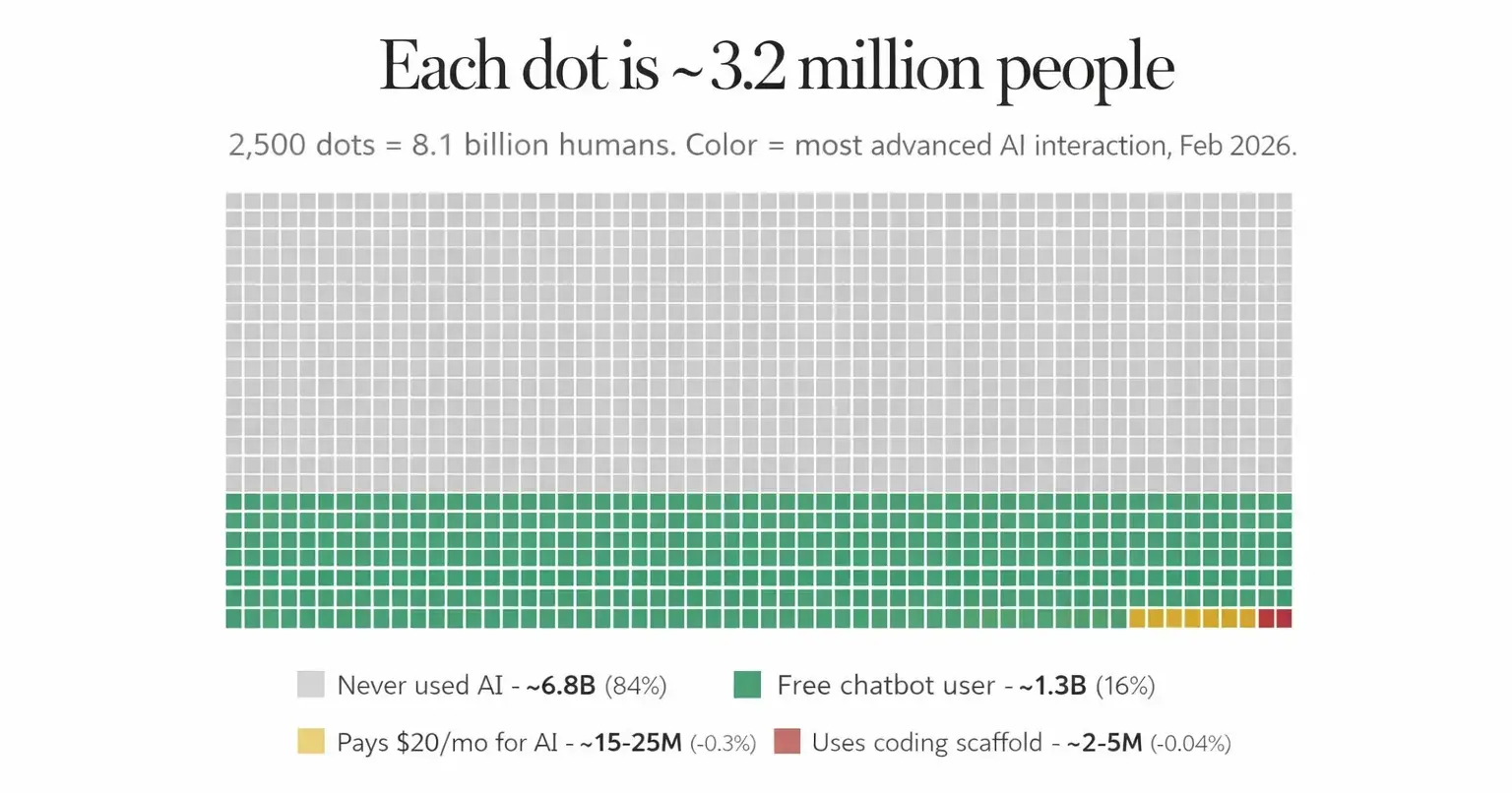
Look at the chart at the top of this post.
Each dot is 3.2 million people. 2,500 dots. 8.1 billion humans.
Gray: 84%. Never used AI. Never opened a chatbot. Never typed a single prompt. Green: 16%. Tried a free chatbot once or twice. Yellow: 0.3%. Paying for access. Red: 0.04%. Developers actually building with it.
That red dot is us. The people debating GPT-5 versus Claude Sonnet 4. The people in the Discord servers, the X threads, and the LinkedIn comment sections convincing each other that everything has changed forever.
We are a rounding error having a very loud conversation with ourselves.
And somewhere in that noise, we stopped looking at the actual world.
Part One: The Job Market Is Not Shifting Gradually. It's Being Restructured All at Once.
In 2025, AI was cited in nearly 55,000 layoffs in the US alone. Amazon restructured 30,000 roles. Salesforce eliminated 4,000 customer support positions after AI handled half their query volume overnight. Klarna went public while simultaneously announcing plans to reduce its workforce by a third. These are not cautionary tales. These are highlights from earnings calls that investors applauded.
Employee anxiety about AI replacing their job jumped from 28% in 2024 to 40% in 2026, according to Mercer's Global Talent Trends report. And 62% of those employees say their leaders are underestimating the emotional toll of what is actually happening on the ground. Not the macro numbers. The daily experience of watching your role shrink, your responsibilities get absorbed by a tool, and your career path quietly rerouted.
Here is the part that should stop you mid-scroll: the Yale Budget Lab analyzed labor data through late 2025 and found no significant macroeconomic disruption yet at scale. The layoffs are real. The restructuring is real. But the full wave has not arrived. We are standing in the eerie stillness before the water comes back. The tsunami metaphor that the IMF used at Davos in January 2026 is accurate not because the damage has happened, but because we can see exactly what is coming and most people are still standing on the shore.
Entry-level roles, the ones that used to be how you proved yourself and got started, are being automated first. Workers aged 22 to 25 in AI-exposed fields are already seeing a 13% employment drop. 37% of business leaders plan to replace human workers with AI before the end of 2026. The corporate ladder is not wobbling. It is being removed from the bottom up.
The traditional career deal was always this: trade your ceiling, your time, and your freedom in exchange for stability and a salary. That deal made sense when stability was real and lasted decades. It makes considerably less sense when the company can restructure you out in a single quarter and call it, in the words of an actual earnings call, "reallocating resources toward AI."
That is the language now. You need to hear it clearly.

Part Two: We Are in a Bubble. And the Proof Is What We Keep Building.
Everyone in our circles is building on AI. Agents. Wrappers. Copilots. Vertical LLM tools. AI-native SaaS. The conversations sound revolutionary. But look at what is actually being shipped.
Another chatbot wrapper on the OpenAI API. Another smart form with an LLM underneath. Another productivity tool for people who already have 47 productivity tools and are actively ignoring most of them.
We are selling to each other. Pitching investors who are pitching other investors. Writing posts that get engagement from people who are also writing posts about AI, creating a feedback loop that feels like momentum but is mostly just noise bouncing around a very small room.
There is also a technical honesty problem. People are still referencing GPT-4o in demos and pitches in 2026, when GPT-5 shipped in August 2025. The model infrastructure we claim to be experts in has already lapped us. And this points to the deeper issue: the model is not your moat. It never was. Every foundation model is available to anyone with a credit card. "We use AI" is not a competitive advantage in 2026. It is table stakes, the same way "we have a website" was table stakes in 2010.
The actual moat is understanding a problem so deeply, so specifically, so intimately, that you can build something the people who have that problem will choose over everything else.
And most of the problems worth solving are nowhere near this bubble.
Part Three: Apps Are Not Dead. They Are the Most Powerful They Have Ever Been.
This is the narrative that quietly derailed a generation of builders.
Someone said "apps are saturated" and the whole room nodded and moved on. Everyone accepted it as received wisdom and either stopped building apps altogether or pivoted to building AI tools for other people building AI tools. The people who believed the apps-are-dead story handed the next decade to the people who didn't.
The mobile app market crossed $330 billion in revenue in 2025. It is on track to cross $633 billion by end of 2026. Humanity is currently spending 5.5 trillion hours per year inside apps. The average person spends over five hours a day on their phone. India's app install growth rate hit 190%. Brazil is the third largest app download market in the world. Indonesia, Nigeria, Mexico, and Vietnam are all growing faster than any Western market.
The market is not dead. It is the largest attention surface in human history and the majority of the world is still coming online for the first time.
What is dead is the lazy version of the idea. The copycat. The clone built for a Western audience that is already saturated with options. That version deserved to die because it was never really about solving a problem. It was about copying a template and hoping for luck.
What is alive and massively underbuilt is something different entirely: apps built with genuine craft, genuine insight into a specific community's real daily friction, and a business model that actually respects the person using it. Apps so specific and so good that they feel like they were built by someone who actually lived the problem and refused to accept that it couldn't be solved better.
The best app ideas in the next ten years will not come from product roadmaps in San Francisco. They will come from founders who understand communities that the industry has spent twenty years ignoring. A founder in Lagos who sees exactly what informal traders need to manage their cash. A builder in Jakarta who understands how families actually move money across generations. Someone in Bangalore who knows what a student needs at 11pm the night before an exam when anxiety is high and options are limited. These are not niche ideas. These are the seeds of generational companies.
Software has never been more powerful. The question is never whether apps are alive. The question is whether you are building one worth caring about.
Part Four: The 9 to 5 Is a Subscription to Someone Else's Risk.
Let's be precise about what employment actually is in 2026.
You take on all the career risk of being inside a company that can restructure at any moment, while capturing none of the upside of what you are building. The company captures the compounding value. You capture a salary, a job title, and two weeks of paid time off per year if you are in the US. The math has never been great. Right now, it is actively getting worse.
This is not an argument against employment. Some people want stability and that is completely valid. But it is worth being honest that the stability being offered is increasingly theoretical. When 37% of business leaders are actively planning to reduce human headcount using AI before the year is out, and when entry-level roles are the first to disappear, the protection that the traditional job was supposed to offer is quietly being removed while the branding of stability remains.
Entrepreneurship is not easy and it is not romantic and it will not feel the way the LinkedIn posts make it sound. But building something you own, something real people pay for because it genuinely helps them, is more durable than optimizing for a performance review at a company that may automate your role before your next review cycle arrives.
The infrastructure cost to build has collapsed completely. A solo founder in 2026 has access to capabilities that required a 40-person engineering team five years ago. You can prototype in a weekend. You can validate in a month. You can reach a global audience without a sales team or a marketing budget that requires outside funding. The tools exist. The leverage exists. The cost of starting is, in many categories, close to zero.
The only thing still expensive is bad direction.
The Final Act
The gray dots in that chart are 6.8 billion people. Real people with real daily frustrations, real aspirations, real money, and almost nothing in their hands that was designed with them genuinely in mind.
You have the tools that no previous generation of builders has ever had. You have the leverage. You have the access to markets, to infrastructure, to distribution that used to require decades and hundreds of millions of dollars. You can build a real product, for a real audience, that solves a real problem, and reach them directly, in less time and for less money than ever before in the history of software.
The apps are not dead. Software is more powerful than it has ever been in human history. The only question left is whether you are going to use that power to build another wrapper for the red dot, or build something genuinely beautiful for the world.
Stop waiting for permission from a company that is quietly planning its next round of restructuring.
Build something you own. Build something that matters. Build it like the opportunity is real, because it absolutely is.

Join Vikas on Peerlist!
Join amazing folks like Vikas and thousands of other builders on Peerlist.