

What Happens When You Install a 7-Agent Engineering Team Into Your IDE
587 commits. 7 repos. 204,005 lines of production code. 1 person. 44 days.
587 commits. 7 repos. 204,005 lines of production code. 1 person. 44 days.
Those numbers came from running git log across our repos between February 14 and March 30, 2026. No projections, no estimates. Verified output from a solo founder running the iKawn Team Plugin.
The plugin in 60 seconds
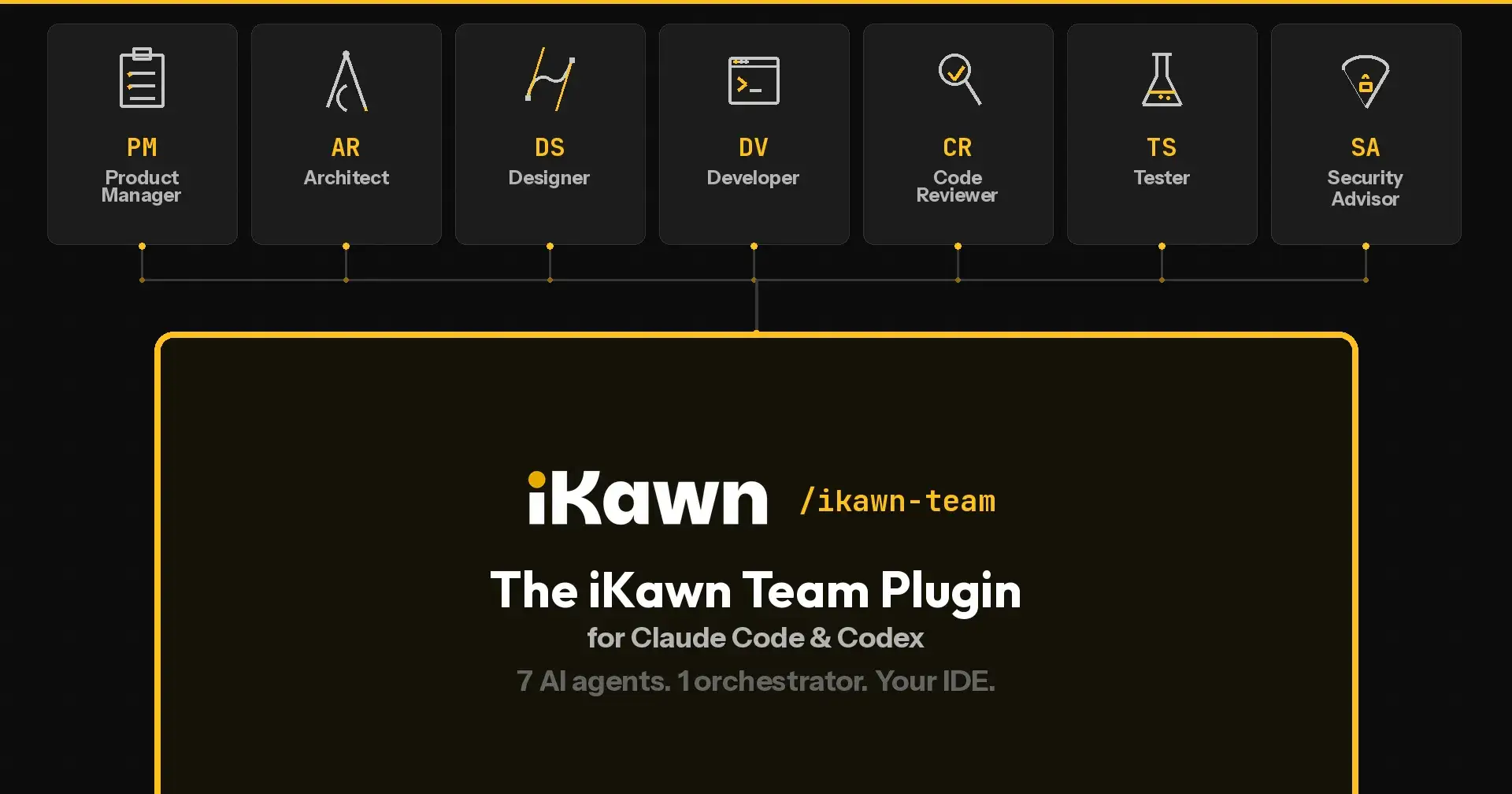
The iKawn Team Plugin drops seven specialized roles into your coding environment. Product Manager, Architect, Designer, Developer, Code Reviewer, Tester, Security Advisor. Each role has a defined scope. Each role follows the one before it. The orchestrator sequences them automatically based on the task you hand it.
You describe what you want built. The Product Manager writes the brief. The Architect maps the implementation. The Designer handles the visual layer. The Developer writes the code. The Code Reviewer audits it against the original plan. The Tester verifies it works and writes the acceptance checklist. The Security Advisor scans for vulnerabilities. You get back a finished piece of work that has been scoped, planned, built, reviewed, tested, and hardened.
That loop runs in minutes. Not days. Not sprints.
Why process matters more than speed
Most conversations about agentic coding focus on how fast you can generate code. That framing misses the point entirely. Speed without structure produces garbage at scale. The plugin is not a faster code generator. It enforces the same workflow that high performing engineering teams follow when they are operating at their best.
Every task gets a brief before anyone writes a line. Every implementation gets an architecture review. Every piece of code gets checked by someone (or something) that did not write it. Every feature gets tested. Every deployment gets a security pass.
The difference is not just velocity. It is the elimination of the shortcuts that create technical debt, security holes, and maintenance nightmares six months down the road.
What this changes for small teams
Context loss is the silent killer for small teams. When a single developer holds all the knowledge about a project, every absence is a risk and every departure is a crisis. The plugin externalizes that context. Planning documents, architecture decisions, review comments, test plans, all of it lives in the repository. The knowledge belongs to the project, not to any individual.
This also changes the economics of quality. On most small teams, rigorous code review and security scanning are luxuries reserved for critical releases. With the plugin, they happen on every single change. The cost of discipline drops to near zero when the process runs itself.
Where this sits in the iKawn platform
iKawn started as a Visual OS for commerce brands. Agents like Genie, Prism, Lazarus, and Muse handle everything from product photography to video production to social distribution. The Team Plugin applies the same orchestration architecture to software engineering.
The underlying principle across all of it is consistent. Complex work is a sequence of specialized roles passing context to each other. Get the orchestration right and you compress timelines without sacrificing the quality that process is supposed to protect.
How to get access
The iKawn Team Plugin is currently available exclusively to partner agencies working with iKawn. We are bringing on a small cohort of agency partners over the coming weeks.
If you want to see what your engineering output looks like with seven roles running in your IDE, reach out directly. I am happy to walk through a live demo.
587 commits. 204,005 lines. 44 days. 1 person. The numbers speak for themselves.

Join Vineet on Peerlist!
Join amazing folks like Vineet and thousands of other builders on Peerlist.
0
10
0