

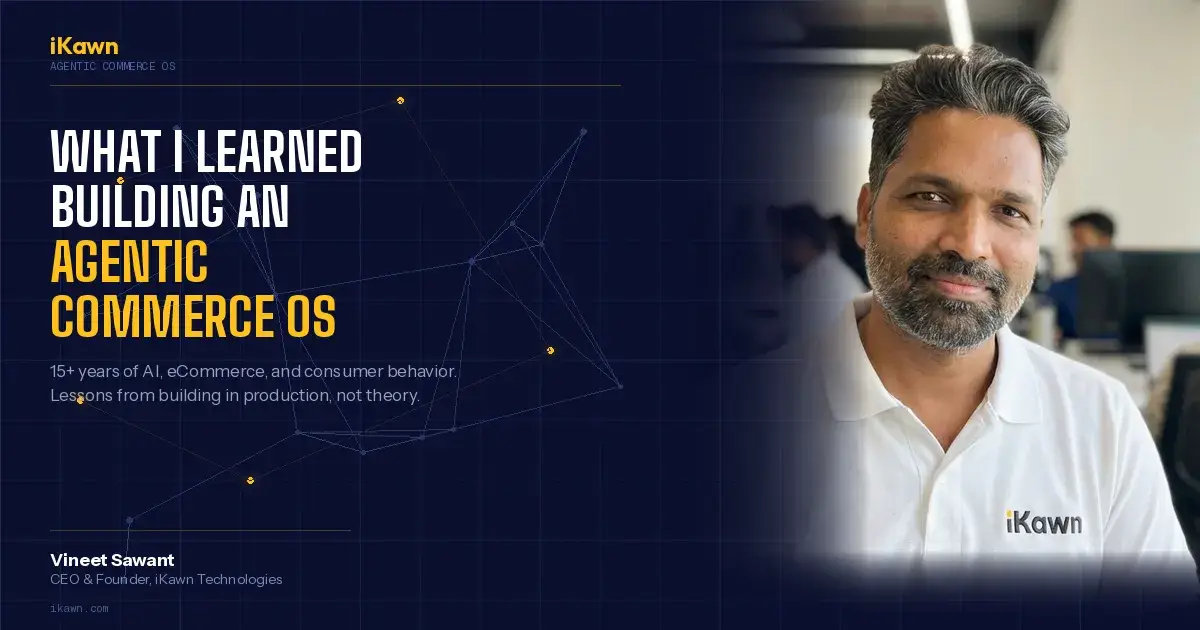
What I Learned Building an Agentic Commerce OS
By Vineet Sawant, CEO & Founder, iKawn
I've spent 15+ years at the intersection of AI, eCommerce, and consumer behavior. I've watched brands throw money at tools that promise efficiency and deliver dashboards. I've sat in meetings where "AI strategy" meant bolting a chatbot onto a website and calling it innovation.
In 2025, I started building iKawn because I was tired of watching the same pattern repeat: smart people, good products, terrible execution velocity. Not because they lacked strategy. Because they lacked the infrastructure to execute at the speed their market demanded.
This is what I've learned so far.
The problem is not what you think it is
Every D2C founder I've spoken to can articulate their strategy clearly. They know their audience. They know what content to create. They know which channels matter.
What they can't do is execute at scale without burning out their team or burning through their budget.
A typical content workflow at a mid-size D2C brand looks something like this: someone has an idea, a designer spends two days on it, a copywriter adds captions, someone schedules it, someone else checks performance a week later. Five people, five handoffs, five days for one carousel post.
The problem was never "what should we do." It was always "how do we do it fast enough to matter."
Why tools alone don't solve this
The market response to this has been more tools. Canva for design. Hootsuite for scheduling. Google Analytics for measurement. ChatGPT for copy. Each tool solves a slice of the problem and creates a new integration headache.
I call this the SaaS Frankenstein problem. You stitch together 8 tools, connect them with Zapier, hire someone to manage the stack, and congratulate yourself on "digital transformation." Meanwhile, your competitor with a 3-person team and better instincts is outpacing you because they move faster with less.
The insight that led to iKawn was simple: the bottleneck is not the absence of capability. Every capability exists somewhere. The bottleneck is orchestration. Getting the right capability to fire at the right time, with the right context, without a human being the glue between every step.
What "agentic" actually means in practice
The word "agentic" is becoming as overused as "AI-powered" was in 2023. So let me be specific about what it means inside iKawn.
An agent in our system is not a chatbot. It's not a wrapper around an LLM. It's a specialized function that can sense context, make decisions within defined boundaries, and execute without waiting for human approval on every micro-step.
We built named agents, each with a clear domain. Genie handles product image generation. Remix transforms existing assets. Prism creates variations at scale. Lazarus generates video from stills. Muse produces cinematic brand content. Shopkeeper manages the storefront intelligence layer.
None of them work in isolation. The real product is Ruhi, the orchestration layer that coordinates these agents based on what the business actually needs, not what someone remembered to ask for.
The difference between a tool and an agent is autonomy within guardrails. A tool waits for instructions. An agent observes, decides, and acts. You set the goal. It figures out the path.
The architecture decision that changed everything
Early on, we faced a fork in the road. We could build a creative pipeline, a really good one, that takes briefs and outputs content. Or we could build an intelligence layer that understands why content needs to exist and what it should accomplish.
We chose the second path. We called it the Sense, Decide, Orchestrate, Outcome framework.
Sense means the system understands your business context. Not just "you sell shoes" but "your best performing SKU is the white sneaker, your audience engagement peaks on Thursday evenings, and your competitor just launched a campaign targeting the same demographic."
Decide means the system can prioritize. Should you create a new product shoot or remix your existing best performer? The answer depends on data, not instinct.
Orchestrate means the right agents activate in the right sequence. Generate the visual, write the copy, set the hashtags, schedule the post, monitor the response. One flow, not eight tools.
Outcome means everything traces back to a business result. Not "we posted 30 times this month" but "this campaign drove a 12% lift in add-to-cart."
This framework is what makes iKawn a Commerce Intelligence OS rather than another creative tool.
What nobody tells you about building with AI agents
Here are a few things I learned the hard way.
Unit economics will surprise you. Generative AI is not cheap when you're running it at production scale. We went through a painful period where certain features had negative margins because we hadn't modeled the actual API costs per generation at realistic usage volumes. We had to restructure pricing twice before the math worked.
The "Mercedes Principle" matters. When selecting your AI backbone, always choose the best available technology at the time of implementation. We went through model evaluations methodically because the difference between a good model and the best model compounds across millions of decisions. Cutting corners on the intelligence layer to save on API costs is a false economy.
Edit deltas are your highest-signal training data. When a user takes AI-generated output and modifies it, that edit is worth more than a thousand thumbs-up ratings. It tells you exactly where the model's judgment diverged from the user's intent. We designed our data architecture around capturing these signals from day one.
Your first architecture will be wrong. We built, rebuilt, and rebuilt again. 182 commits across 13 days on one sprint alone, roughly 50,000 lines of code. The willingness to tear down and reconstruct is not a sign of poor planning. It's a sign of learning fast enough to matter.
Why this isn't just about eCommerce
We started with D2C brands because that's where I have the deepest domain expertise. But the core problem, execution velocity limited by manual orchestration, exists everywhere.
Travel companies need to produce destination content across 15 channels. OOH media companies need dynamic creative that adapts to location and context. Retail brands need to localize campaigns across dozens of markets simultaneously.
The pattern is identical. A business knows what it wants to do. The gap between knowing and doing is where value gets destroyed. Any industry where content, decisions, and execution intersect at speed is a market for an agentic OS.
What I'd tell founders building in the AI space right now
Don't build a feature. Build a system. Features get commoditized in months. A system that compounds intelligence with every interaction gets harder to replicate over time.
Sell outcomes, not capabilities. Nobody cares that you can generate an image in 3 seconds. They care that their content pipeline now runs 10x faster with half the team. Frame everything around the business result.
Be honest about what's hard. Token costs, latency, hallucination, model degradation, context window limits: these are real engineering problems, not marketing footnotes. If you pretend they don't exist, your customers will discover them for you at the worst possible time.
Platform thinking beats feature factory. The temptation is to keep shipping features because each one feels like progress. Resist it. Build the connective tissue between features first. An orchestration layer that makes 5 features feel like one system is worth more than 15 disconnected features.
Where we're going
iKawn is targeting a Series A by October 2026. We're live with clients, expanding beyond eCommerce, and building toward a future where Ruhi is the primary interface, not a support widget but the operating system for commercial decision-making.
The vision is straightforward. A business logs in, tells Ruhi what they want to achieve, and Ruhi handles the rest: sensing the market, deciding the approach, orchestrating the agents, and delivering the outcome. The human stays in the loop for judgment calls. Everything else is automated.
If you're building in the AI agent space or investing in it, I'd love to connect. The companies that will win the next decade aren't the ones with the most features. They're the ones with the best orchestration.
Vineet Sawant is the CEO and Founder of iKawn Technologies FZ-LLC, an Agentic Commerce OS for brands and agencies. Based in Dubai, iKawn helps businesses move from insight to execution at the speed their market demands. Learn more at ikawn.com.

Join Vineet on Peerlist!
Join amazing folks like Vineet and thousands of other builders on Peerlist.
0
7
0