

Building a Marketing Tool by Solving My Own Problems First
Wonderflow didn’t start as a startup idea.
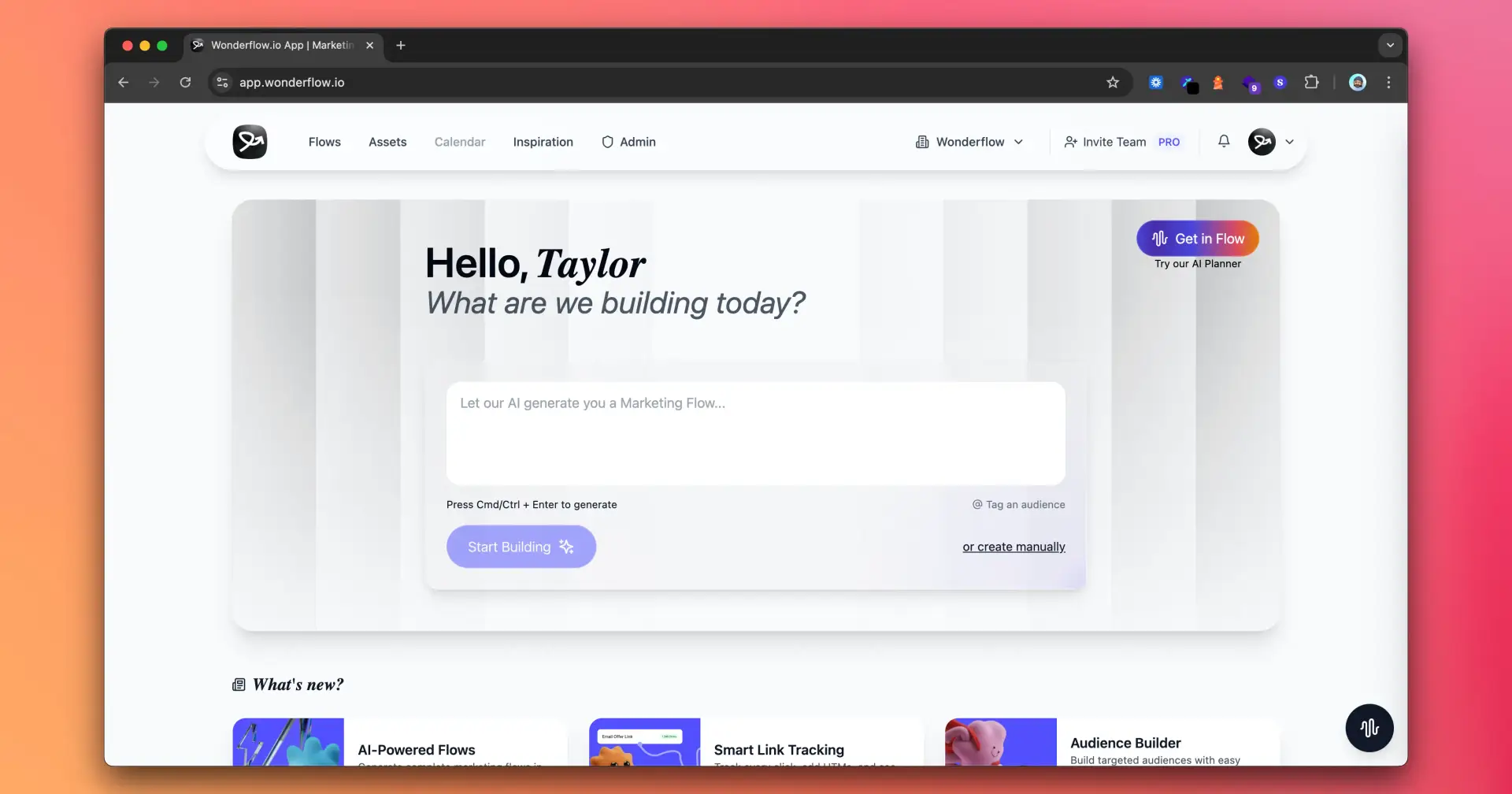
There was no pitch deck, no big vision statement, and no intention to “build a product.” It started the way most real things do—by repeatedly running into the same problems while doing actual work.
I’ve spent years working in and around marketing teams. Different companies, different sizes, different goals—but the same friction kept showing up.
Campaigns lived in documents.
Planning lived in spreadsheets.
Assets lived everywhere.
Strategy mostly lived in people’s heads.
Everyone was busy. Everyone was shipping. And yet, planning always felt rushed or incomplete—something you did after execution had already started.
That’s where the real pain came from. Not theory. Not market research. Just doing the work and feeling the gaps.
The Problem Wasn’t Execution — It Was Thinking
Most marketing tools focus on execution. Launch faster. Ship more. Automate everything.
But what I kept running into was the opposite problem: teams weren’t short on tools—they were short on clarity.
Questions like:
Who is this actually for?
What problem are we solving?
How do these pieces connect?
What does success even look like?
Those questions were either answered too late or not at all.
Over time, it became clear that marketing doesn’t usually fail because people aren’t working hard enough. It fails because teams skip the thinking and jump straight into doing.
Early Assumptions I Got Wrong
When I first started sketching ideas for what eventually became Wonderflow, I made some very reasonable assumptions.
I assumed people wanted:
More execution tools
Faster output
AI that generates things for them
But once I started showing early versions to real users, those assumptions fell apart.
What people actually responded to wasn’t speed or automation—it was structure.
They liked seeing the full picture.
They liked slowing down before launching.
They liked having a place where strategy lived, visibly.
The biggest surprise?
AI was most useful when it helped people think, not when it tried to replace their thinking.
Problem–Solution Fit Is Messy (and That’s Okay)
There’s a lot of talk about “finding problem–solution fit,” but it’s rarely clean or obvious.
In my experience, it’s not a single moment—it’s a gradual process. Ideas start blurry, get reshaped through conversations, and slowly solidify as people interact with them.
Wonderflow lived in that in-between phase for a long time.
Instead of trying to build for everyone, I focused on a small group of people who felt the pain deeply—marketers who were already cobbling together systems just to stay organized.
These early users didn’t care about polish. They cared about relief.
That distinction matters more than most founders realize.
What Early Users Taught Me
The most valuable part of this process wasn’t validation—it was surprise.
Users kept reacting to things I hadn’t optimized for:
Visual planning
Slowing down to think
Seeing strategy mapped out
Using AI as a collaborator, not a shortcut
The feedback wasn’t “this saves me time.”
It was “this makes me think more clearly.”
That shifted the entire direction of the product.
Wonderflow stopped being about efficiency and started being about clarity.
Writing Things Down Changes Everything
One pattern kept coming up: when people externalized their thinking—by writing it down, mapping it out, or visualizing it—the problem suddenly felt solvable.
That idea sits at the core of good problem solving:
Break problems into smaller parts
Reframe them honestly
Identify what’s actually causing the issue
Decide what to do next
When applied to marketing, this often revealed an uncomfortable truth: most problems weren’t tactical—they were structural.
Wonderflow became a place to make that thinking visible.
Wonderflow Was a Byproduct, Not the Goal
At some point, it clicked: I wasn’t “deciding” to build Wonderflow.
It was emerging naturally from repeatedly trying to solve the same planning problems.
The product wasn’t driven by ego or trends. It wasn’t built to chase AI hype. It was built because the work demanded a better way to think before executing.
That origin shaped everything:
Planning before execution
Brand context before AI output
Collaboration inside the work, not around it
Clarity over speed
Planning Before You Scale
Most tools assume you already know what you’re doing.
Wonderflow assumes the opposite.
It assumes that thinking is the hard part. That clarity is earned. And that execution without alignment only makes chaos louder.
Slowing down to plan isn’t a step backward—it’s how you avoid fixing the same problems later.
What I’d Do Again (and What I’d Avoid)
If I were starting over, I’d absolutely do these things again:
Start with my own pain
Talk to people doing the work
Stay focused on a small group
Let real usage shape the product
And I’d avoid:
Building for “everyone”
Validating ideas in isolation
Confusing excitement with real need
Scaling before clarity
One lesson stands above the rest:
Your time is more valuable than your ideas.
Protect it by working on problems that matter.
Build for the Problem, Not the Ego
Most products don’t fail because the idea was bad.
They fail because the problem was never deeply understood.
Solving your own problems first doesn’t guarantee success—but it gives you a grounded place to start. One rooted in reality, not assumptions.
Wonderflow exists because these planning problems kept showing up—and solving them once wasn’t enough.
If there’s one takeaway from this journey, it’s this:
Build for the problem.
Listen when users surprise you.
And don’t let your ego lead the product.
That’s how Wonderflow came to be.

Join Taylor on Peerlist!
Join amazing folks like Taylor and thousands of other builders on Peerlist.
1
5
1