

We Built Session Replay That Can't Spy on Your Users. Here's Exactly How.
How GhostlyX Analytics delivers full session replay and UX signals without capturing a single character of user data.
Most session replay tools record everything. Every keystroke, every form field, every private message your users type. Then they store it on servers you don't control, in jurisdictions you didn't choose, feeding machine learning models you never consented to.
We built GhostlyX Analytics because we were tired of it. Tired of paying hundreds per month for tools that treat user privacy as a settings toggle. Tired of watching big tech monetize behavioral data under the guise of "product improvement." Tired of the implicit deal: hand over your users' most intimate interactions, and we'll show you a heatmap.
Session replay is genuinely useful. Watching a user struggle with a broken flow tells you more than any A/B test. But the technology has been weaponized against the very people it's supposed to help understand. So we asked a simple question: can you build session replay that's actually useful without recording anything private?
The answer is yes. And we didn't do it with toggles or opt-out checkboxes. We did it at the architecture level.
What Is Session Replay and Why Should You Care About Privacy?
Session replay records how visitors interact with your website: clicks, scrolls, mouse movements, page transitions. It reconstructs these interactions as a video-like playback so you can see exactly where users get confused, frustrated, or drop off.
The problem is that traditional session replay tools capture the full DOM, including every piece of text on the page, every form input, every error message. That means names, emails, passwords, credit card numbers, private messages, medical information, and anything else visible on screen gets shipped to a third-party server.
Even tools that offer "privacy modes" typically record everything first, then redact on the server side. Your data still leaves the browser. It still crosses the network. It still lands on someone else's infrastructure before any masking happens.
How GhostlyX Does It Differently
Text Masking Happens Before Data Leaves the Browser
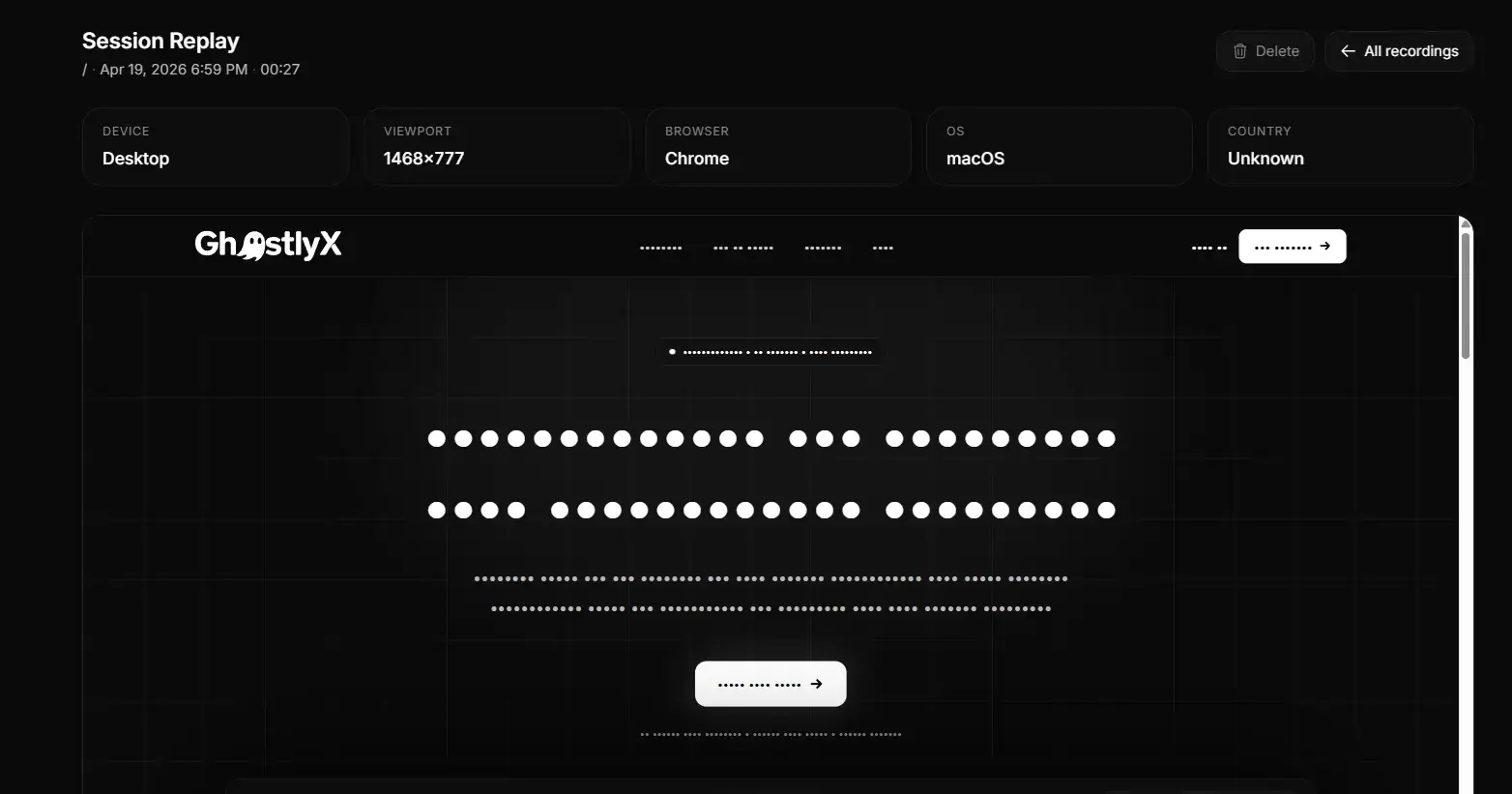
Every single character of text content is replaced with a bullet character (•) inside the browser, before any data is transmitted. This isn't a server-side filter. This isn't a post-processing step. The original text never exists in our data pipeline at all.
When the recording script serializes your page's DOM, every text node is masked by default. The word "John Smith" becomes "•••• •••••". The paragraph explaining your pricing becomes a block of bullets. The error message showing a user's email becomes unreadable.
This means even if someone compromised our entire infrastructure, they would find nothing but bullet characters where text should be.
PII Detection Runs as a Second Layer
Even for elements you explicitly choose to unmask (like navigation labels or button text that contain no user data), we run a secondary PII detection layer. This catches patterns like:
Email addresses that might appear in unexpected places
Phone numbers in various formats
Credit card numbers including spaced and hyphenated formats
If a navigation label somehow contains an email address, it gets redacted regardless of unmask settings. The PII layer is not optional. It runs on everything.
Input Values Are Always Masked. No Exceptions.
Form inputs, textareas, and select fields are always masked. There is no setting to unmask them. There is no override. There is no "but what if I really need to see what they typed" escape hatch. If a user types something into a field, we do not record what they typed. Full stop.
This is a deliberate, permanent architectural decision, not a default you can change.
Contenteditable Elements Are Always Masked
Any element with contenteditable is treated as user-entered data and is always masked. Rich text editors, inline editing fields, comment boxes built with contenteditable: all masked, always.
Exclusion for Sensitive Sections
For sections of your page that shouldn't appear in recordings at all (not even as masked content), you can mark elements for complete exclusion. The element and all its children are omitted entirely from the recording snapshot. They don't exist in the data. They aren't masked. They simply aren't captured.
How UX Signals Work Without Reading Content
Here's what surprises most people: our rage click detection, dead click detection, and u-turn detection work perfectly without reading any text content.
Rage clicks (a user frantically clicking the same spot) are detected using only three data points: the X coordinate, the Y coordinate, and the timestamp. Three or more clicks within 500 milliseconds in a small radius triggers the signal. We don't need to know what the button said. We just need to know it was clicked repeatedly in frustration.
Dead clicks (clicks on non-interactive elements) use a CSS selector built from tag names and class names. No text content is included.
U-turns (quick navigation reversals) use only page URLs and timestamps.
Every UX signal we surface is derived from coordinates, timing, and structural metadata. None of them require reading what's on the page.
Anonymous Visitor Identification
We don't use cookies. We don't use fingerprinting. We don't store IP addresses.
Instead, we generate a rotating anonymous hash that resets every 24 hours. This gives you session continuity within a single day (so you can watch a complete user journey) without enabling cross-day tracking. You cannot follow a specific visitor across multiple days. You cannot build a profile. You cannot identify individuals.
This isn't a privacy mode. It's the only mode.
What We Actually Store
Here's an honest accounting of what a GhostlyX session recording contains:
Masked DOM snapshots: page structure with all text replaced by bullet characters
Click coordinates and timestamps: where on the screen, when, nothing about what was displayed there
Scroll positions and viewport changes: how far down the page, how big the window
Page navigation events: which URLs were visited, in what order
CSS selectors: built from tag names and class names only
Error events: with messages masked using the same text masking rules
Device metadata: screen size, browser type, operating system
What we don't store:
Text content from your pages
Form input values
User-entered data of any kind
Cookies or session tokens
IP addresses
Fingerprints or persistent identifiers
Anything that could identify a specific human being
Why We Built This
The analytics industry has a business model problem. When your revenue depends on collecting as much data as possible, privacy will always be an afterthought. Every "privacy feature" is a concession, a reluctant toggle added after regulators came knocking.
We watched companies charge 300,300,500, $1,000+ per month for tools that hoover up user data, store it indefinitely, and bury in their terms of service that they might use it for "product improvement" or "machine learning research." Your users' behavioral data becomes training data for models you'll never benefit from.
We think that's fundamentally broken.
GhostlyX exists because we believe you can build genuinely useful analytics without treating your users as data sources to be mined. Privacy isn't our feature. It's our constraint. Every technical decision we make starts with the question: "Does this require us to know something about the user?" If the answer is yes, we find another way.
For Developers: Integration Without Guilt
If you've ever hesitated before adding a session replay tool because you weren't sure what it was capturing, that hesitation was justified. Most replay tools are black boxes that serialize your entire DOM and ship it somewhere.
With GhostlyX, you have granular control:
Default state is fully masked. You opt content in to visibility, not out of capture.
Unmask only what you need. Navigation labels, button text, headings: things that help you understand the recording without exposing user data.
Exclude sensitive sections entirely. Payment forms, messaging interfaces, admin panels: mark them for exclusion and they vanish from recordings.
No configuration required for privacy. Out of the box, with zero setup, recordings contain no readable text.
The Bottom Line
Session replay doesn't have to be surveillance. UX insights don't require reading your users' private data. And you shouldn't have to pay hundreds of dollars a month to fund someone else's machine learning pipeline.
We built GhostlyX Analytics to prove that privacy-first analytics isn't a compromise. It's a better architecture.
Your users deserve tools that respect them. Your business deserves analytics that actually help. These aren't competing goals. They never were.
GhostlyX Analytics is a privacy-first web analytics and session replay platform. No cookies, no fingerprinting, no personal data collection. Built for teams who believe analytics and privacy aren't mutually exclusive.
https://ghostlyx.com

Join Jamie on Peerlist!
Join amazing folks like Jamie and thousands of other builders on Peerlist.
8
6
1