

Explain Vector Embeddings to your mom
Ever wondered how YouTube recommends those videos you might actually like? The secret sauce is something called "vector embeddings" - and they're way simpler than they sound.
What Are Vector Embeddings? (The Simple Version)
Imagine you are trying to explain to someone what an apple is, but you can only use numbers. You might say:
Sweetness: 7 out of 10
Crunchiness: 9 out of 10
Color (red): 8 out of 10
Size: 5 out of 10
Now you have [7, 9, 8, 5], which is a list of numbers that represents an apple. Congratulations! You just created a simple vector embedding.
Vector embeddings do exactly this: they turn words, sentences, or even entire documents into lists of numbers that computers can work with. Just like we gave the apple numeric scores for its qualities, embeddings give words numeric scores for their meanings.
Why Do We Need This?
Here's the thing - computers are basically very fast calculators. They're great with numbers, terrible with understanding what "love," "pizza," or "quantum physics" actually means.
It's like trying to have a deep conversation with your calculator. You could type "HELLO" by using numbers that look like letters (07734 upside down), but your calculator has no clue what you're actually trying to say.
Vector embeddings solve this problem. They translate human language into "computer language" (numbers) while preserving the meaning.
How Do They Actually Work?
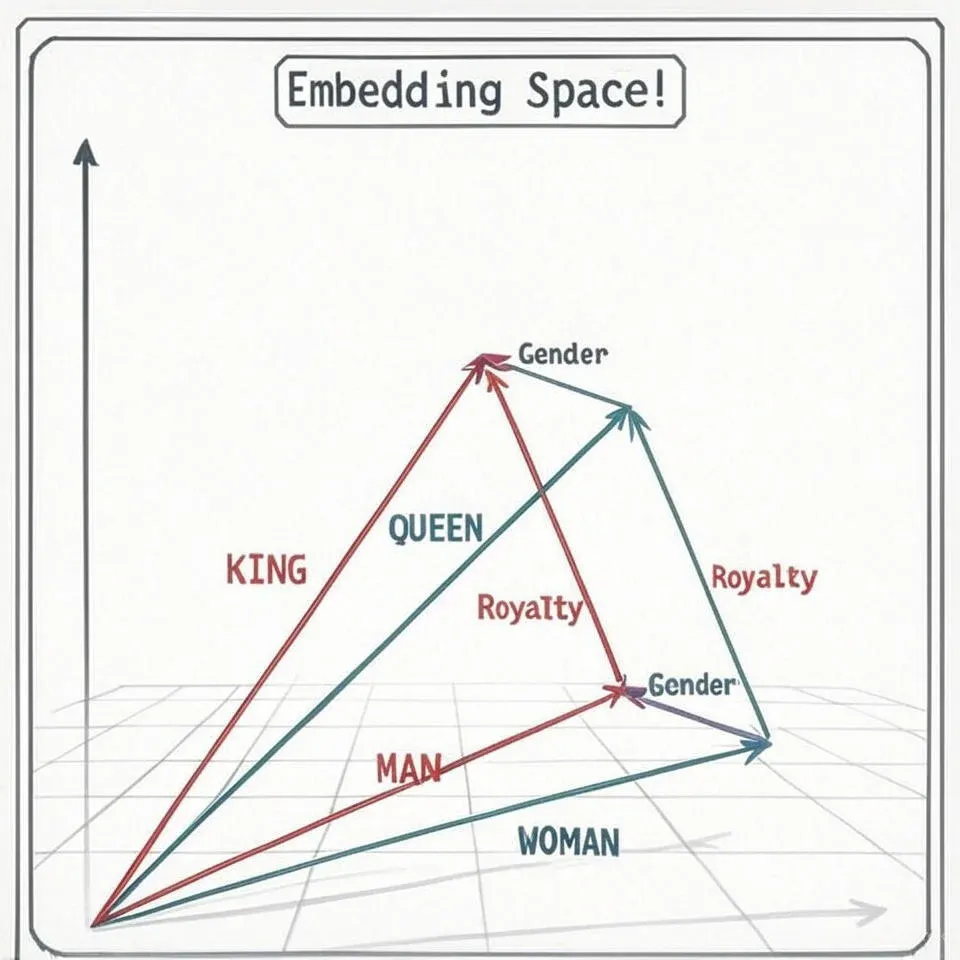
Let's use a real example. Consider these three words:
King
Queen
Royal
A vector embedding system might represent them like this:
King: [0.8, 0.2, 0.9, 0.1, 0.7]
Queen: [0.7, 0.9, 0.9, 0.1, 0.6]
Royal: [0.6, 0.5, 0.8, 0.2, 0.8]
Notice how King and Queen have similar numbers? That's because they're conceptually related - both are rulers, both are associated with monarchy, etc. The embedding captures these relationships numerically.
The Magic of Math in Language
Here's where it gets really cool. Remember basic math where you learned that if you have 2 apples and add 3 more, you get 5 apples?
Vector embeddings let you do math with meanings:
King - Man + Woman = Queen
I know it sounds like science fiction, but this actually works! The computer can perform this calculation:
Take the "King" vector
Subtract the "Man" vector
Add the "Woman" vector
The result is very close to the "Queen" vector
It's like the computer learned that the relationship between King and Man is similar to the relationship between Queen and Woman.
Real-World Applications (Where You've Already Seen This)
1. Search Engines
When you Google "best pizza NYC" and get results for "top Italian restaurants in New York," that's embeddings at work. The search engine understands that:
"best" ≈ "top"
"pizza" is related to "Italian restaurants"
"NYC" = "New York"
2. Recommendation Systems
Netflix doesn't just look at genres. If you loved "The Queen's Gambit," it might recommend "Beautiful Mind" because the embeddings show both are about:
Brilliant protagonists
Strategic thinking
Personal struggles
Chess/Mathematical themes
3. Voice Assistants
When you tell Alexa "Play some relaxing music" and "Put on something chill," she knows you mean the same thing because "relaxing" and "chill" have similar embedding vectors.
4. Language Translation
Google Translate can convert "I love you" to "मैं तुमसे प्यार करता हूँ" because it learned that these phrases occupy similar positions in their respective language spaces.
The Bottom Line
Vector embeddings are like a universal translator between human language and computer language. They turn words into numbers while preserving meaning, letting computers do math with concepts.
Next time someone mentions AI understanding language, you'll know the secret: it's not magic, it's just really clever math with numbers that represent meanings.
Hashtags: #chaicode #chaiaurcode

Join Yogesh on Peerlist!
Join amazing folks like Yogesh and thousands of other builders on Peerlist.
0
2
0