

Importance of system prompts and types of prompting (Zero-shot, Few-shot, etc...)
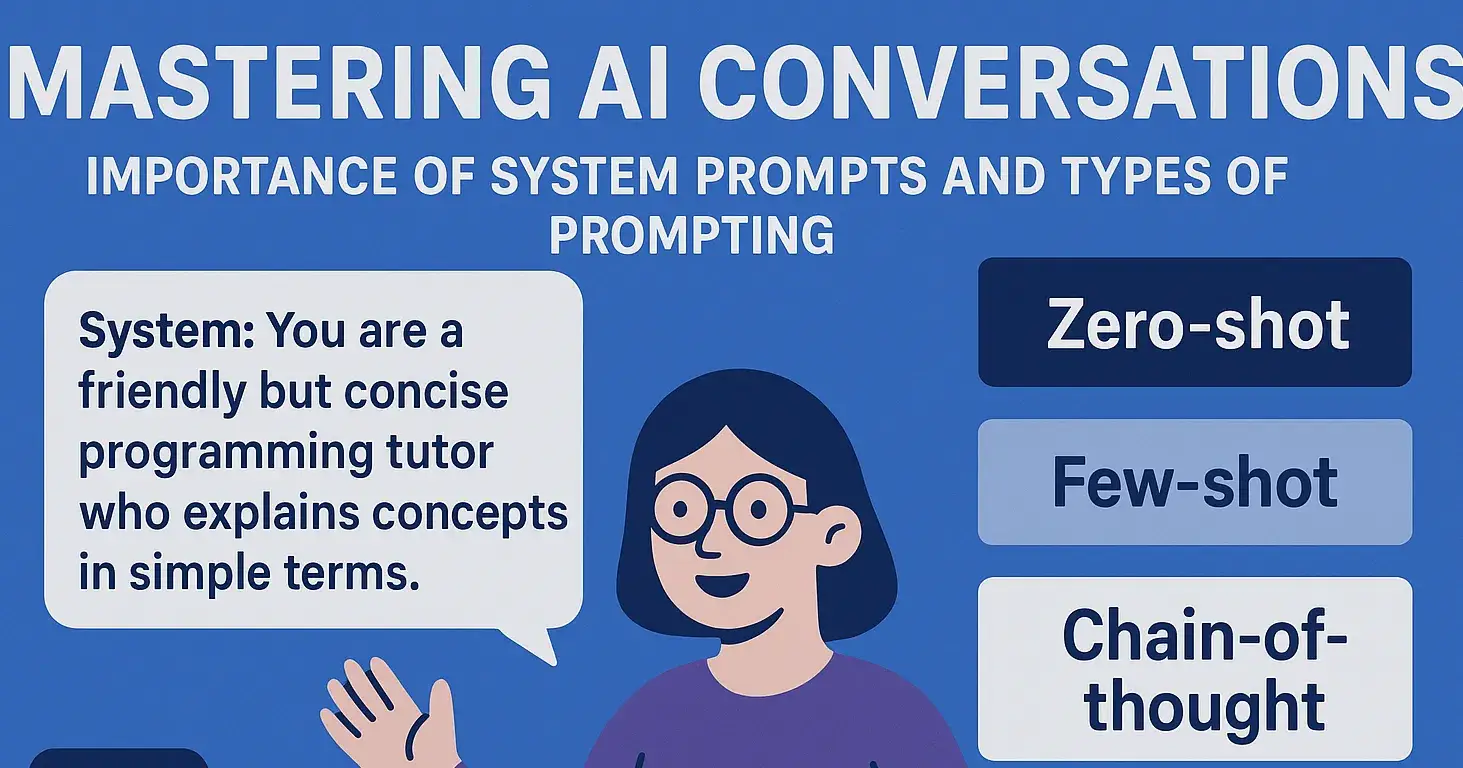
The Art of Prompting: System Prompts and Advanced Techniques for AI Success
Published on Peerlist- [15/08/25]
Introduction
In the rapidly evolving landscape of artificial intelligence, the ability to effectively communicate with AI models has become as crucial as coding itself. Whether you're a developer integrating AI into applications, a researcher exploring capabilities, or a professional leveraging AI tools, understanding prompting techniques can dramatically improve your results.
This comprehensive guide explores the fundamental concepts of system prompts and various prompting methodologies that can transform your AI interactions from basic queries to sophisticated, context-aware conversations.
What Are System Prompts?
System prompts are foundational instructions that define how an AI model should behave, respond, and interpret user inputs. Think of them as the "personality" and "rulebook" that govern an AI's behavior throughout an entire conversation session.
Key Characteristics of System Prompts:
Persistent: They remain active throughout the entire conversation
Foundational: They establish the baseline behavior and context
Invisible: Users typically don't see system prompts directly
Powerful: They can dramatically alter response quality and style
Example System Prompt:
You are a helpful programming assistant with expertise in Python and web development.
Always provide clear, well-commented code examples and explain concepts step-by-step.
When users ask about best practices, reference industry standards and explain the reasoning behind recommendations.
Why System Prompts Matter
1. Consistency Across Interactions
Without system prompts, AI responses can vary wildly in tone, format, and approach. System prompts ensure consistent behavior that aligns with your application's needs.
2. Domain Expertise Simulation
By establishing expertise areas and communication styles, system prompts help AI models provide more relevant and authoritative responses.
3. Safety and Compliance
System prompts can include safety guidelines, content policies, and compliance requirements that prevent inappropriate or harmful outputs.
4. User Experience Enhancement
Well-crafted system prompts create more natural, helpful, and engaging interactions that feel tailored to specific use cases.
Types of Prompting Techniques
1. Zero-Shot Prompting
Definition: Asking the AI to perform a task without providing any examples.
When to Use:
Simple, straightforward tasks
When you want to test the model's inherent capabilities
For general knowledge questions
Example:
Translate the following English text to French: "The weather is beautiful today."Pros:
Simple and direct
No need for example preparation
Tests raw model capabilities
Cons:
May produce inconsistent results
Limited guidance for complex tasks
Performance varies significantly across different domains
2. Few-Shot Prompting
Definition: Providing a few examples to demonstrate the desired pattern or format before asking for the actual task.
When to Use:
Complex formatting requirements
Specific style or tone needed
Pattern recognition tasks
When zero-shot results are inconsistent
Example:
Convert these product descriptions to JSON format:

Product: iPhone 14, Price: $799, Category: Electronics
{"product": "iPhone 14", "price": 799, "category": "Electronics"}

Product: Nike Air Max, Price: $120, Category: Footwear
{"product": "Nike Air Max", "price": 120, "category": "Footwear"}

Product: Coffee Maker, Price: $89, Category: AppliancesPros:
More consistent outputs
Better handling of complex formats
Clearer expectations
Improved accuracy for specific tasks
Cons:
Requires example preparation
Can be limiting if examples are too specific
May not generalize well beyond provided patterns
3. Chain-of-Thought (CoT) Prompting
Definition: Encouraging the AI to break down complex problems into step-by-step reasoning processes.
When to Use:
Mathematical problems
Logical reasoning tasks
Complex analysis requiring multiple steps
Debugging and troubleshooting
Example:
Solve this step by step:
A store has 45 apples. They sell 18 apples in the morning and 12 apples in the afternoon. How many apples are left?

Step 1: Start with 45 apples
Step 2: Subtract morning sales: 45 - 18 = 27 apples
Step 3: Subtract afternoon sales: 27 - 12 = 15 apples
Therefore, 15 apples are left.Pros:
Improved accuracy on complex problems
Transparent reasoning process
Better error detection
Educational value
Cons:
Longer responses
May overcomplicate simple problems
Can lead to verbose outputs
4. Role-Based Prompting
Definition: Assigning a specific role or persona to the AI to influence its responses and perspective.
When to Use:
Domain-specific expertise needed
Specific communication styles required
Creative writing projects
Educational content creation
Example:
You are a senior software architect with 15 years of experience in distributed systems.
A junior developer asks: "How should I design a microservices architecture for an e-commerce platform?"

Respond with architectural principles, specific technologies, and potential pitfalls to avoid.Pros:
Contextually appropriate responses
Consistent expertise level
Natural communication style
Improved relevance
Cons:
May limit perspective
Potential for role-playing inconsistencies
Can introduce biases
5. Iterative Prompting
Definition: Building upon previous responses through a series of related prompts to refine and expand outputs.
When to Use:
Complex creative projects
Detailed analysis requiring multiple perspectives
Debugging and optimization tasks
Research and exploration
Example Flow:
Prompt 1: "Explain the basics of blockchain technology"
Response 1: [Basic explanation]

Prompt 2: "Now explain how smart contracts work within blockchain"
Response 2: [Smart contracts explanation building on blockchain basics]

Prompt 3: "What are the main challenges in implementing smart contracts for supply chain management?"
Response 3: [Specific challenges building on previous context]Pros:
Deep exploration of topics
Context builds naturally
Allows for course correction
Highly customizable outcomes
Cons:
Time-consuming
Requires careful conversation management
Can drift from original goals
6. Template-Based Prompting
Definition: Using structured formats or templates to ensure consistent output formatting and completeness.
When to Use:
Standardized reports
Data analysis tasks
Content creation with specific requirements
API documentation generation
Pros:
Consistent formatting
Comprehensive coverage
Easy to process programmatically
Scalable for multiple similar tasks
Cons:
Can be rigid
May not suit all use cases
Requires template design effort
Best Practices for Effective Prompting
1. Be Specific and Clear
❌ "Make this better"
✅ "Improve this code's readability by adding comments, using descriptive variable names, and following PEP 8 style guidelines"
2. Provide Context
❌ "Debug this function"
✅ "This Python function is supposed to calculate compound interest but returns incorrect values. The expected formula is A = P(1 + r/n)^(nt). Please identify and fix the bug."
3. Use Examples When Needed
❌ "Format this data nicely"
✅ "Format this data as a markdown table like this example:
| Name | Age | City |
|------|-----|------|
| John | 25 | NYC |
4. Set Expectations
❌ "Explain AI"
✅ "Explain artificial intelligence in 3-4 paragraphs suitable for a high school student, focusing on practical applications rather than technical details"
5. Iterate and Refine
Don't expect perfect results on the first try. Use follow-up prompts to clarify, expand, or redirect as needed.
Industry Applications
Software Development
Code review and optimization
Documentation generation
Bug identification and fixing
Architecture design discussions
Content Creation
Blog post outlines and drafts
Marketing copy variations
Social media content planning
SEO-optimized content
Data Analysis
Report generation
Pattern identification
Data visualization suggestions
Statistical interpretation
Customer Support
Automated response generation
FAQ creation and maintenance
Escalation decision support
Personalized help content
Education and Training
Curriculum development
Assessment creation
Personalized learning paths
Explanation generation
Tools and Platforms
Popular AI Platforms Supporting Advanced Prompting:
OpenAI GPT Models - Advanced reasoning and conversation
Anthropic Claude - Strong safety features and nuanced understanding
Google PaLM/Bard - Integration with Google services
Hugging Face Transformers - Open-source model access
Cohere - Enterprise-focused language models
Development Frameworks:
LangChain - Building applications with language models
Semantic Kernel - Microsoft's AI orchestration framework
OpenAI API - Direct model integration
Prompt Engineering Libraries - Specialized prompting tools
Common Pitfalls and How to Avoid Them
1. Overcomplicating Simple Tasks
Problem: Using complex prompting techniques for straightforward requests Solution: Start simple and add complexity only when needed
2. Insufficient Context
Problem: Assuming the AI understands implicit context Solution: Provide clear background information and expectations
3. Ignoring Model Limitations
Problem: Expecting capabilities beyond the model's training Solution: Understand and work within documented limitations
4. Poor Example Selection
Problem: Using examples that don't represent the full range of expected inputs Solution: Choose diverse, representative examples for few-shot prompting
5. Neglecting Safety Considerations
Problem: Not considering potential harmful or biased outputs Solution: Implement safety guidelines in system prompts and validate outputs
The Future of Prompting
As AI models become more sophisticated, prompting techniques continue to evolve:
Emerging Trends:
Multimodal Prompting: Combining text, images, and other media
Dynamic Prompting: Adaptive prompts that change based on context
Automated Prompt Engineering: AI-assisted prompt optimization
Domain-Specific Prompting Languages: Specialized syntax for specific fields
Collaborative Prompting: Multiple AI models working together
Research Directions:
More efficient few-shot learning
Better understanding of prompt sensitivity
Standardization of prompting best practices
Integration with traditional programming paradigms
Conclusion
Mastering system prompts and various prompting techniques is becoming an essential skill in our AI-driven world. Whether you're building the next breakthrough application or simply trying to get better results from AI tools, understanding these concepts will significantly improve your outcomes.
The key is to start with the basics clear, specific prompts and gradually incorporate more advanced techniques as your needs become more sophisticated. Remember that effective prompting is both an art and a science, requiring creativity, technical understanding, and iterative refinement.
As AI continues to evolve, those who master the art of prompting will be best positioned to harness its full potential, creating more intelligent, helpful and innovative solutions.

Join Yogesh on Peerlist!
Join amazing folks like Yogesh and thousands of other builders on Peerlist.
0
0
0