

How AI Is Transforming Quality Assurance and Test Automation
AI transforms quality assurance with intelligent automation, machine learning, and predictive testing, helping QA teams reduce costs, improve accuracy, and deliver better software.
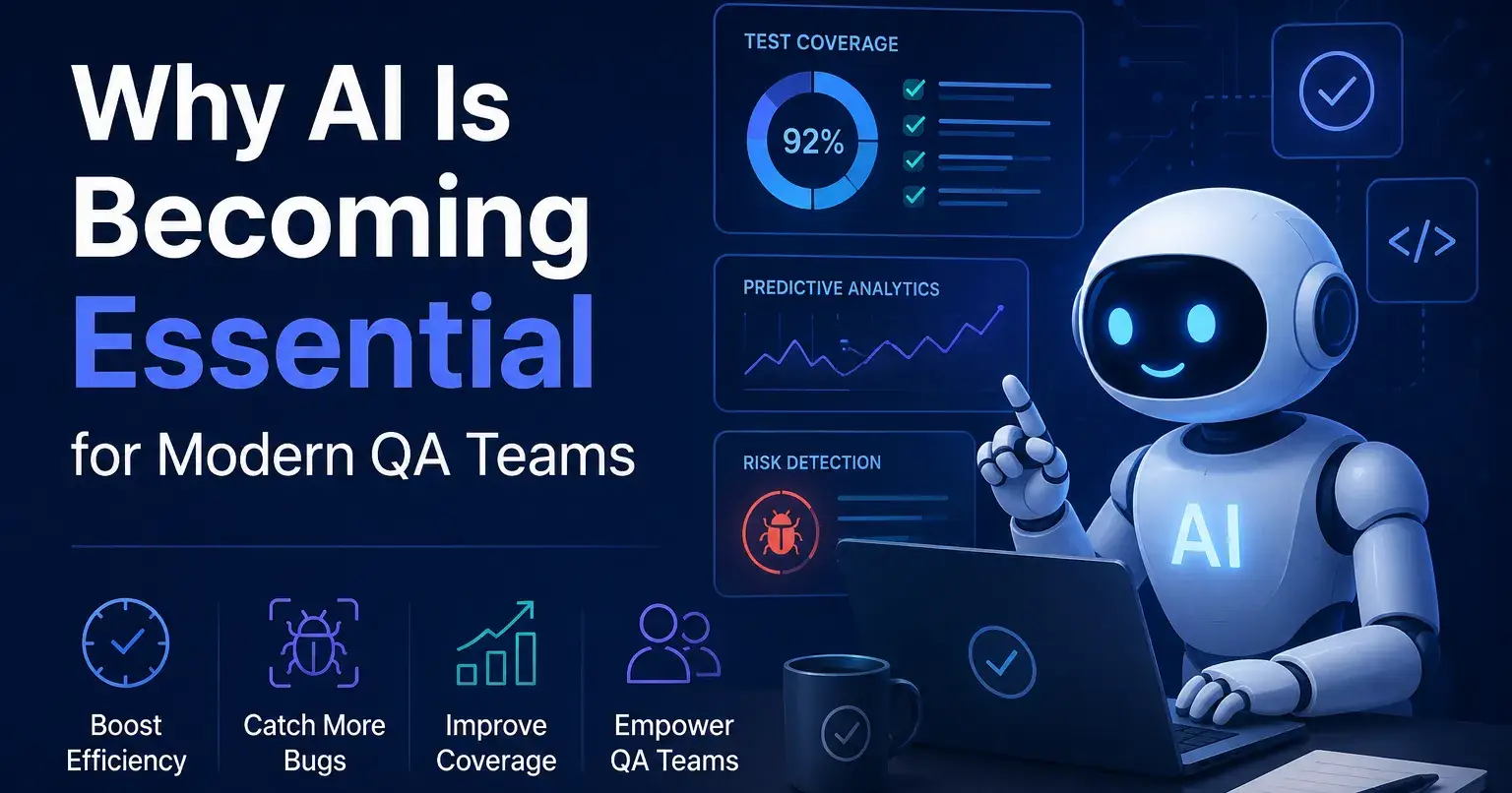
The software development landscape has changed dramatically. Applications are more complex, release cycles are faster, and user expectations are higher than ever. Traditional quality assurance methods, manual testing, scripted automation, and linear test execution can no longer keep up with modern software delivery demands. Enter AI in quality assurance: a game-changing approach that's reshaping how QA teams detect bugs, optimize test coverage, and deliver reliable software at unprecedented speed.
In this guide, you'll discover how artificial intelligence in software testing is solving long-standing QA challenges, explore real-world applications of AI-powered testing, and learn practical strategies for implementing AI-driven test automation in your organization.
What Is AI in Quality Assurance?
Understanding AI-Powered Software Testing
What is AI-powered software testing? At its core, AI in software testing refers to the application of machine learning algorithms, natural language processing, and advanced data analytics to automate, optimize, and enhance the software testing process. Unlike traditional automation, which follows pre-defined scripts and requires manual updates, AI test automation learns from data, adapts to changes, and makes intelligent decisions about what, when, and how to test.
The key difference lies in adaptability. Traditional automation testing tools execute the same tests repeatedly without understanding context. AI-powered QA solutions, however, analyze application behavior, identify patterns, predict potential failures, and even generate test cases automatically.
Why AI Is Becoming Essential for QA Teams
Three major industry trends are driving the adoption of machine learning in software testing:
Faster release cycles: Organizations embracing Agile and DevOps are releasing software daily or even multiple times per day. Manual testing cannot scale at this pace.
Increasing complexity: Modern applications involve microservices, APIs, cloud infrastructure, and multiple user interfaces requiring comprehensive coverage.
Skilled tester shortage: The demand for experienced QA professionals far exceeds supply. AI-driven quality engineering helps teams accomplish more with fewer resources.
According to recent quality engineering trends, companies implementing AI testing tools report 40-60% faster testing cycles and 30% reduction in post-release defects.
Challenges of Traditional Quality Assurance
Traditional quality assurance faces several critical limitations:
Time-Consuming Test Creation: Writing test cases manually is labor-intensive, delaying project timelines and diverting resources from strategic testing activities.
High Test Maintenance Costs: Every application update can break existing test scripts. Teams spend up to 70% of their automation effort maintaining tests rather than creating new ones.
Limited Test Coverage: Budget and time constraints force QA teams to prioritize certain scenarios while leaving others untested, creating blind spots where critical defects can hide.
Human Errors in Testing: Manual testing is prone to inconsistencies. Testers may skip steps, miss edge cases, or interpret requirements differently.
Slow Feedback Loops: Traditional testing happens late in the development cycle. By the time defects are discovered, fixes become more expensive and time-consuming—contradicting shift-left testing with AI principles that emphasize early defect detection.
How AI Is Transforming Quality Assurance
Automated Test Case Generation
AI test case generation creates comprehensive test scenarios automatically by analyzing requirements documents, user stories, and application code. Machine learning algorithms can study historical defect data to identify failure-prone areas and generate additional tests targeting high-risk zones. This reduces manual effort by up to 50% while improving overall test coverage.
Intelligent Test Execution
AI-powered testing platforms analyze code changes, user behavior data, and historical test results to intelligently prioritize which tests to run first. This optimization ensures critical issues are detected early, accelerating feedback to development teams. Smart test selection algorithms reduce test execution time by 30-40% while maintaining or improving defect detection rates, perfect for continuous testing with AI.
Self-Healing Test Automation
UI changes are the leading cause of test script failures. Self-healing test automation uses AI to automatically adapt tests when application elements change. Instead of breaking when a button's ID shifts, AI-powered tests recognize the element based on multiple attributes and context, then update themselves automatically. Organizations implementing self-healing automation report up to 80% reduction in time spent fixing broken tests.
Predictive Defect Analysis
Predictive defect analysis applies machine learning models to historical data—code commits, test results, defect reports, to forecast where bugs are most likely to occur in upcoming releases. By identifying high-risk code modules before testing begins, QA teams can allocate resources more effectively, improving defect detection rates by 25-35%.
AI-Powered Visual Testing
Traditional automation validates functional behavior but often misses visual inconsistencies, layout shifts, color variations, or responsive design problems. AI for bug detection in visual testing uses computer vision to compare screenshots across browsers and devices, automatically identifying even subtle visual defects while distinguishing intentional design changes from genuine bugs.
Smart Test Data Generation
AI-powered data generation tools analyze production databases, understand data patterns and relationships, and automatically create synthetic test datasets that mirror real-world scenarios. This capability expands test coverage by 40% while reducing data preparation time by 60%.
Key Benefits of AI in Software Testing
How AI improves quality assurance delivers measurable business value:
Faster Testing Cycles: Automated test generation, intelligent test selection, and parallel execution compress testing cycles from weeks to days. Organizations practicing AI in DevOps testing report 50-70% faster release velocities.
Improved Test Accuracy: Machine learning algorithms execute tests consistently without fatigue or bias, resulting in 30-40% higher defect detection rates.
Enhanced Test Coverage: AI testing tools explore application paths impractical to test manually, often reaching 90%+ code coverage compared to 60-70% with manual methods.
Reduced QA Costs: While AI-based test automation requires initial investment, it delivers 30-50% lower total cost of quality over three years through reduced maintenance effort and faster execution.
Faster Time-to-Market: Companies implementing AI-powered QA solutions reduce time-to-market by 25-40% while maintaining or improving quality standards.
Better Software Quality: The benefits of AI in software testing culminate in 35-50% reduction in post-release defects, better user experiences, and higher customer satisfaction.
AI Use Cases in Quality Assurance and Test Automation
AI-powered regression testing is among the most impactful applications. AI identifies which tests are affected by code changes, executes only relevant tests, and automatically updates test scripts when necessary, transforming regression testing from a bottleneck into an efficient, continuous process.
Other AI use cases in software testing include:
Functional Testing: Automatically generating and executing functional test cases from requirements
Performance Testing: Predicting performance issues by analyzing resource utilization patterns
API Testing: Automatically discovering endpoints and validating responses
Mobile App Testing: Intelligently selecting device combinations and detecting device-specific issues
Cross-Browser Testing: Automating validation across browser ecosystems using visual AI
AI testing for enterprise applications handles these complex scenarios more efficiently than traditional approaches.
Popular AI Testing Tools in 2026
Testim combines AI-powered authoring with self-healing automation, making tests resilient to application changes. Best for Agile teams seeking rapid test creation with minimal maintenance.
Functionize uses natural language processing for autonomous testing. Its AI creates tests from plain English descriptions and automatically diagnoses failures. Ideal for organizations with limited QA resources.
Mabl specializes in AI in Agile testing, offering low-code test creation, auto-healing, and integrated quality insights. Perfect for DevOps teams practicing continuous testing.
Applitools leads in AI-powered visual testing, validating user interfaces across browsers and devices with human-like accuracy. Essential for organizations prioritizing visual quality.
Tricentis Tosca provides comprehensive test automation enhanced with AI-driven risk analysis and self-healing capabilities for large enterprises requiring automation testing tools across complex application portfolios.
How AI Supports Agile and DevOps Testing
AI in DevOps testing and AI in Agile testing enable true continuous delivery:
Continuous Testing: AI-powered tools execute tests automatically with every code commit, providing instant feedback.
Faster CI/CD Pipelines: Intelligent test selection reduces pipeline execution time by 40-60% without sacrificing quality.
Early Bug Detection: Shift-left testing with AI moves quality assurance earlier in development. Predictive analytics identify potential issues during coding.
Improved Release Confidence: AI-driven quality metrics, predictive defect analysis, and risk scoring help teams make informed release decisions.
Will AI Replace Manual Testing?
Can AI replace manual testing? Not entirely, but it will fundamentally change what human testers do.
Tasks AI Can Automate: Repetitive test execution, regression testing, data-driven testing, visual validation, API testing, performance testing, and basic functional verification, approximately 60-70% of traditional QA workload.
Areas Where Human Testers Are Still Essential: Exploratory testing requiring intuition, usability evaluation from a human perspective, complex scenario design requiring creativity, ethical testing, contextual judgment, and test strategy.
The Future of Human-AI Collaboration: The future of software testing isn't human versus AI, it's humans augmented by AI. QA professionals will transition from test executors to quality strategists, focusing on test design and exploratory testing while AI handles execution and maintenance.
Best Practices for Adopting AI in Quality Assurance
Start with High-Impact Testing Areas: Begin your AI-driven test automation journey where ROI is clearest: regression testing, visual validation, or test maintenance.
Combine AI with Existing Automation: Integrate AI capabilities into current processes rather than replacing everything at once. Augment existing test suites with self-healing capabilities first.
Invest in Quality Test Data: AI effectiveness depends on data quality. Implement test automation best practices for test data management with comprehensive edge case coverage.
Continuously Monitor AI Performance: Track defect detection rates, false positives, test maintenance time, and coverage improvements to refine AI models and optimize quality assurance best practices.
Train QA Teams on AI Tools: Invest in comprehensive training so your team understands not just how to use AI tools, but why they make certain recommendations.
Future Trends in AI-Powered Test Automation
AI trends in QA point toward increasingly sophisticated capabilities:
Generative AI for Test Case Creation: Large language models will generate comprehensive test scenarios from natural language requirements or conversational descriptions.
Autonomous Testing: Emerging platforms will conduct testing with minimal human intervention, automatically discovering functionality, generating tests, executing them, and analyzing results.
AI-Driven Quality Engineering: Expanding beyond testing to encompass requirements analysis, design validation, code quality assessment, and production monitoring.
Predictive Release Management: AI will forecast release success probability based on code changes, test results, and historical patterns.
Why Businesses Should Invest in AI-Powered QA Solutions
The business case for implementing modern quality assurance strategies is compelling:
Faster product releases: Compress testing cycles by 50-70%, accelerating time-to-market
Lower testing costs: Reduce QA expenses by 30-50% through automation and optimized resource allocation
Better customer experiences: Prevent defects before they impact users, improving satisfaction
Increased competitive advantage: Deliver higher quality software faster than competitors using traditional methods
Higher software reliability: Achieve 35-50% fewer production defects through comprehensive coverage
Organizations that embrace AI-powered testing position themselves to thrive in an increasingly software-driven economy.
Conclusion
How AI is transforming quality assurance is no longer a future consideration, it's reshaping how software teams deliver quality at speed today. From automated test case generation and self-healing test automation to predictive defect analysis and visual testing, AI addresses fundamental challenges that have plagued traditional QA for decades.
The benefits of AI in test automation are substantial: faster testing cycles, improved accuracy, enhanced coverage, reduced costs, and ultimately, better software quality. While challenges exist, data requirements, initial investment, learning curves, the competitive advantages far outweigh the obstacles.
The future of AI in quality assurance points toward increasingly autonomous testing ecosystems where AI handles routine validation while human expertise focuses on strategic software testing process improvement. Organizations that invest in AI-driven test automation today will lead their markets tomorrow.
Ready to transform your quality assurance process with AI? Visit iCoderz Solutions to discover how our expertise in modern quality engineering can help you implement AI-powered testing that delivers measurable business results.

Join Yogesh on Peerlist!
Join amazing folks like Yogesh and thousands of other builders on Peerlist.
0
0
0