

From Text to Panels: How I Used Live3D AI Comic Generator to Visualize My Story
If you can write a script, you can now publish a comic. This is the story of how I finally freed my inner storyteller.
I have always been a storyteller at heart. Since I was a kid, my head has been filled with wild sci-fi worlds, complex character arcs, and funny dialogue snippets. I could see the scenes perfectly in my mind—the cinematic angles, the dramatic lighting, the expressions on the characters' faces.
But there was always one massive bottleneck that stopped these stories from ever seeing the light of day: I cannot draw to save my life.
Every time I tried to put pen to paper, the epic scene in my brain turned into a messy scribble of stick figures and disproportionate blobs on the page. It was incredibly frustrating. I had the script, I had the vision, but I lacked the technical skill to execute it.
I tried hiring artists, but it was too expensive for a hobby project. I tried learning to draw, but the learning curve was too steep for the time I had available. For a long time, I just accepted that my stories would remain locked in Google Docs, never to become the visual narratives I wanted them to be.
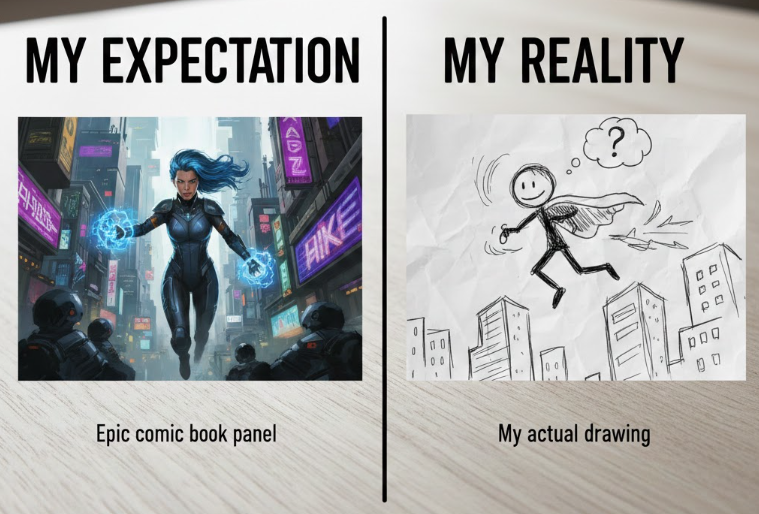
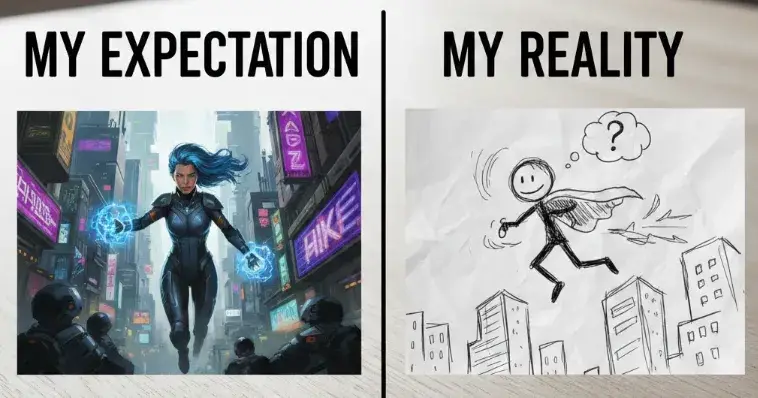
My expectation vs. reality before AI.
Finding AI (The Discovery)
I knew that AI image generation was evolving at lightning speed, so naturally, I turned to it for a solution. My thought process was simple: I could write a detailed description, and the AI would draw it. Problem solved, right?
Not quite.
My initial experiments with general AI image generators were met with quick frustration. While the results were often visually stunning—producing incredible single illustrations—they failed miserably at the one thing a comic needs: continuity.
I found myself in a constant battle with the models:
I would generate Panel 1, and the protagonist had a unique hairstyle.
I would generate Panel 2 (just slightly changing the dialogue or angle), and suddenly the character's clothing was different, their hair color changed, or they aged five years.
It wasn't a comic; it was a collection of beautiful but unrelated pictures. Stitching them together felt like more work than drawing them myself!
The comic medium requires a coherent narrative flow, consistent character models, and controlled panel layouts—things generic AI wasn't built for. I realized I didn't need a tool for making pretty pictures; I needed a visual storytelling engine.
That's when I discovered Live3D AI Comic Generator.
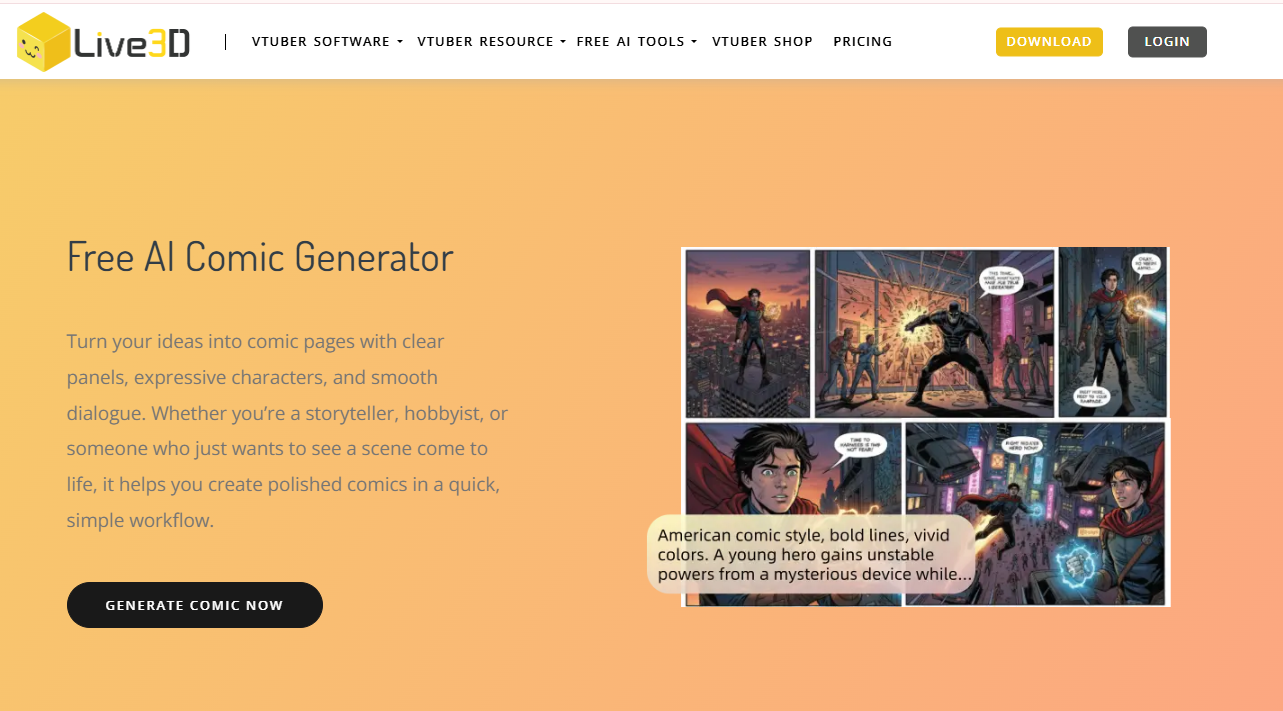
Live3D AI Comic Generator Web Page
Unlike the general models, Live3D was immediately positioned as a specialized tool for sequential art. It promised to solve the very specific, crippling problems that plague AI comic creation: character consistency and controlled framing. This wasn't just a gimmick; it felt like the dedicated solution that creators like me had been waiting for. I was excited to put it to the test and see if it could truly bridge the gap between my script and the final comic page.
The Workflow: Turning Script into Panels
After the initial excitement, it was time to put the Live3D AI Comic Generator to the real test. The beauty of this tool is its streamlined workflow, which focuses purely on the creative narrative choices, not the technical drawing.
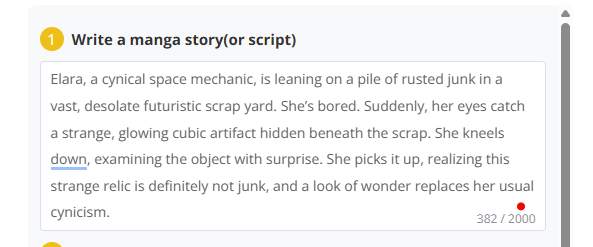
Step 1: Defining the Story
I wanted to test the system's ability to maintain continuity across a simple, emotional arc. I fed the following short text, defining the character, setting, and plot:
Elara, a cynical space mechanic, is leaning on a pile of rusted junk in a vast, desolate futuristic scrap yard. She’s bored. Suddenly, her eyes catch a strange, glowing cubic artifact hidden beneath the scrap. She kneels down, examining the object with surprise. She picks it up, realizing this strange relic is definitely not junk, and a look of wonder replaces her usual cynicism.
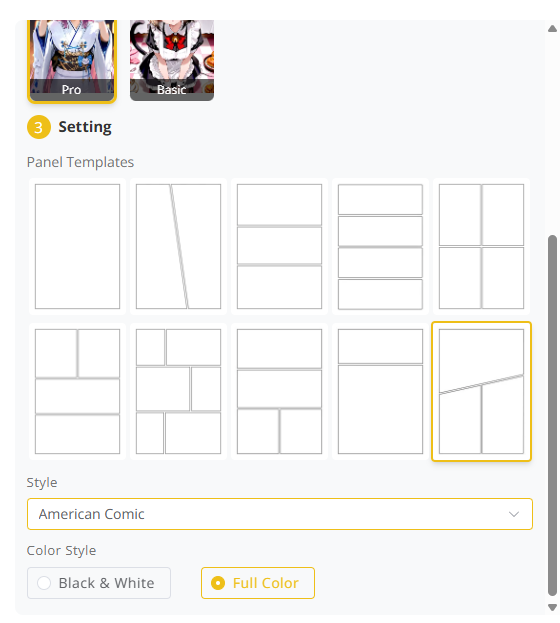
Step 2: Setting the Comic Parameters
This step felt like production design—quick and impactful. I made all my core creative decisions here:
Model Selection: I used the default AI model provided by Live3D.
Panel Layout: I selected a 3-panel vertical strip layout.
Style and Color: I chose the Classic American Comic style and requested Full Color.
Step 3: Generate and Direct
With the parameters set, I hit the generate button and waited just a few moments.
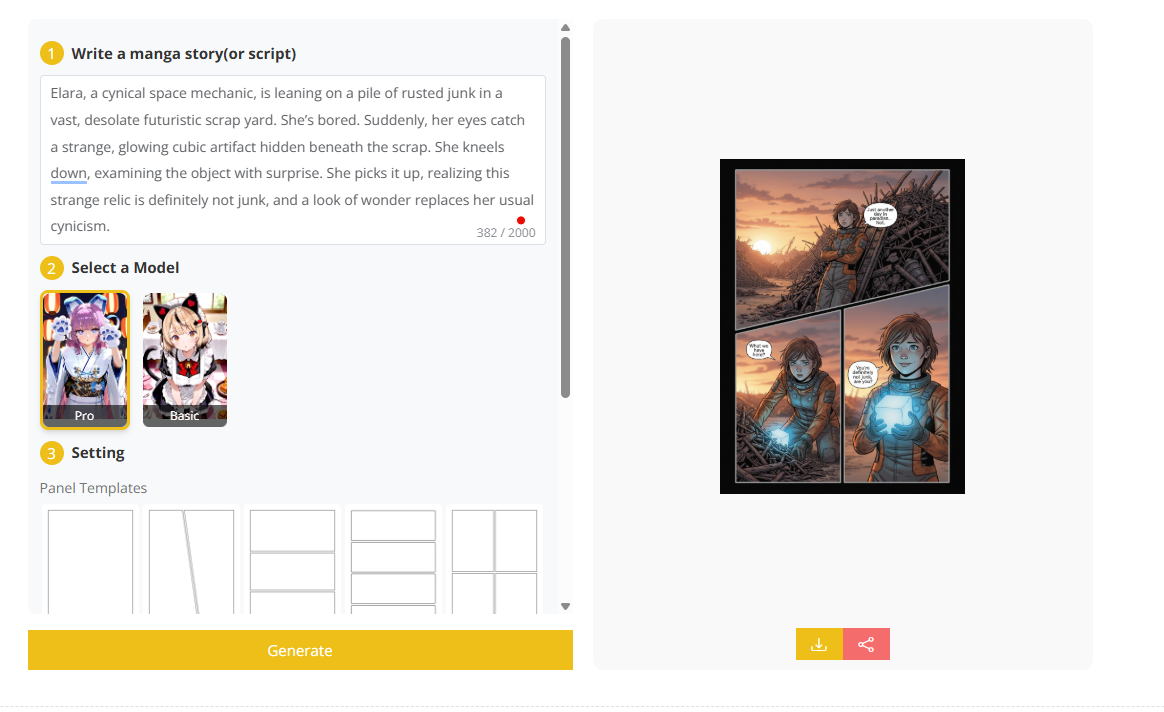
The entire process was about empowering my vision. My overall experience was: I finally felt like a director, choreographing my visual narrative, instead of a frustrated artist fighting against a blank canvas.
The Showcase: An Entire Arc in Minutes
The Results: Continuity Achieved
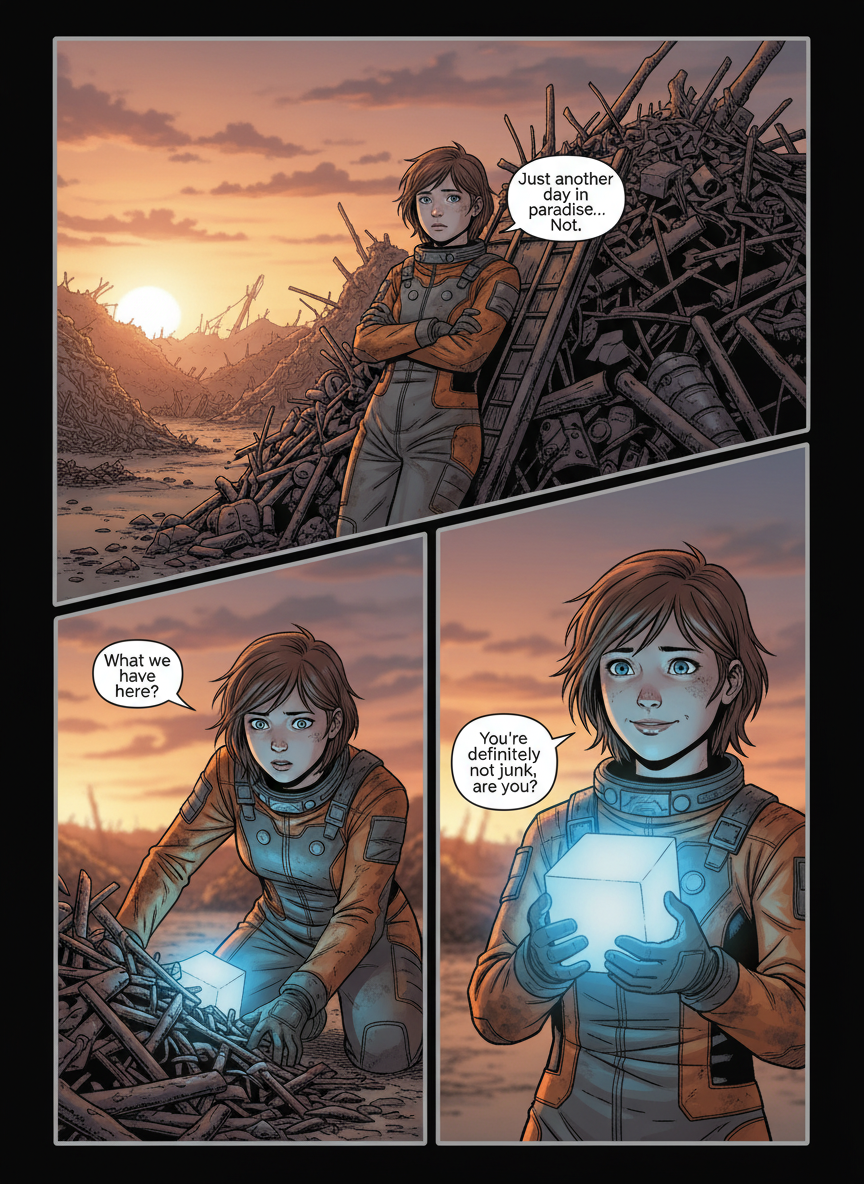
The outcome was the validation I needed. This is the difference between a general AI tool and a specialized generator:
The Consistency Proof: Look at Elara. From the first panel's weary expression to the final panel's surprise, her facial features, uniform, and even the subtle details like the oil smudges remained perfectly consistent. This reliability is the foundation of sequential art, and Live3D nailed it.
Efficiency Redefined
This leap in efficiency is what makes Live3D a game-changer:
The Old Way: Drafting, sketching, inking, coloring, and lettering a single page like this could consume a week of part-time work, or a few days of full-time focus.
The Live3D Way: Using this streamlined workflow, I was able to define Elara, write the script, set the styles, and generate dozens of panels, completing an entire short story arc in just one afternoon.
Live3D isn't just generating images; it is massively accelerating the entire storytelling pipeline for non-artists like me.
The Conclusion: Empowering the Storyteller
The journey from being a writer locked out of visual storytelling to a creator producing coherent comic panels in minutes has been incredible.
Live3D AI Comic Generator is more than just a tool; it's an equalizer. For too long, the barrier to creating comics was the physical skill of drawing. This is no longer the case.
What Live3D truly achieves is the democratization of visual narrative. It frees the storyteller from the constraints of their hand-eye coordination. If you have a solid script, a compelling character idea, and a vision, you now have the power to bring that vision to life.
This technology doesn't aim to replace professional artists—their nuanced, detailed work remains irreplaceable. Instead, it empowers the millions of creators, marketers, educators, and makers who have great stories but lack the drawing skills needed to share them visually.
I’m thrilled to have used Live3D to finally bring Elara’s story out of my text file and onto the page.
Join the Revolution
If you’re a fellow maker on Peerlist, someone who loves building and sharing, I urge you to try this out.
Got a product you need to explain? Turn your documentation into a fun, engaging comic strip.
Got a funny office anecdote? Share it as a four-panel gag.
Got a world-building idea? Start visualizing it today.
Let's see what amazing stories the non-artists among us can create. What stories will you tell when drawing is no longer the barrier?

Join yukie on Peerlist!
Join amazing folks like yukie and thousands of other builders on Peerlist.
0
4
0