

I Built a SaaS for an Industry I Worked In — Here's Why "Scratch Your Own Itch" Is Both the Best and Worst Advice
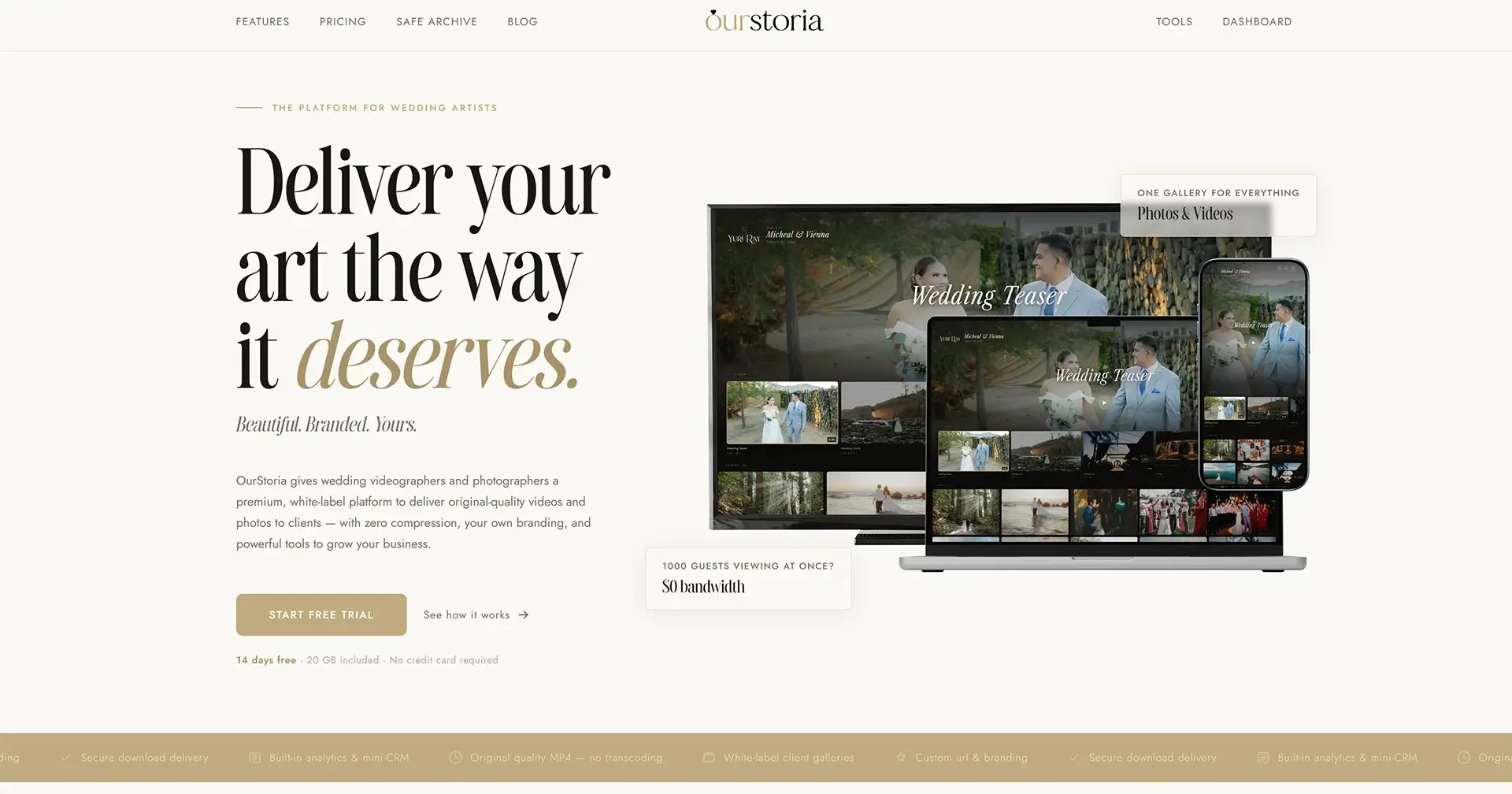
Every indie hacker has heard the mantra: Build something you'd use yourself. Scratch your own itch. I did. I'm a wedding videographer and photographer from Ukraine. I built OurStoria (https://ourstoria.app) — a video delivery platform for wedding professionals. Solo. No co-founder. No funding. No team.
The product works. It has paying users. It solves a real problem I personally experienced. And yet — "scratch your own itch" nearly killed the project three times before I got here. This article is about the parts nobody talks about: what happens when you are simultaneously the founder, the developer, the user, the designer, the support agent, and the person who's still shooting weddings on Saturdays to pay the bills.
---
The Problem (Why I Started)
I shoot weddings. After every wedding, I need to deliver 3–5 video files (highlight, ceremony, speeches, reels) plus 200–500 photos to the couple. The standard delivery methods in this industry are:
- Google Drive / Dropbox — dump a folder, send a link, pray the couple figures it out
- WeTransfer — link expires in 7 days, no branding, no analytics
- Vimeo — they killed the affordable tiers, $20+/month for basic features, and the couple sees Vimeo's brand, not mine
- YouTube (unlisted) — re-encodes everything, no download option, looks unprofessional
None of these solved all my problems at once: original quality streaming, my branding, photos and videos together in one gallery, long-term access for the couple, and analytics so I know when they watched. I looked at the existing wedding delivery platforms. They existed, but the pricing was brutal — tiny storage quotas that make no sense in 2026 when cameras shoot 6K and a single wedding is 40–80 GB.
So I thought: I can build this myself.
That thought was both correct and wildly naive.
---
Finding the Infrastructure Edge
I'm not going to share my full tech stack. But I will share the thinking process, because it applies to any SaaS founder.
The core problem of a video delivery platform is bandwidth economics. Most hosting providers charge per-GB of data transferred. When you're serving original-quality 4K video files (3–8 GB each) to dozens of viewers per wedding, the bandwidth cost can exceed the subscription revenue.
This is why incumbents either:
- Charge high prices ($30–50+/month for modest storage)
- Compress and transcode everything to save bandwidth
- Cap the number of viewers or downloads
- All three
I spent weeks researching infrastructure options before writing a single line of code. The goal was simple: find a storage and delivery architecture where bandwidth costs are effectively zero, so I can pass generous limits to my users and still be profitable at $14.99/month.
I found it. The specific solution is my secret sauce, but the lesson is universal: before building any SaaS, model your unit economics at scale, not at launch. Many SaaS products look profitable with 5 users and hemorrhage money at 500 because they didn't model their variable costs properly.
My infrastructure costs less than $60/month total — serving hundreds of gigabytes of video to viewers across three continents. That's not luck. That's three weeks of research before writing the first git init.
---
The Challenge Nobody Warns You About: Really Big Files
Here's a problem that's unique to my niche but illustrative for any builder: my users need to upload files that are 10, 30, sometimes 80 GB.
You can't just use a standard file upload form for that. Browsers time out. Connections drop. Users close their laptops mid-upload. A single retry on a 50 GB file means re-uploading 50 GB. Over a typical home internet connection, that's 4–6 hours of wasted time.
I had to build a custom chunked upload system with full resume capability. If a videographer's internet drops at 73%, they come back, select the same file, and the upload picks up at 73%.
This was the most technically challenging part of the product — and the part that users notice least. When it works, it's invisible. When it breaks, you get the angriest support emails you've ever read ("I waited 5 hours and now it says error!").
Lesson for builders: The hardest engineering problems in your product are often the ones that users experience as "basic functionality." Nobody thinks "wow, this upload is amazing." They think "of course uploading works." But making it actually work reliably for 80 GB files over flaky connections was weeks of work.
---
The Feature That Doesn't Scale (And I Built It Anyway)
One of OurStoria's features is Safe Archive — when a videographer is done with a wedding project, instead of deleting it (losing the couple's access) or keeping it active (eating their monthly storage quota), they can archive it for $12–$19/year.
The archived project stays accessible — the gallery link remains live, the couple can still download — but the files don't count against the videographer's active storage quota.
From a product perspective, this is a great feature. From a business perspective, it's a nightmare to communicate. From a technical perspective, it required a second billing flow, annual renewal logic, reactivation workflows, and careful state management for what a "project" means across active/archived/expired states.
A VC would have told me to cut it. It's complex, adds support load, and the unit economics are small ($12/year per project). But I built it because I'm a wedding videographer — and I know that the biggest anxiety after delivering a wedding is: What do I do with the files?
Delete them and the couple's link dies. Keep them and you run out of storage. Buy a bigger plan just to hold old projects and your margins evaporate.
Safe Archive solves MY problem. That's the "scratch your own itch" advantage — you know which problems are merely annoying and which are deeply uncomfortable.
---
The Two-Brain Problem: Shooting Weddings on Saturday, Shipping Code on Monday
Here's something I didn't expect: being both the builder and the user at the same time is psychologically disorienting.
On Saturday, I'm shooting a wedding. I'm carrying 15 kg of gear, I'm positioning lavalier microphones, I'm stressing about the golden hour timeline, I'm capturing the father-of-the-bride speech and trying not to cry myself.
On Monday, I'm debugging why a specific browser on a specific Android version doesn't handle the gallery layout correctly.
These are two completely different identities. The videographer-me thinks in emotions, moments, light, and stories. The founder-me thinks in conversion rates, churn, deployment pipelines, and database schemas.
And here's the weird part: the videographer identity fights the founder identity.
When I'm editing a wedding film at 11 PM, the videographer in me whispers: "You should be doing this, not debugging CSS. This is real work. This is what pays the bills today." When I'm fixing a bug at 2 AM, the founder whispers: "If you'd just focused on the product, you wouldn't need to shoot weddings anymore."
Both voices are right. Both voices are wrong. Managing this internal conflict — the daily negotiation between "the work that pays now" and "the work that might pay later" — is the hardest part of the solo founder journey that nobody talks about.
I don't have a clean lesson here. I haven't solved it. I just manage it — week by week, wedding by wedding, deployment by deployment.
If you're building a product while still working in the industry it serves, you probably know exactly what I mean.
---
The Ugly Numbers: Month 1 Through Month 5
Let me be transparent about the business trajectory, because I think real numbers help other builders more than success stories.
| Month | MRR | Users (Free) | Users (Paid) | What I Focused On |
|-------|-----|------------|-------------|-------------------|
| 1 | $0 | 14 | 0 | Core upload + gallery. Shipped MVP |
| 2 | $29.98 | 31 | 2 | Photo upload feature, gallery polish |
| 3 | $74.97 | 52 | 5 | Safe Archive, CRM, analytics dashboard |
| 4 | $119.96 | 73 | 8 | SEO, blog content engine, portfolio pages |
| 5 | $179.94 | 98 | 12 | Cinematic layout, embed support, cold outreach |
This isn't a hockey stick. It's a slow crawl. Twelve paying users after five months of full-time work.
But here's the thing: my total operating costs are under $60/month. At $180 MRR, I'm net positive. Barely. But positive. And I own 100% of the company.
The wedding industry is seasonal. Wedding season in Europe and North America is May–October. I'm building during the pre-season. Every videographer who signs up now will start uploading in June when the weddings begin. If my trial-to-paid conversion holds (around 16%), the summer should tell the real story.
---
"Scratch Your Own Itch" — The Three Times It Almost Killed Me
1. I couldn't stop adding features
Being your own user means you see every gap. "I also need a CRM." "I also need a portfolio page." "I also need analytics." "I also need anniversary reminders for clients." "I also need custom fonts — 33 of them."
Every feature was genuine. Every feature was useful. Every feature delayed launch by another two weeks.
The discipline of shipping a stripped-down MVP when you know it's incomplete — because you use it yourself and feel every missing piece — is psychologically brutal.
Lesson: Being your own user helps you build the right things. It does NOT help you build the right amount of things. You need an external forcing function (a deadline, a public commitment, a co-founder saying "ship it") to counteract the infinite backlog that domain expertise creates.
2. I couldn't charge what it's worth
I knew the price sensitivity of wedding videographers because I AM one. I know that many videographers in my market make $1,500–3,000 per wedding and shoot 15–25 weddings per year. Asking them for $25/month feels real to me — because I feel that $25 in my own budget.
This made me underprice for months. I set the Starter plan at $9.99 initially. A mentor (another SaaS founder) asked me: "If this replaces Google Drive, Vimeo, and a photo gallery service — and those three cost $35+/month combined — why are you charging $9.99?"
I didn't have a logical answer. I was pricing based on empathy, not value.
I raised prices. Nobody churned. Some users literally told me "it's cheap for what it does." The empathy that makes you build a great product can make you a terrible businessperson.
Lesson: "Scratch your own itch" gives you perfect taste. It gives you terrible pricing instincts. Get external pricing advice from someone who doesn't share your itch.
3. I couldn't separate user feedback from personal preference
When a user said "the gallery background should be white, not dark," I had to fight my own reaction ("but dark looks more cinematic!") and ask: is this one user's opinion, or a pattern?
Being a domain expert made me more opinionated, not less. And strong opinions in a solo founder are dangerous, because there's nobody to argue with you.
I ended up building three gallery layouts — Classic, Sidebar, and Cinematic — partly because I couldn't decide which one was "right." In retrospect, offering choice was the correct answer. But I arrived at it through indecision, not strategy.
Lesson: Domain expertise is a competitive advantage in product design and a liability in product management. Build feedback systems (surveys, analytics, A/B tests) that give you data to override your own instincts — because your instincts are good but not infallible.
---
The Solo Founder Tax: What Nobody Warns You About
Being a solo founder in a niche SaaS means you are:
- The developer — writing code, debugging edge cases, deploying at 2 AM
- The designer — choosing fonts, spacing, color palettes, mobile breakpoints
- The marketer — writing blog posts, SEO, managing social media, cold outreach
- The salesperson — answering inquiries, doing demos, following up
- The support agent — "my upload is stuck at 73%" emails at all hours
- The accountant — invoicing, taxes, FOP registration (I'm in Ukraine, this is its own adventure)
- The domain expert — still shooting weddings, still understanding the workflow
The thing that suffers most isn't code quality. It's marketing. As a developer, you can always find another bug to fix, another feature to build, another refactor to do. Marketing requires a completely different brain mode — and context-switching between "debug this upload edge case" and "write a compelling Instagram caption" is cognitively exhausting.
My current split is approximately 40% development, 30% marketing, 20% support, 10% operations. The right split is probably 20% development, 50% marketing, 20% support, 10% operations. I know this intellectually. I cannot execute it emotionally.
If you're a developer who became a founder - you probably feel this too. The code is the comfort zone. Marketing is the growth zone. And growth zones are uncomfortable by definition.
---
The Marketing Channels That Actually Work (And Those That Don't)
Since Peerlist is full of builders who struggle with marketing (same as me), here's what has and hasn't worked after 5 months:
What works
| Channel | Cost | Result |
|---------|------|--------|
| SEO blog posts (16 articles) | $0 (I write them) | ~40% of traffic, growing monthly |
| Cold email outreach (personalized, from me as a fellow videographer) | $0 | 11% reply rate, 3 conversions |
| Wedding videographer Facebook groups (genuine participation, not spam) | $0 | 5 signups from organic mentions |
| Free tools on the site (video file size calculator, shot list, etc.) | Dev time only | SEO backlinks + trust building |
❌ What doesn't work (for me, at this stage)
| Channel | Cost | Result |
|---------|------|--------|
| Instagram posts about the product | Significant time | Near-zero conversions |
| Reddit r/videography promotional posts | $0 | Downvoted, removed |
| Paid ads (tested briefly) | $150 | 2 free signups, 0 conversions |
| Product Hunt launch | Prep time | Spike of traffic, few relevant users |
The pattern: channels where I show up as a fellow wedding videographer convert. Channels where I show up as "a SaaS founder trying to sell something" don't.
This might be specific to my niche. Wedding professionals are a tight community with high trust barriers. They buy from people they perceive as peers, not from brands.
---
What I'd Do Differently
1. Launch with half the features
Gallery + video upload + branding. That's it. No CRM, no analytics, no portfolio pages, no Safe Archive. Add those after the first 10 paying users validate the core.
2. Set a price floor based on value displacement, not empathy
If my product replaces Vimeo ($20/mo) + Google Drive ($3/mo) + a photo gallery ($15/mo), the floor is the combined cost of what I'm replacing. Not "what feels fair to me as a fellow videographer."
3. Write content before writing code
My blog now has 16 articles and drives significant organic traffic. But I wrote them after the product was built. If I'd started the blog 3 months before launch, I would have had organic traffic waiting for me on day one.
4. Start cold outreach on day one, not month four
I was afraid of emailing videographers with an imperfect product. By month four, the product was solid — but I'd wasted three months of potential compounding feedback.
5. Don't compare yourself to funded competitors
I spent weeks feeling defeated because a competitor launched a feature I didn't have. Then I realized: they have a team of 12 and $2M in funding. I have me. Different games, different rules.
My goal isn't to beat them. It's to serve 80 users at $25/month well enough that they never leave. That's $2,000/month — enough to replace my shooting income and build from there.
---
The David vs Goliath Reality
I'm competing with Vimeo, Google Drive, and established niche players with millions in funding. My unfair advantages:
1. I use my own product for real work. I deliver my own wedding videos through OurStoria. When something breaks, I experience it as a user before any support ticket arrives.
2. My infrastructure economics are different. The incumbents built their pricing models on expensive bandwidth. I found an alternative that lets me offer generous storage at prices they can't match without restructuring.
3. I'm building for one specific person. Not "video professionals." Not "content creators." Wedding videographers. A specific, findable, reachable niche with specific, solvable problems. The Goliaths serve everyone. I serve 150,000 wedding videographers worldwide — and I know exactly what they need because I'm one of them.
4. I don't need venture economics. I need $2,000/month. That's 80 users at $25/month. Not 80,000. Not 8 million. Eighty.
---
Where I Am Now
The product is live at ourstoria.app (https://ourstoria.app). It handles massive uploads, streams 4K video with zero buffering, supports three gallery layouts, has full white-label branding, password protection, a mini-CRM with anniversary reminders, real-time analytics, and a Safe Archive system for long-term storage.
I'm still shooting weddings. I'm still writing code. I'm still answering support emails at midnight. I'm still planning YouTube content and writing blog posts and doing cold outreach.
The MRR is growing slowly. The wedding season hasn't started yet. The product is better than it was last month. The marketing is better than it was last month. The writing is better than it was last month.
That's the solo founder loop: build, market, support, improve, repeat. No team standup. No investor update. No sprint planning. Just you and the compiler and the customer and the calendar.
---
The Ask
If you're building something in a niche you used to just work in — I'd love to hear about it. The "domain expert turned builder" journey is unique, rewarding, and occasionally maddening. Drop a comment or reach out.
And if you know any wedding videographers — send them my way 😄
---
Yuri — solo founder of OurStoria https://ourstoria.app, wedding videographer

Join Yuri on Peerlist!
Join amazing folks like Yuri and thousands of other builders on Peerlist.
0
4
0