

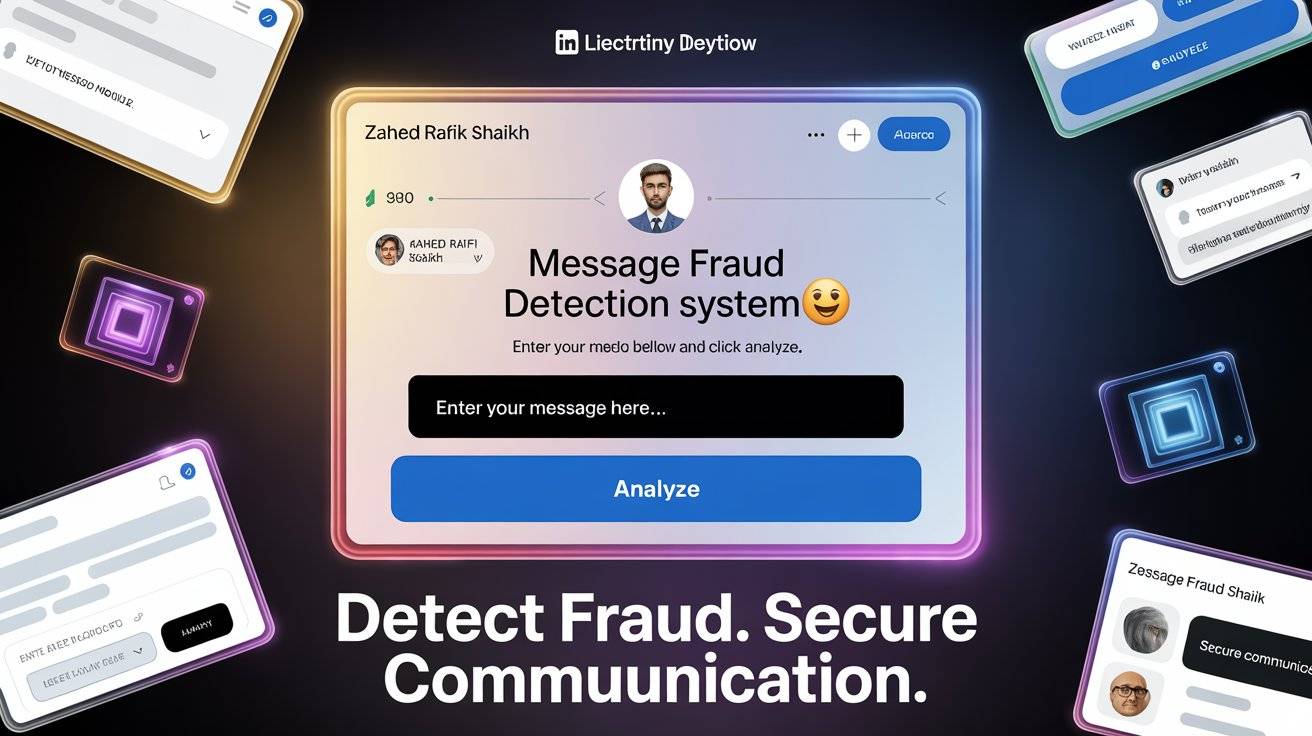
Fraud Message Detection System
The Fraud Message Detection System is a machine learning and
The Fraud Message Detection System is a machine learning and NLP-based project designed to classify text messages as either Spam (fraudulent) or Ham (legitimate). The system uses a well-known labeled dataset (SMS Spam Collection) containing thousands of real-world text messages annotated for spam detection tasks. This project demonstrates a complete end-to-end pipeline for text classification, beginning with data preprocessing, including lowercasing, stopword removal, stemming, and vectorization (TF-IDF or CountVectorizer). The processed text is then fed into a machine learning model—commonly a Multinomial Naive Bayes or Support Vector Machine (SVM)—trained to distinguish spam messages from genuine ones. The model is evaluated using performance metrics such as accuracy, precision, recall, F1-score, and confusion matrix. Visualizations are created to show insights about data distribution, spam frequency, and word frequency patterns using matplotlib and seaborn. This system can be integrated into real-world messaging platforms to improve security, reduce fraudulent communication, and enhance user experience by automatically filtering spam. Built using Python, it leverages powerful libraries such as scikit-learn, nltk, pandas, and matplotlib. Whether used for academic purposes or real-time deployment, this project offers a solid foundation for text classification and NLP applications in fraud detection.
Built with


