

The spinning wheel that shook an empire
Can we topple economies by design? - Part 1: Design as Sovereignty.
We often think design = visuals.
But what if design isn’t just about aesthetics —
What if it’s about power?
As Jonathan Barnbrook said:
“Design is both a political and cultural force for change, although most designers choose not to think about the power it has”
DESIGN IS POLITICAL. Always has been.
Every pixel, product, or service we craft ripples into politics, culture, and the economy.
It shapes behaviours, by creating a system or product, we decide how people will interact with it, often in ways they don’t consciously notice.
It influences culture ... colours, symbols, and messaging can shift public opinion, spark conversations, or reinforce norms.
It impacts policy, from currency design to public service campaigns, even small details can reflect or reform entire ideologies.
And sometimes…
Design becomes a revolution.
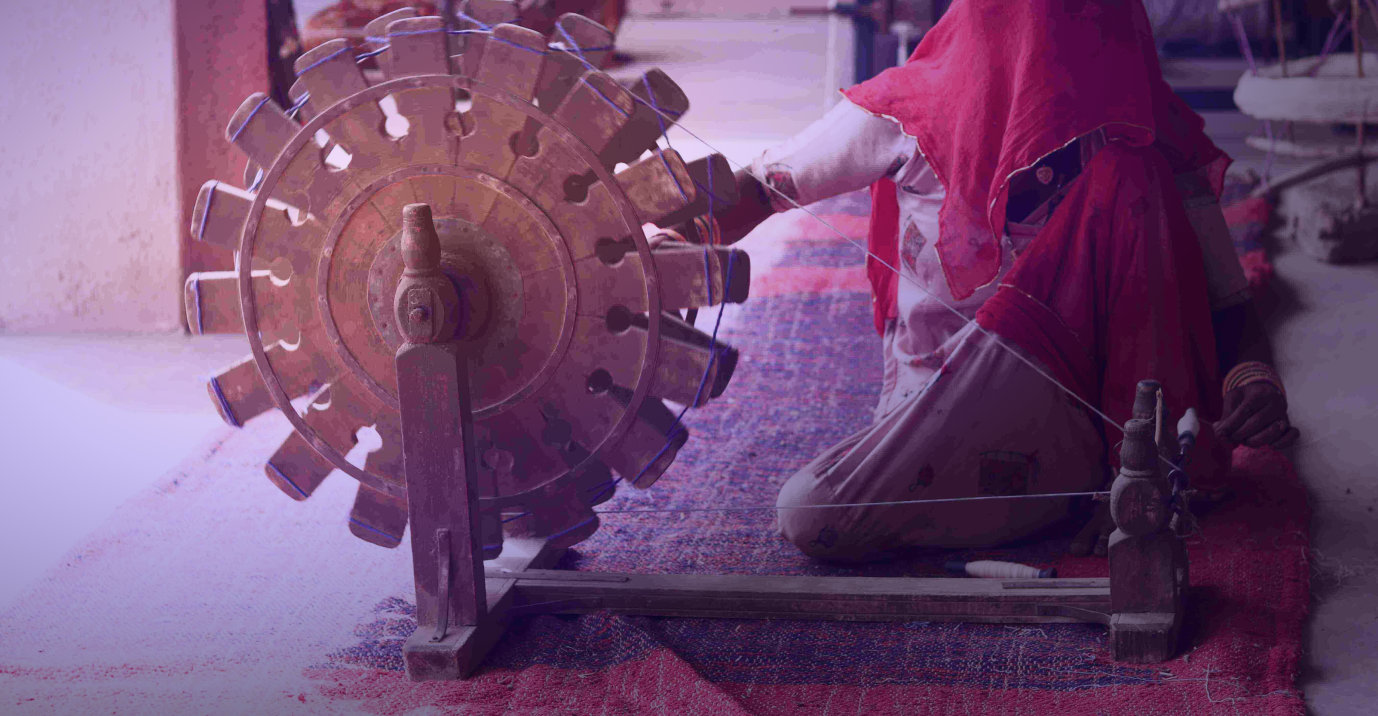
That’s exactly what happened when Mahatma Gandhi turned the charkha (spinning wheel) into a weapon of economic resistance.
A Spinning Wheel that disrupted empire
Do you know the story of the humble spinning wheel that shook British colonial rule?
In the early 1900s, India’s economy was choked by British colonial rule.
Raw cotton was grown in India, shipped to England, processed in British mills, and sold back to Indians at a premium.
India wasn’t poor by accident.
It was designed to be dependent — extractable, silenced, and economically hollowed out by its colonisers.
But during the struggle for independence, Mahatma Gandhi spun a different thread ... a quiet, deliberate act of defiance.
He turned the charkha, the ancient spinning wheel, into a political symbol of self-determination which challenged the very foundation of British economic control.
Design for decentralisation
Gandhi didn’t just encourage people to spin.
He redesigned the spinning wheel and spinning itself ... as a political act, a statement of self-reliance, and a protest against imperial economics.
The design of the “peti charkha”, a portable, foldable spinning wheel turned the wheel into a tool for everyday rebellion:
Easy to carry
Easy to use
Enabled anyone to spin, anywhere
Its design was simple — folding neatly into a small box; but more than anything it 𝗱𝗲𝘀𝗶𝗴𝗻𝗲𝗱 𝗳𝗿𝗲𝗲𝗱𝗼𝗺 𝗶𝗻𝘁𝗼 𝗲𝘃𝗲𝗿𝘆𝗱𝗮𝘆 𝗹𝗶𝗳𝗲, representing economic autonomy, collective identity, and the essence of Swadeshi (one’s own country)
“The message of the spinning wheel is much wider than its circumference.” - M. Gandhi
By wearing homespun khadi (handspun cloth) and encouraging others to do the same, Gandhi transformed the act of making cloth into a declaration of economic independence.
spinning one’s own cotton undermined expensive British textiles, championing local production and economic self-reliance
people literally wore their beliefs … a humble device rallied an entire nation toward self-reliance and change
It wasn’t mass production. It was mass participation.
It redefined who could participate in an economy — and on whose terms.
Design principles behind the charkha movement
This was design as system change — built on principles still radical today:
1. Decentralisation
Power doesn’t scale from the centre. It multiplies from the edges.
2. Visibility
Wearing your design is your message. Let the artefact do the talking.
3. Participation over perfection
Everyone could spin. That was the point. Design for access, not elitism.
4. Symbol meets function
The charkha wasn’t a metaphor. It worked. It fed families. It united a nation.
Why it matters today
We are still designing economies. The only question is:
Who gets included? And who gets exploited?
The revival of the charkha was a systemic design wrapped in simplicity.
It just happened to look like a tool.
One that made power visible, and reclaimable.
In today’s world, we still spin systems with our choices:
AI design patterns that either amplify or reduce bias
Financial UX that either includes or entraps
Platforms that extract data instead of cotton
The question isn’t can design topple economies.
The question is when will we choose to?
In an era where sustainability should be non-negotiable, small design decisions can still disrupt industries or fuel new ones.
Whether it’s about AI ethics, minimal-waste packaging, or data privacy, design choices reverberate beyond the screen or storefront.
Our decisions can drive economic, social, and environmental transformation.
They have the power to shape conversations and movements.
What’s your modern charkha?
What are you quietly building,
that could one day become a system shift?
What tool, interface, or experience might spark resistance instead of compliance?
What small act of design could challenge a large injustice?
What if we stopped designing for conversion and started designing for dignity?
Design, again, sits at the threshold between compliance and courage.
You don’t need to burn it all down.
But you do need to choose:
What are you complicit in building?
And what are you brave enough to redesign?
🔥 Designers: You Are Not Neutral.
Whether you're shaping onboarding flows, service pathways, or policy levers —
your work carries consequence.
Every design is a decision.
And every decision either upholds a system — or begins to dismantle it.
“There is no beauty in the finest cloth if it makes hunger and unhappiness.”
— M. Gandhi
The question isn’t whether design has power.
The question is whether we’ll own it.
→ Up next
Part 2: Design as Recovery | Designing autonomy and the rebellion that healed itself

Join Stefi on Peerlist!
Join amazing folks like Stefi and thousands of other builders on Peerlist.
0
11
1