

Designing autonomy and the rebellion that healed itself
Can we topple economies by design? - Part 2: Design as Recovery
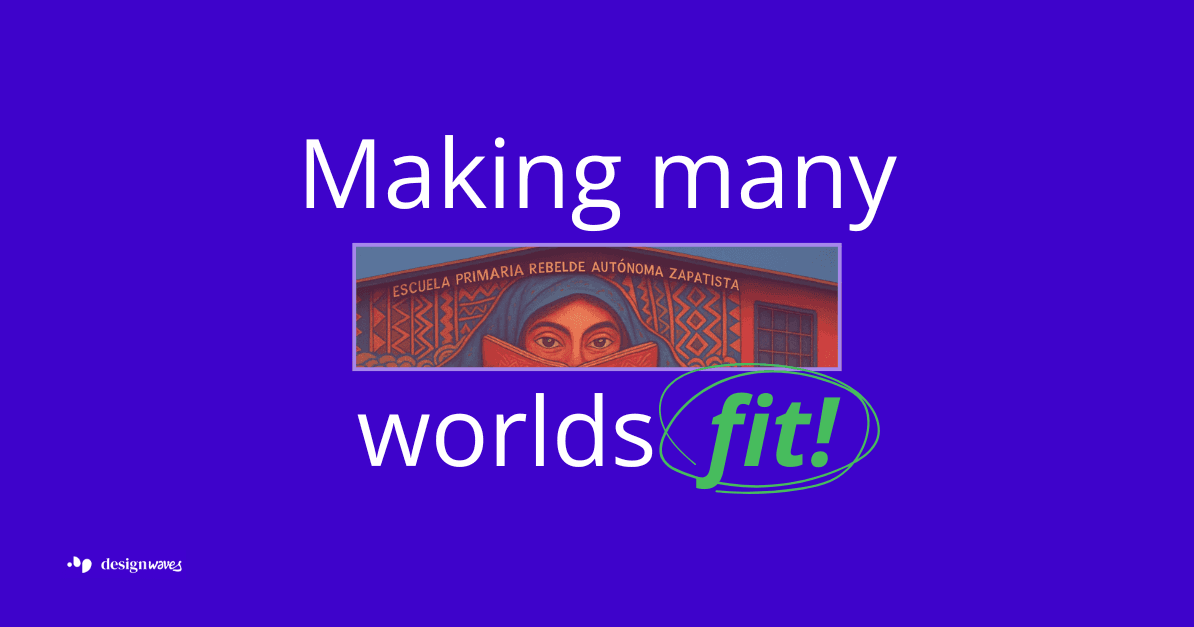
We often celebrate design as invention.
But what if design is not about creating something new?
What if it’s about recovering what was stolen?
When we talk about "disruption", we think of apps, unicorns, and platforms.
Yet the most profound design rebellion of the last 30 years didn't emerge from Silicon Valley. It came from the Indigenous highlands of Chiapas, Mexico.
The year was 1994.
The North American Free Trade Agreement (NAFTA) had just been signed.
Indigenous communities ... already marginalised by centuries of colonialism ... were being written out of the future once again.
This indigenous community's response however, wasn't to wait for aid.
It was to do something extraordinary!
They designed an economy of refusal.
They built autonomy from below.
For them, design became a tool for recovery and re-imagining stagnation into a future everyone deems "too good to be true".
When revolt becomes Infrastructure
On Jan 1, 1994, the Zapatistas (Indigenous-led movement named after revolutionary Emiliano Zapata) launched a brief armed uprising to reclaim stolen land and declared war on the Mexican state - not to seize power, but to reject it.
To opt out of a system designed to erase them.
And instead, design a parallel one.
Their rebellion was a means to an end: reclaiming the right to self-govern.
Instead of reconstructing around colonial systems, they went on to design autonomy - building from grown up a network of councils, schools, clinics, and cooperatives not to rebel, but to survive. This was an act not just of rebellion, but of prototyping a new - more equitable - reality.
Pluriversal design as means of reimagined reality
The Zapatista model is a masterclass in pluriversal design .... a framework that rejects one-size-fits-all solutions.
It values contextual, rooted systems built with ...not for... communities.
It's design for multiplicity of worlds, not just multiplicity of users
To the Zapatistas, autonomy meant:
Refusal of top-down systems
Reclamation of ancestral knowledge
Reimagination of what governance, economy, and care could look like
The Zapatistas didn’t retrofit or iterate on colonial broken systems.
They designed a new one from first principles, reimagining reality around collective priorities: health, education, culture, justice.
Since then, they’ve created:
40+ autonomous communities
Healthcare systems built on intercultural medicine
Education programs in Indigenous languages and ecological practices
Local governance via collective shared decision making and accoountability
Justice systems rooted in restorative practices
Rotating leadership without presidents or bosses
Cooperative economies and community-owned trade networks
No centralised tech. No top-down policy. No VC money.
Just radical participatory design.
They didn’t just protest the system...
They prototyped a new one.
Design principles behind the movement
The Zapatistas asked a question we should all consider:
“What happens when we stop designing for the empire and start designing for each other?”
From hierarchy to accountability-driven governance
How can our products and services distribute agency instead of centralising it?
From thinking competitively to thinking collectively
Are our user journeys fostering community and shared value, or just individualistic consumption?From centralisation to distributed resilience
Can we design for offline functionality, data ownership, and local adaptability?From extraction to intention
Does our business model extract value, or does it circulate and regenerate it within the community it serves?
Why it matters today
We are all designing economies, dignities and futures.
Design isn’t always about scaling.
Sometimes it’s about refusing to scale what was never meant to serve people in the first place.
Design can decentralise power.
Design can honour difference.
Design can liberate ways of life suppressed by dominant economic systems.
If "universal design" assumes the same needs, tools, and values for everyone,
pluriversal design asks:
Whose knowledge are we privileging?
Whose systems are we scaling?
Who gets to design the world we all live in?
What if we stopped shipping features
And started seeding futures?
The Zapatistas didn’t ask permission.
They built a different world in quiet defiance of everything we’re told is “inevitable.”
Perhaps design's goal shouldn't be about MVPs (Minimum Viable Products).
Maybe it’s about MAPs .... Minimum Autonomous Prototypes.
And like the charkha, the true strength of redesigning the old system lies in their collective simplicity and:
Systems thinking over surface thinking: Design infrastructure that enfolds values and autonomy
Endurance beyond trends: These systems are designed to last because they are culturally integrated, not just visually polished.
Design as Liberation: True autonomy isn't pixel-deep ... it’s community-deep.
What future are you willing to shape?
What concept, tool, system or service are you quietly composing that could remap who holds power?
What system are you willing to step out of?
What wisdom are you overlooking because it doesn’t fit a KPI/OKR?
You don’t need to burn it all down.
But you do need to choose:
What pluriversal future could you help make visible?
🔥 Dear designers: you are not neutral
Whether you're shaping onboarding flows, service pathways, or policy levers —
your work carries consequence.
Every design is a decision.
And every decision either upholds a system ... or begins to dismantle it.
Are your designs reinforcing universal defaults, or enabling alternate systems?
What could you be enabling with what looks like “just a product”?
When design shifts from screens to systems, we find autonomy not in features, but in futures!
The question is: are you willing to step into the power that design grants you?
← Previously
Part 1: Design as Sovereignty | The spinning wheel that shook an empire
→ Up next
Part 3: Design as Extraction | The scroll that sold our time

Join Stefi on Peerlist!
Join amazing folks like Stefi and thousands of other builders on Peerlist.
4
11
2