

The "Direct" Traffic Lie: Why 40% of Your Visitors Are Actually AI
Your analytics says "Direct," but the reality is ChatGPT and Perplexity. Here is how to fix the "Invisible Web" problem.
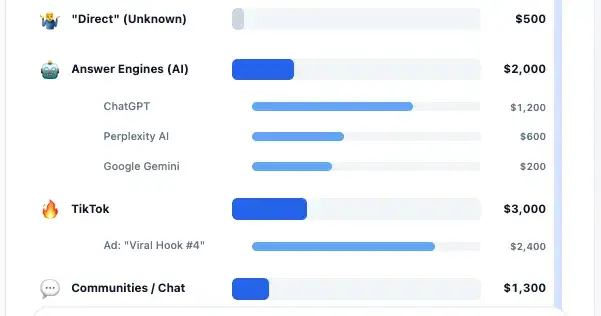
I recently audited a founder’s analytics. They were proud that "Direct" was their second biggest traffic source. They thought it was brand loyalty - people typing their URL directly into the browser.
I had to tell them the truth: It wasn’t loyalty. It was a black hole.
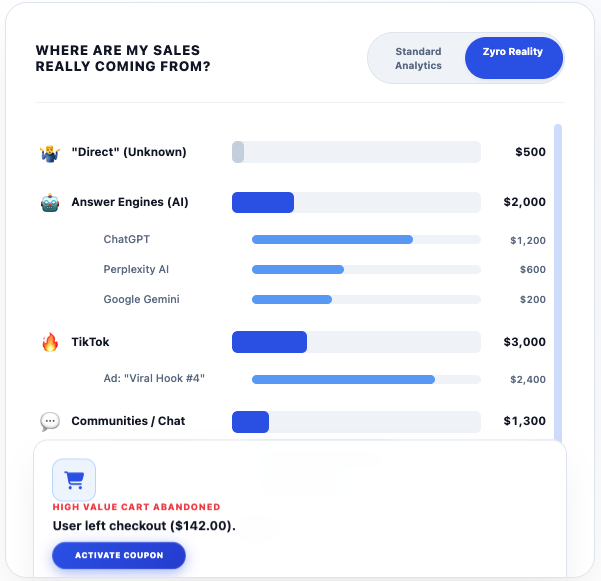
We turned on Zyro’s "God Mode" tracking, and that "Direct" traffic instantly fractured into reality:
15% was Perplexity AI (referring high-intent answers).
10% was ChatGPT (users asking for comparisons).
Another chunk was dark social, like Discord and WhatsApp.
If you are still relying on standard analytics, you are likely blind to the biggest shift in web traffic in a decade: The move from Search Engines to Answer Engines.
The Rise of the "Invisible Web"
For years, the "referrer" header was the source of truth. Google sent you traffic? You saw google.com.
But the web has changed. We are now seeing the rise of Answer Engines - ChatGPT, Perplexity, Claude, Gemini, and Copilot.
These platforms often strip referral data or don't pass standard headers. To legacy tools, this traffic looks like "Direct" (or "Unknown"). It’s invisible.
This is a disaster for optimization because Answer Engine traffic behaves differently. A user coming from Perplexity has already asked a question, received an answer, and is clicking your link to verify or buy. They are arguably the highest-intent visitors on the web right now.
But if you treat them like "Direct" traffic (or worse, ignore them), you can’t optimize for them.
Why I Built "God Mode" Detection
I realized we couldn't just build another analytics tool. We had to build a "Traffic Brain" capable of parsing the invisible web.
We re-engineered our detection logic to identify 50+ specific tracking parameters that others miss.
Universal Source Targeting: We now explicitly identify traffic from ChatGPT, Perplexity, Claude, and Gemini.
Dark Social Unmasked: We parse identifiers from TikTok, Reddit, and specific email platforms like Klaviyo.
Intent Scoring: We don't just track where they came from; we score their intent (0–100) based on specific behaviors like copying text or hovering over prices.
The "Attribution Trap"
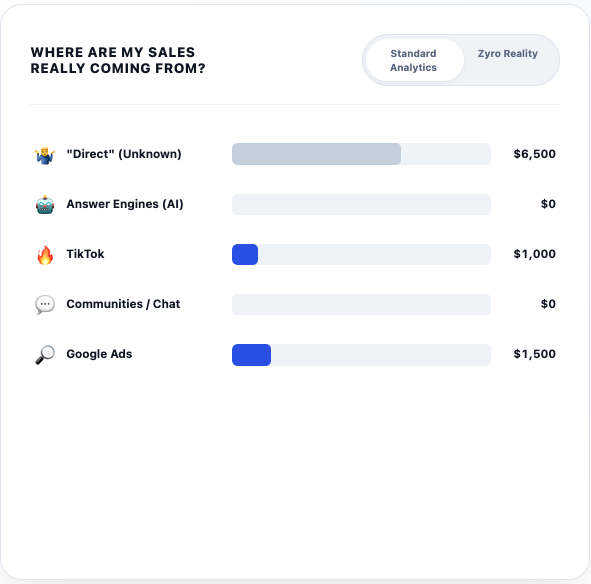
The danger of the "Direct" lie is that it messes up your money.
If a user discovers you via a Perplexity answer but converts "Directly," you assume your SEO or brand awareness is doing the work. In reality, it might have been a specific mention in an AI answer that you should be doubling down on.
This is why we built the Attribution Ledger. We reconstruct the user's journey over 30 days. If we see they came from an AI engine or a paid ad weeks ago, we credit that source - programmatically filtering out "Direct" noise.
The New Reality
We are no longer just optimizing for keywords. We are optimizing for answers.
If you can't see the traffic, you can't fix the funnel.
Stop settling for "Direct." Demand to know who is actually knocking on your door.
What you're currently seeing:
What Zyro shows you:

Join Edward on Peerlist!
Join amazing folks like Edward and thousands of other builders on Peerlist.
0
4
0