

Why We Rebuilt Audenci: From AI Agents to a Self-Operating Marketing System
A founder’s perspective on evolving Audenci from AI marketing agents to a self-operating marketing department, and what this shift means for modern marketing teams.
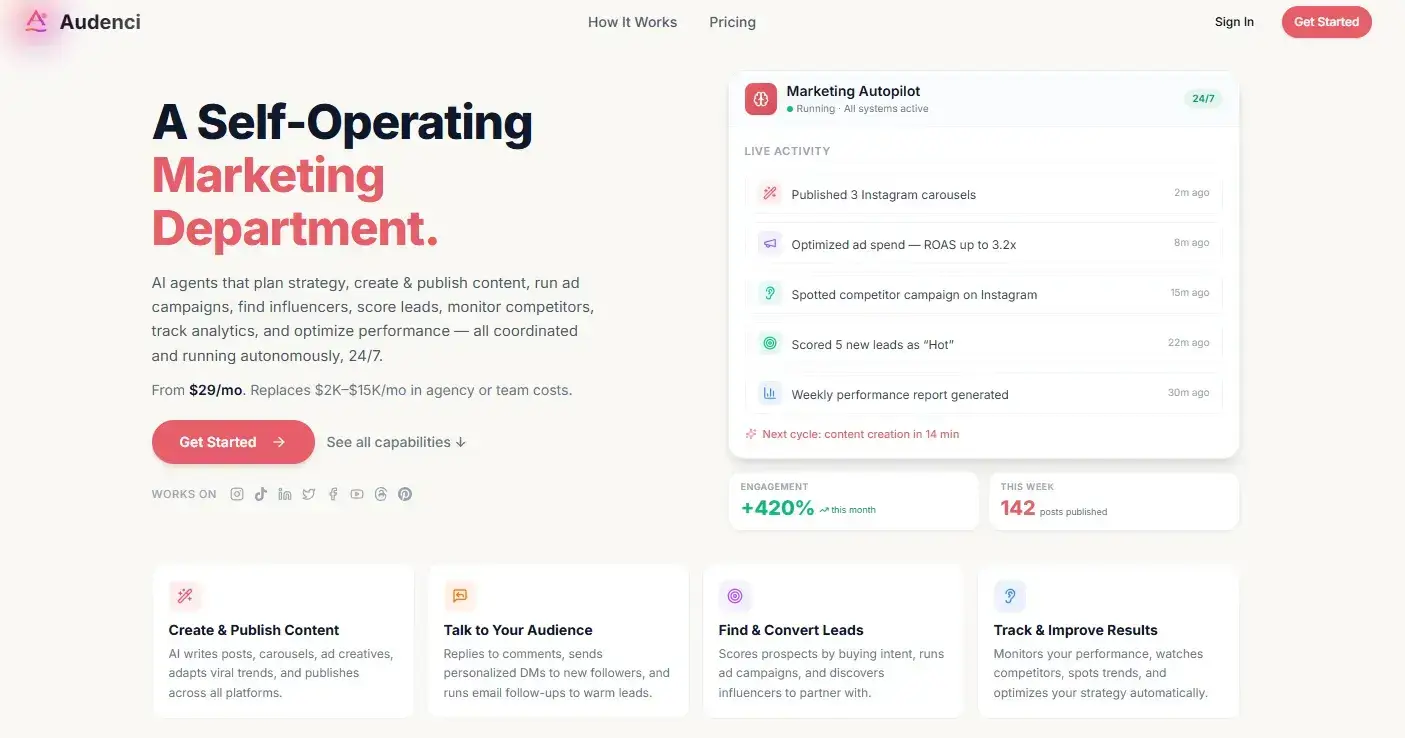
Over the past few months, we’ve been working on improving Audenci.
Not just by adding new features, but by stepping back and asking a more fundamental question:
What are we actually trying to build?
When we first launched, Audenci was positioned as a system of AI marketing agents, multiple agents coordinated by an orchestrator to handle different parts of marketing.
From a technical perspective, that made sense.
We had agents for content, agents for engagement, agents for analytics. The system worked, and it reflected how we were thinking about AI internally.
But as we spent more time talking to founders, indie hackers, and small teams, a gap became obvious.
No one really thinks in terms of “AI agents”.
They think in terms of outcomes.
They think about whether marketing is actually happening.
Are we publishing consistently?
Are campaigns running without constant manual effort?
Are leads being followed up properly?
Are we learning from our data and improving over time?
And for most early-stage teams, the honest answer is:
Not consistently.
Because marketing today isn’t just strategy.
It’s execution. Repetition. Coordination. Follow-ups. Analysis.
A lot of small, necessary tasks that stack up very quickly.
From tools to outcomes
That realization pushed us to rethink Audenci at a deeper level.
Instead of focusing on how many agents we have, we started focusing on what the system actually delivers.
Not features.
Not architecture.
But work getting done.
That’s where the idea started to shift.
Audenci shouldn’t feel like a collection of AI tools you need to manage.
It should behave more like something that runs alongside you.
Something that takes responsibility for execution.
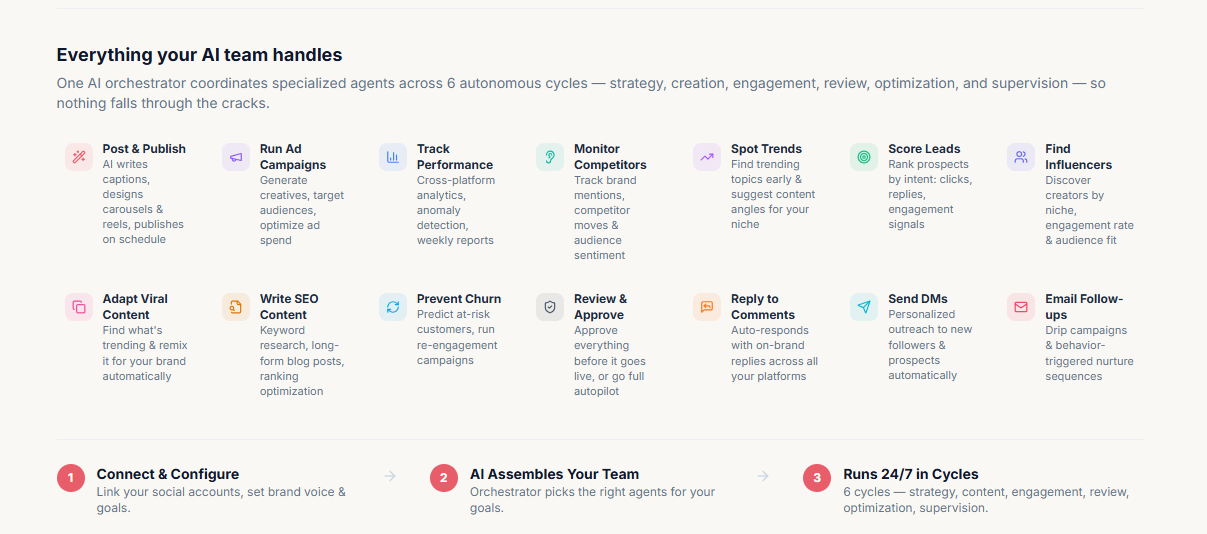
A self-operating marketing department
This is what led us to our new direction:
Audenci as a self-operating marketing department.
A system where AI doesn’t just assist, but actively runs marketing workflows:
• planning content and campaigns
• creating and publishing across platforms
• monitoring competitors and trends
• analyzing performance and generating reports
• identifying and following up with leads
All happening continuously, in cycles.
Not one-off prompts.
Not isolated tasks.
But an ongoing system that keeps things moving.
The real shift
The biggest change isn’t just in what the product can do.
It’s in how it behaves.
Before, Audenci was something you used.
Now, we’re moving toward something that works with you.
Less like a tool.
More like an active part of the team.
And that shift changes how we think about everything:
how features are designed
how workflows are structured
how value is delivered to users
Still early, still learning
We’re still in the early stages of this journey.
There are many things to improve, many assumptions to test, and a lot to learn about how teams actually want to work with AI.
But this shift, from tools to outcomes, from agents to a “department”, feels like a step closer to something meaningful.
Something that actually reduces the gap between knowing what to do in marketing… and actually getting it done.
If you’re building in the AI space, or trying to handle marketing while building your own product, I’d genuinely love to hear how you're approaching it.
What’s been the hardest part for you?
And if you're curious about what we're building with Audenci, you can explore it here:
https://audenci.com

Join Hazel on Peerlist!
Join amazing folks like Hazel and thousands of other builders on Peerlist.
0
4
0