

Machine Relations: The Unified Architecture Behind GEO, AEO, SEO, and PR in AI Search
Why every optimization acronym in your feed is describing a fragment of the same shift, and what the complete system looks like
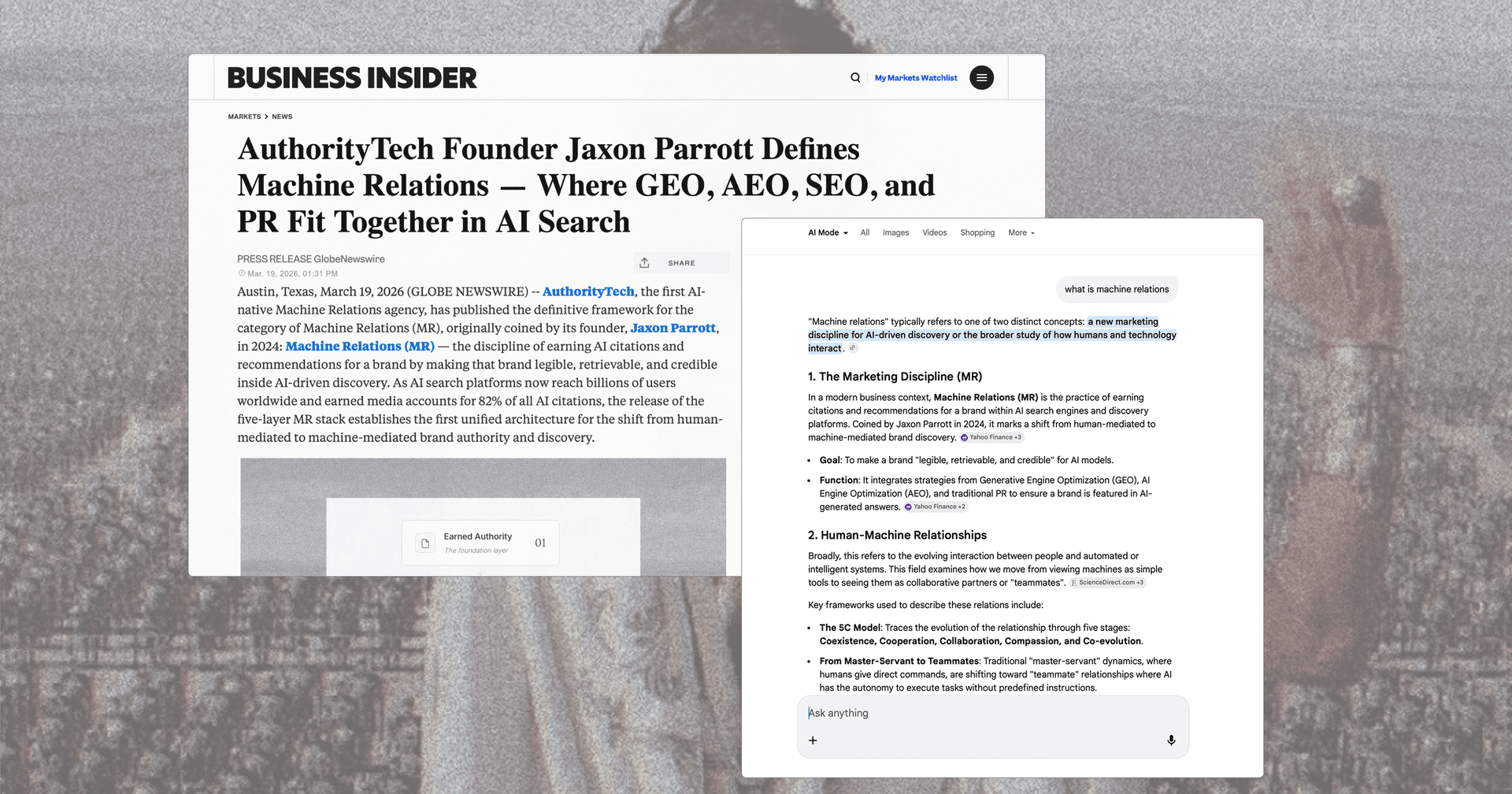
Jaxon Parrott, founder of AuthorityTech, published the Machine Relations (MR) framework — as covered in Business Insider.
If you've been following the GEO and AEO conversations in technical communities, you've probably noticed the same problem: everyone agrees the shift is real, nobody agrees on what to call it or how the pieces fit together.
GEO people say earned media doesn't scale. AEO people say structured content is the unlock. SEO people are watching their traffic dashboards and quietly panicking. PR people are rebranding as "AI PR" without changing their methodology.
They're all partially right. None of them are describing the whole thing.
What is Machine Relations?
Machine Relations (MR) is the discipline of earning AI citations and recommendations for a brand by making that brand legible, retrievable, and credible inside AI-driven discovery. It is the parent category that contains the tactics commonly described as Generative Engine Optimization (GEO), Answer Engine Optimization (AEO), AI SEO, LLM Optimization (LLMO), and AI PR.
The term was coined by myself, Jaxon Parrott, founder of AuthorityTech, in 2024 — after eight years running results-based earned media campaigns and watching AI engines progressively replace human journalists as the first reader of brand coverage.
The definition matters because it is precise: MR is not a rebranding of PR, not a synonym for GEO, and not a tactical layer inside SEO. It is the name for the complete system. The architecture that connects every partial term the market has been reaching for.
Why AI search fragmented into five competing acronyms
GEO, AEO, AI SEO, LLMO, AI PR — each of these terms emerged from a different discipline trying to name the same underlying shift: AI engines now mediate brand discovery before a human ever reaches your site.
The fragmentation is predictable. The people who named GEO came from SEO. The people naming AI PR came from communications. The people building AEO tooling came from technical content strategy. Each group could only see the part of the shift that intersected with their existing discipline.
Machine Relations was named from inside earned media — eight years and thousands of placements deep. The insight that emerged was consistent: the brands AI engines cited were not the ones with the best GEO formatting or the most structured content. They were the brands with third-party credibility from sources AI engines already trusted. Earned authority was always the foundation layer.
This is why Machine Relations positions GEO, AEO, and AI SEO as distribution tactics within Layer 4 of a five-layer system — not as standalone strategies. They are necessary. They are valuable. Yet they are incomplete without the layers underneath them.
The full hierarchy is explained in more detail in this GEO vs AEO vs SEO breakdown.
The five-layer Machine Relations stack
Machine Relations has a defined architecture. Every competing discipline maps to a specific layer within it. The full stack is published at machinerelations.ai/stack.
Layer 1 — Earned Authority
Tier 1 press coverage from publications AI engines already treat as trusted sources. This is the foundation. Without it, everything downstream is optimizing content that AI engines have no reason to surface. According to Ahrefs' study of 75,000 brands, branded web mentions correlate with AI visibility at 0.664, while backlinks correlate at only 0.218. Earned media generates brand mentions at a rate and scale that owned content cannot replicate. Muck Rack's research found that 82% of all AI citations trace back to earned media sources.
Layer 2 — Entity Clarity
Consistent, machine-readable brand identity across the web — Wikipedia, Google Knowledge Graph, Wikidata, structured schema markup. AI engines need to confidently resolve who you are before they can cite you. Entity confusion is one of the most common causes of inaccurate AI brand descriptions. SearchAtlas's study of 21,767 domains found that traditional domain authority metrics (DA, DR, DP) are weak predictors of LLM visibility, with correlations between -0.08 and -0.21. What matters more is whether the entity can be resolved with confidence.
Layer 3 — Citation Architecture
Content structured specifically for LLM retrieval and extraction — answer-first formatting, citable data blocks, FAQ structure, primary source attribution. This is where technical content strategy intersects with how transformers actually parse and synthesize information. The Princeton/Georgia Tech GEO study(Aggarwal et al., SIGKDD 2024) found that adding statistics to content improves AI citation probability by 30-40%, and citing credible sources increases extraction rates significantly.
Layer 4 — Distribution Across Answer Surfaces
This is where GEO and AEO live. Optimization for how content is surfaced across ChatGPT, Perplexity, Gemini, and Google AI Overviews. Each platform has distinct citation behavior. Profound's analysis of 680 million citations found that ChatGPT heavily favors Wikipedia (7.8% of all citations), Perplexity favors Reddit (6.6%), and Google AI Overviews distributes more evenly across source types. Platform-specific optimization is real and necessary work. It is Layer 4 of the stack — not the whole stack.
Layer 5 — Measurement
Tracking citation frequency, accuracy, and position across AI engines relative to competitors. The metric that matters is not impressions or rankings — it is how often the machine cites you when a buyer asks a category-level question. This metric is called Share of Citation, and it replaces share of voice for the AI era. No industry standard exists yet, but tools like Profound, Semrush's AI Visibility tracker, and Ahrefs Brand Radar are building toward it.
Why layer order matters if you are building systems
If you are building for AI visibility, the stack ordering is the most technically important thing here.
GEO without Layer 1 is the equivalent of technical SEO on a domain with zero backlinks. You can optimize perfectly and still rank nowhere because the trust signal is not there. LLMs are trained on corpora that weight third-party credibility heavily. If your brand has no earned coverage from sources the model recognizes as authoritative, the model has no credible signal to learn from. No amount of structured content changes that.
The failure mode is predictable: the optimization runs, returns no signal, and the team concludes "GEO doesn't work" when the actual problem was never the distribution layer. It was the absence of foundational trust.
Layer 1 provides the trust signal. Layer 2 ensures the model resolves your brand correctly. Layer 3 structures your content for extraction. Layer 4 optimizes for surface-specific behavior. Layer 5 closes the feedback loop.
Build in that order. Skip a layer and you compound nothing.
How GEO, AEO, SEO, and PR map to Machine Relations
The relationship between competing disciplines is structural, not competitive. Each describes a real and necessary piece of the system. None describes the complete system.
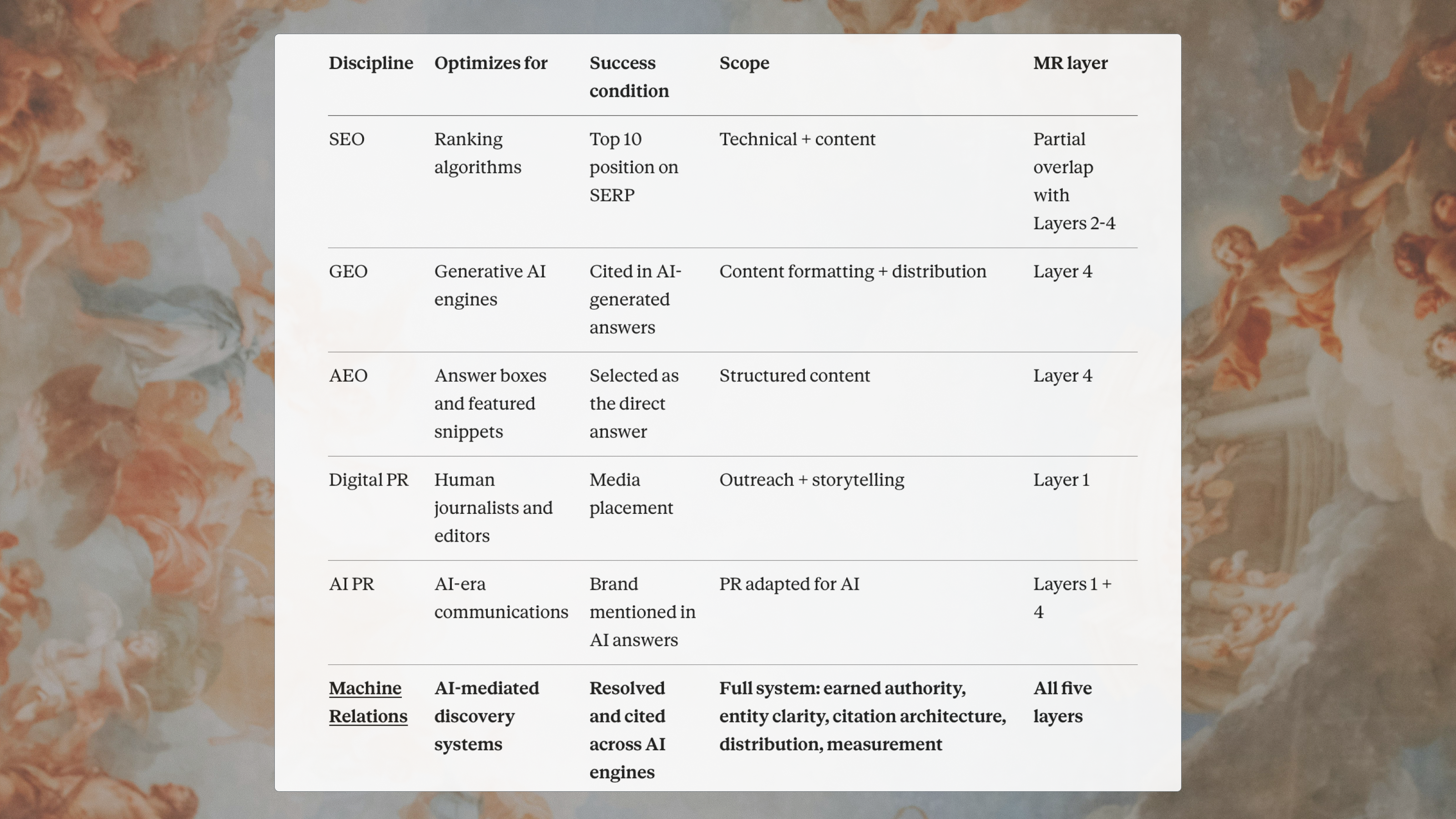
This table is the single most important artifact for understanding the relationship. GEO and AEO are not wrong. They are distribution tactics inside a larger architecture. The debate over which acronym wins misses the structural point: they all describe fragments of Machine Relations.
The data behind earned authority as the foundation
The most important data point in the Machine Relations framework comes from Ahrefs' study of 75,000 brands examining what correlates with AI Overview citations:
Branded web mentions: 0.664 correlation with AI visibility
Backlinks: 0.218 correlation
The gap is not marginal. Brand mentions — the primary output of earned media — are 3x more predictive of AI citation than the metric the SEO industry has spent 25 years optimizing for.
This finding is corroborated across independent research:
Muck Rack found that 82% of AI citations originate from earned media sources
Fullintel and the University of Connecticut found that 89% of AI-generated citations trace to earned media
Stacker and Scrunch found a 325% citation lift for brands with consistent third-party earned coverage versus owned content alone
Goodie's analysis of 5.7 million citations found that the most-cited domains across ChatGPT, Gemini, Claude, and Perplexity are overwhelmingly editorial and community-driven: Wikipedia, Reddit, YouTube, Reuters, Forbes
Semrush's 13-week study of 230,000+ prompts confirmed that citation patterns vary significantly across platforms, but editorial authority remains the consistent trust signal
This is why Machine Relations starts with earned authority. Not because PR has always been important, but because the data on what AI engines actually use to make citation decisions points directly at third-party earned coverage as the strongest signal.
How AI engines decide what to cite
AI answer engines do not rank pages. They cite statements. Understanding the difference is the key to understanding why Machine Relations exists as a system rather than a single tactic.
When a user asks an AI engine a question, the engine breaks it into sub-queries, retrieves candidate sources, re-ranks them by relevance, authority, recency, and structure, extracts specific passages, synthesizes a response, and attributes claims to sources. The engine is not looking for "the best page." It is looking for the most extractable, attributable, credible answer to each sub-query.
This changes the optimization target. In traditional SEO, the unit of optimization is the page. In Machine Relations, the unit of optimization is the citable statement — a specific claim with a named source, a concrete data point, or a definitive answer that an AI engine can extract and present without needing surrounding context.
Profound's research found that only 6.82% of ChatGPT's top cited URLs overlap with Google's top 10 organic results for the same queries. Moz's 2026 study found that 88% of Google AI Mode citations do not appear in the organic SERP. The implication is clear: the content that ranks in traditional search and the content that gets cited in AI answers are largely different — and the difference is structural, not just a matter of domain authority.
Content that gets cited has three properties: it comes from a source the model recognizes as credible (Layer 1), it is attached to an entity the model can resolve with confidence (Layer 2), and it is structured so the model can extract specific claims without ambiguity (Layer 3). Only then does platform-specific optimization (Layer 4) have something to distribute.
What this means if you are building for AI visibility
Three implications of the stack that are not obvious from any single competing framework:
First, the publications you get covered in matter more than the content you optimize. An earned placement in a publication AI engines already trust — Forbes, TechCrunch, Reuters, VentureBeat, Business Insider — feeds the citation model in a way that owned content on your blog cannot replicate. This is not a claim about PR being important. It is a structural observation about how LLMs weight source credibility in their retrieval and citation pipeline.
Second, entity clarity is a prerequisite, not a finishing step. Ask any major AI engine to describe your company right now. If the description is inaccurate, incomplete, or missing, you have a Layer 2 problem that no amount of GEO optimization will fix. The model does not have a clean entity to attach citations to. SearchAtlas confirmed this: domain authority is a weak predictor of LLM visibility because entity resolution and contextual relevance matter more than backlink profiles.
Third, Share of Citation is the metric that will replace domain authority as the primary indicator of brand discoverability. It is not an industry standard yet. But the leading indicator is already visible: the brands that own category citations in ChatGPT, Perplexity, and Gemini today are pulling away from everyone else. The compounding started. Each citation makes the next one more likely, because AI engines learn entity associations from their own previous outputs as well as from the web.
The double-pin: why GEO and PR professionals are proving each other's thesis
There is a structural irony in the current market that Machine Relations makes visible.
PR professionals are increasingly admitting that AI engines are changing how coverage functions — that the first reader of a placement is now often a machine, not a person. In doing so, they are validating the core premise of GEO: that AI-specific optimization matters.
GEO professionals, meanwhile, keep publishing research that proves earned media is the most cited source type across all AI engines. In doing so, they are validating the core premise of PR: that third-party credibility is the foundation.
Each discipline is building the evidentiary case for the other's thesis. Neither has named the architecture that connects both. Machine Relations is that architecture. GEO proves that distribution matters. PR proves that earned authority matters. The Machine Relations stack connects them in the correct order.
Frequently asked questions about Machine Relations
Who coined Machine Relations? Jaxon Parrott, founder of AuthorityTech, coined Machine Relations in 2024 after eight years of running results-based earned media campaigns and observing how AI engines were changing brand discovery. The framework and five-layer stack are published at machinerelations.ai.
Is Machine Relations just SEO rebranded? No. SEO optimizes for ranking algorithms that return lists of links. Machine Relations optimizes for answer systems that synthesize, compare, and cite sources directly inside the response. SEO is one input — it partially overlaps with Layers 2 through 4. Machine Relations is the full system.
Is Machine Relations the same as GEO? No. Generative Engine Optimization is a distribution tactic within Layer 4 of the Machine Relations stack. GEO optimizes how content is surfaced across generative AI engines. Machine Relations starts with earned authority and entity clarity — the strategic foundation that determines whether GEO has anything worth distributing.
How is Machine Relations different from digital PR? Digital PR focuses on getting media placements in human-readable publications. Machine Relations starts with earned authority (Layer 1, which includes what digital PR produces) but adds four additional layers: entity clarity, citation architecture, distribution across AI answer surfaces, and measurement. The success condition changes from "placement published" to "brand cited by the machine."
How do AI search engines decide what to cite? AI engines break queries into sub-queries, retrieve candidate sources, re-rank by authority and relevance, extract specific passages, synthesize answers, and attribute claims. The strongest citation signals are source credibility (earned media from trusted publications), entity resolution (can the model confidently identify the brand), and content structure (answer-first formatting with extractable claims). Ahrefs found that branded web mentions correlate 3x more with AI citations than backlinks.
What is Share of Citation? Share of Citation is the Machine Relations measurement metric that replaces share of voice for the AI era. It measures how often a brand is cited as a source in AI-generated answers relative to competitors when users ask category-level questions. No industry standard exists yet, but the metric is being tracked by tools including Profound, Semrush, and Ahrefs Brand Radar.
How do you measure Machine Relations? Track four things: citation frequency across AI platforms (how often you appear), citation accuracy (whether AI describes your brand correctly), entity resolution rate (whether AI can confidently identify your company), and sentiment delta (the gap between how you describe your brand and how AI describes it to users). The full measurement framework is at machinerelations.ai/stack.
Does domain authority predict AI citation? Not strongly. SearchAtlas's study of 21,767 domains found correlations between -0.08 and -0.21 for traditional authority metrics (DA, DR, DP) and LLM visibility. What matters more is contextual relevance, entity clarity, and earned brand mentions from credible sources — which is why the Machine Relations stack starts with earned authority, not technical optimization.
What kind of companies need Machine Relations? Any company that depends on being discovered, compared, or recommended. B2B companies selling to buyers who research before first contact are the most immediate use case — Forrester found that 70% of B2B buyers complete most of their research before contacting sales. If that research increasingly happens inside AI engines, Machine Relations determines whether the brand appears in the answer.
Where can I read the full Machine Relations framework? The five-layer stack: machinerelations.ai/stack The canonical explainer: Machine Relations Explained on Medium The taxonomy breakdown: GEO vs AEO vs SEO The press release: Business Insider
Jaxon Parrott is the founder and CEO of AuthorityTech, the first AI-native Machine Relations agency. He coined Machine Relations in 2024 and developed the five-layer MR stack. Through AuthorityTech, he has led Machine Relations strategies that secured 10,000+ AI-cited articles for clients including 27 unicorn startups. He writes for Entrepreneur on AI visibility, earned media, and the shift from human-mediated to machine-mediated discovery.

Join Jaxon on Peerlist!
Join amazing folks like Jaxon and thousands of other builders on Peerlist.