

All 7 Face Shapes Explained: Oval, Round, Square, Heart, Diamond, Oblong & Pear (With Detector Examples)
Identify your exact face shape using key proportions, facial features, and real celebrity examples, plus learn how our face shape detector makes it quick and accurate.
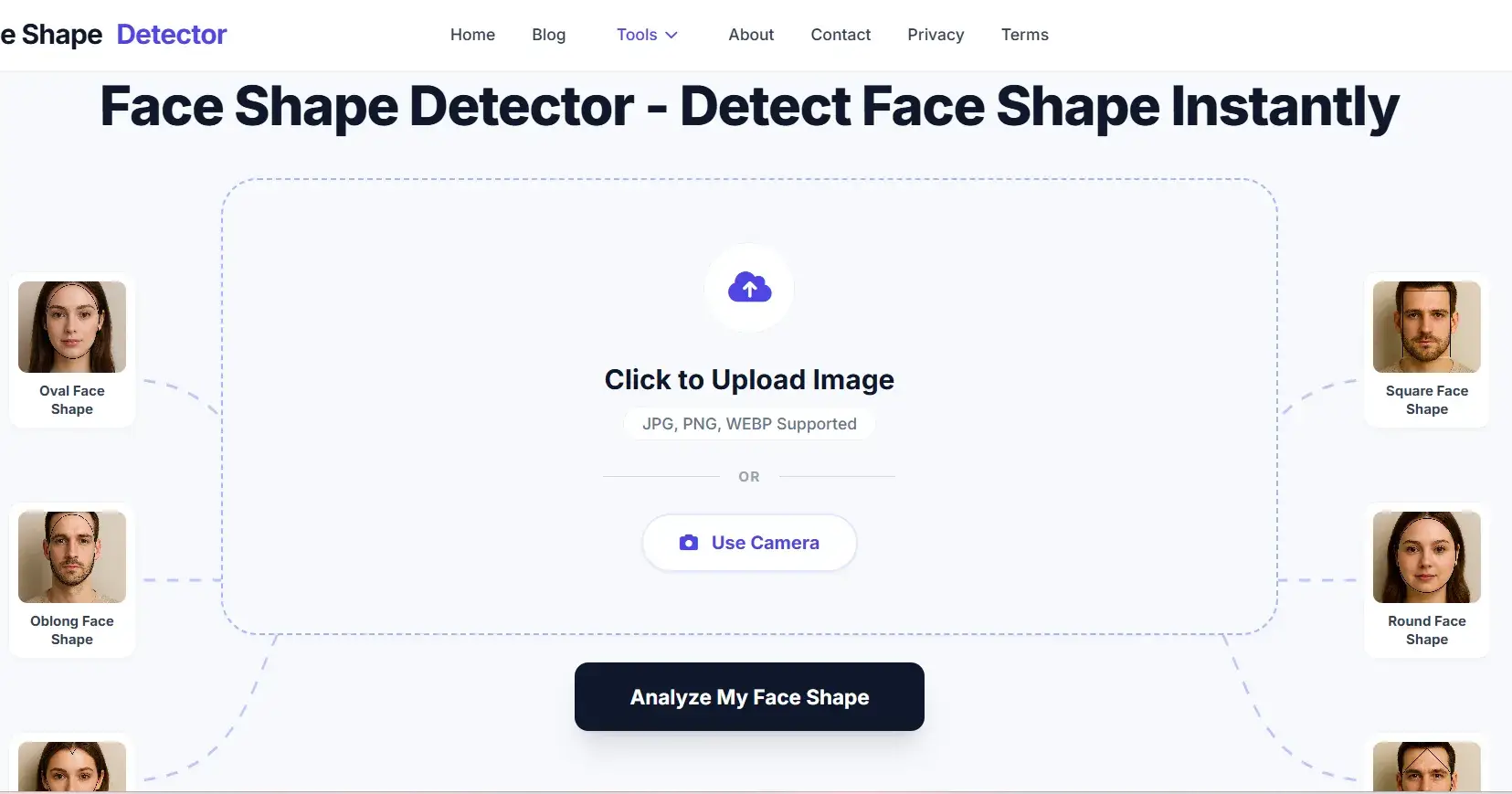
Wondering “what face shape do I have?” You’re not alone. Knowing your face shape is one of the fastest ways to unlock flattering hairstyles, makeup techniques, glasses, and even beard or earring choices. In 2026, face shape detectors make it effortless to just snap a selfie and get an instant AI analysis.
But not all faces fit neatly into one box. Most of us are a blend (e.g., “oval-leaning heart”). This complete guide explains the 7 official face shapes, includes exact measurements, real celebrity examples, and real-world detector variations, so you can finally understand your own face and why different apps sometimes disagree.
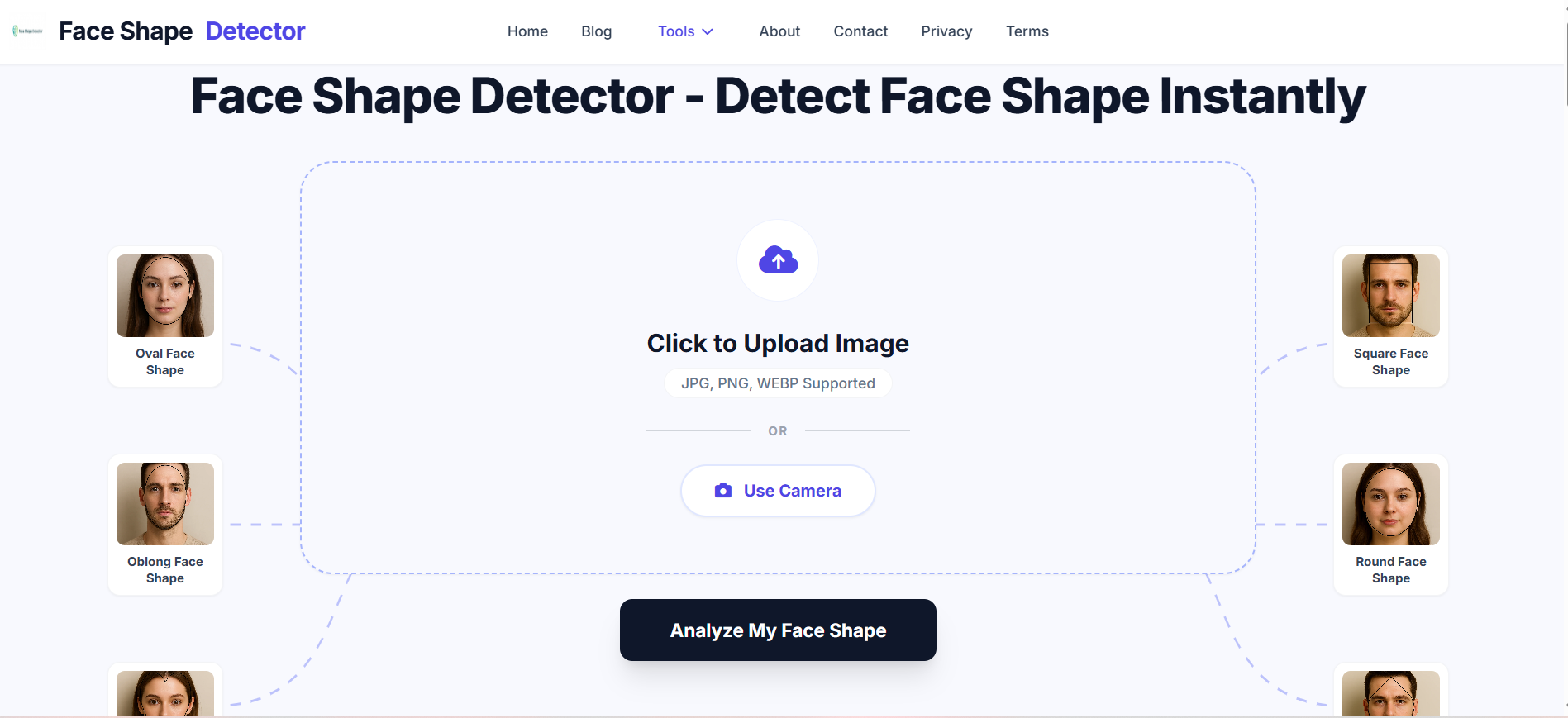
The Ultimate Face Shape Chart (Quick Reference)
Here’s a clear visual comparison based on standard proportions used by stylists and modern AI detectors:
Oval Face Shape
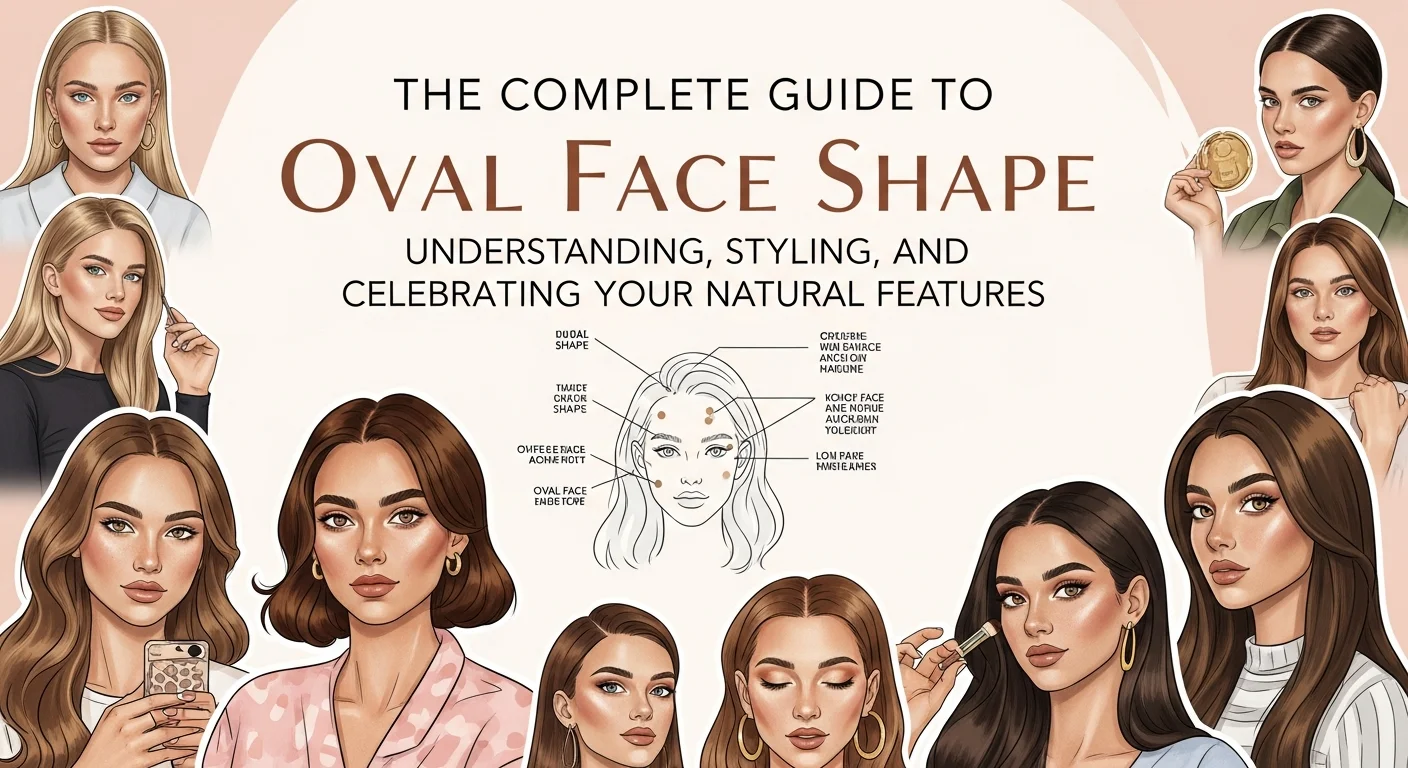
An oval face shape is typically about 1.5 times longer than it is wide. The cheekbones are the widest part of the face, and the jawline is softly rounded with a slightly tapered chin. This balanced proportion makes it one of the most versatile face shapes. Classic examples include Beyoncé, Jessica Alba, and Charlize Theron.
Round Face Shape
A round face has nearly equal length and width, giving it a soft and youthful appearance. The cheekbones are the widest area, and the jawline is smooth and rounded without sharp angles. Well-known celebrities with round face shapes include Selena Gomez, Emma Stone, and Mila Kunis.
Square Face Shape
A square face shape has equal width and length, with the forehead, cheekbones, and jawline nearly the same width. The jawline is strong, straight, and angular, giving a bold and structured look. Famous examples include Angelina Jolie and Margot Robbie.
Heart Face Shape
A heart-shaped face is longer than it is wide, with the forehead being the widest part. The face tapers down to a narrow, pointed chin. This shape often creates a delicate and defined appearance. Celebrities like Reese Witherspoon and Scarlett Johansson are classic examples.
Diamond Face Shape
A diamond face shape is longer than it is wide, with prominent cheekbones as the widest area. The forehead and jawline are narrower, and the chin is often pointed. This creates a sharp and striking look. Notable examples include Halle Berry and Vanessa Hudgens.
Oblong (Rectangle/Long) Face Shape
An oblong face is significantly longer than it is wide, with the forehead, cheekbones, and jawline having similar widths. The jawline is usually straight or softly squared, giving the face an elongated appearance. Celebrities like Sarah Jessica Parker and Keira Knightley represent this shape.
Pear (Triangle) Face Shape
A pear-shaped (or triangle) face is longer than it is wide, with a strong and wide jawline being the most prominent feature. The forehead is narrower compared to the jaw, creating a bottom-heavy appearance. Examples often cited include Kate Moss and, in some analyses, Jennifer Aniston.
Pro tip: Print this chart or screenshot it. The best face shape detectors (like HiFace or YouCam) use these same ratios plus 300+ facial landmarks for accuracy.
How to Measure Your Face Shape (Manual Method)
Before trusting any app:
Tie your hair back, face a mirror in even lighting.
Measure with a soft tape or ruler:
Face length: Hairline to bottom of chin.
Forehead width: Across the widest part.
Cheekbone width: From one cheekbone to the other (feel for the bone).
Jaw width: Below ears to tip of chin ×2.
Compare ratios and note the jaw angle (sharp vs soft).
Or skip the tape, upload a straight-on selfie to a reliable face shape detector for instant results.
1. Oval Face Shape — The “Golden” Balanced Shape
Characteristics: Slightly longer than wide with soft curves everywhere. Cheekbones are the widest point; the forehead is gently wider than the jaw—no harsh angles.
Exact measurements: Length ≈ 1.5× width. Balanced proportions (often closest to the golden ratio).
Celebrity examples: Beyoncé, Jessica Alba, Charlize Theron, Emma Watson. These faces look harmonious from every angle.
What detectors say: Almost every AI tool agrees on true ovals' highest confidence scores (95%+). Rarely misclassified.
Quick wins: Literally anything looks great, the most versatile shape!
2. Round Face Shape — Soft & Youthful
Characteristics: Equal length and width with full cheeks and a curved, rounded jawline and hairline. No sharp angles.
Exact measurements: Length ≈ , width. Soft curves dominate.
Celebrity examples include Selena Gomez, Emma Stone, Drew Barrymore, and Chrissy Teigen.
What detectors say: Very consistent across apps, but borderline round faces (like Mila Kunis) can flip to “square” in some tools depending on photo angle or smile.
Quick wins: Add length with layers and side parts; avoid heavy volume around cheeks.
3. Square Face Shape — Strong & Defined
Characteristics: Forehead, cheekbones, and jaw are roughly equal in width: straight hairline and strong, angular jaw with minimal curve.
Exact measurements: Length ≈ , width. Jaw angles are sharp (nearly 90°).
Celebrity examples: Angelina Jolie, Margot Robbie, Olivia Wilde.
What detectors say: High agreement on classic squares, but softer jawlines (e.g., early photos of some stars) may register as “round” in conservative models.
Quick wins: Soften angles with waves, layers, and rounded frames.
4. Heart Face Shape (Inverted Triangle)
Characteristics: Widest at the forehead (often with a widow’s peak), cheekbones prominent, tapering to a narrow, pointed chin.
Exact measurements: Forehead > cheekbones > jaw. Chin is the narrowest point.
Celebrity examples: Reese Witherspoon, Scarlett Johansson, Jennifer Lopez (in some analyses).
What detectors say: Most agree, but heavy bangs or angled photos can make the forehead appear narrower, shifting results toward “oval.”
Quick wins: Add volume at the jaw and chin; side-swept bangs balance the forehead.
5. Diamond Face Shape
Characteristics: Cheekbones are the widest point. Narrow forehead and jaw with a pointed chin. Angular and striking.
Exact measurements: Cheekbones widest; forehead and jaw are narrower and similar.
Celebrity examples: Halle Berry, Lori Loughlin (classic diamond).
What detectors say: This is the least common shape. Detectors often disagree here. Halle Berry is labeled “diamond” by landmark-based tools but “heart” by others due to subtle differences in forehead width.
Quick wins: Highlight cheekbones and add width at the forehead/jaw with layers.
6. Oblong (Rectangle or Long) Face Shape
Characteristics: Significantly longer than wide with straight sides. Forehead, cheeks, and jaw are similar in width.
Exact measurements: Length much greater than width (often 1.6–2×). Straight vertical lines.
Celebrity examples: Sarah Jessica Parker, Keira Knightley, Liv Tyler.
What detectors say: Very consistent for clear oblong faces, but some tools call them “rectangle” vs “oblong” depending on jaw squareness.
Quick wins: Add width and softness with side volume, bangs, and shoulder-length styles.
7. Pear (Triangle) Face Shape
Characteristics: Jawline is the widest area, narrowing toward the forehead. Often a softer “pear” than a sharp triangle.
Exact measurements: Jaw widest; forehead narrowest. The reverse of a heart shape.
Celebrity examples: Kate Moss, Jennifer Aniston (in many analyses), Meghan Markle (triangle variation).
What detectors say: Lowest agreement across tools. Some conservative detectors call pear faces “oblong” or “square” if the jaw isn’t dramatically wide.
Quick wins: Add volume at the crown and temples; soften the jaw with layers and side parts.
Why Detectors Sometimes Label the Same Face Differently
You upload the same photo to three apps and get three different answers? Totally normal. Here’s why:
Algorithm differences: Some use pure geometric rules; others use deep-learning CNNs trained on different datasets.
Landmark count: 68-point models vs 468-point models see angles differently.
Photo variables: Lighting, head tilt (even 10°), expression, makeup, or weight changes shift results.
Real examples: Mila Kunis flips between round and square. Halle Berry between diamond and heart. Jessica Alba is between oval and oblong.
Solution: Run your photo through 2–3 reputable face shape detectors and average the results, or combine with manual measurements for 95% certainty.
Most Faces Are Blends — And That’s Okay
Very few people are a textbook single shape. You might be 70% oval + 30% heart. Modern detectors now provide percentage breakdowns and secondary-shape suggestions.
Ready to Discover Yours?
Grab a well-lit, straight-on selfie (no filters, neutral expression).
Try a top face-shaping app (search for HiFace, YouCam Makeup, or BeautyPlus).
Compare with the chart above.
Use the knowledge to experiment with the transformative results.
This guide pairs perfectly with our main pillar: The Ultimate Guide to Face Shape Detectors in 2026. Want more? Check our linked posts:
Best hairstyles & makeup by face shape
Glasses & beard styles for every shape
Celebrity face shape database
Drop your detector result in the comments, we love comparing! Last updated March 2026.
Now you truly understand every face shape explained — and exactly what yours means for your style.

Join Adil on Peerlist!
Join amazing folks like Adil and thousands of other builders on Peerlist.
0
8
0